Finding the right other ways to say I hope can make your English sound more natural, precise, and appropriate for the situation. While “I hope” works in almost any setting, repeating it can make formal writing, conversations, and emails feel predictable.
The good news is that English offers many alternatives to I hope. Some show optimism, while others communicate confidence, expectation, anticipation, encouragement, or a personal wish. The key is choosing an expression that matches what you actually mean.
For example, “I trust that everything will go smoothly” sounds professional and reassuring. “I’m keeping my fingers crossed” feels casual and friendly. Meanwhile, “I’m confident that you’ll succeed” expresses much more certainty than “I hope you succeed.”
This guide covers more than 30 different ways to say I hope, including formal alternatives, professional email phrases, informal expressions, supportive messages, and practical examples. You’ll also learn when each phrase works best and when a seemingly similar expression can change the meaning of your sentence.
What Does “I Hope” Mean?
The phrase I hope expresses a desire for something good to happen. It usually refers to a future event or situation whose outcome isn’t completely certain.
For example:
“I hope you get the job.”
The speaker wants the person to get the job. However, the speaker doesn’t know whether that will happen.
That uncertainty separates hope from stronger expressions such as “I’m certain” or “I know.”
The word “hope” can also express a desire for something happening now:
“I hope you’re feeling better.”
Here, the speaker expresses concern about the person’s current condition while wishing for a positive situation.
Common Grammar Patterns With “I Hope”
The phrase works with several sentence structures:
- I hope + present tense: “I hope everything goes well.”
- I hope + will: “I hope you will enjoy the event.”
- I hope + can: “I hope we can meet soon.”
- I hope + past tense: “I hope you had a good weekend.”
- I hope to + verb: “I hope to hear from you soon.”
- Hopefully + sentence: “Hopefully, everything works out.”
Although these structures look simple, the choice of alternative depends heavily on context.
I Hope vs. Wish vs. Expect: What’s the Difference?
Before choosing hope alternatives, it’s important to understand that not every positive phrase means exactly the same thing.
Hope
Hope describes a desired possibility.
“I hope she gets the promotion.”
The speaker wants the promotion to happen but doesn’t know the result.
Wish
Wish expresses a desire. It can refer to realistic situations, but it often appears when something is unlikely, impossible, or contrary to reality.
“I wish I had more time.”
The speaker doesn’t currently have more time.
For good wishes, however, “wish” works naturally:
“I wish you every success.”
Expect
Expect communicates that something seems likely or is anticipated.
“I expect the results tomorrow.”
This isn’t merely a desire. It suggests an expected result based on information or circumstances.
Believe
Believe communicates personal conviction or judgment.
“I believe the project will succeed.”
The speaker expresses confidence in that future outcome.
Trust
Trust suggests confidence in a person, process, decision, or expected outcome.
“I trust that you’ll make the right decision.”
This sounds particularly natural in professional writing.
Understanding these distinctions prevents awkward substitutions. A synonym should preserve the intended meaning, not simply replace the word “hope.”
30+ Other Ways to Say “I Hope”
Also like:
25+ Other Ways to Say “I Am Honored” (With Examples & Usage Tips)
The best alternative phrases for I hope depend on your tone and purpose. Some expressions are formal. Others belong naturally in friendly conversations or casual messages.
“I’m hoping that…”
“I’m hoping that” is one of the closest and most natural alternatives to I hope.
It sounds conversational while remaining perfectly acceptable in many professional situations.
Example:
“I’m hoping that we can finalize the project this week.”
This version emphasizes an ongoing feeling of hoping rather than making the sentence sound overly formal.
Best for: everyday speech, friendly messages, and neutral workplace communication.
“Hopefully…”
“Hopefully” provides a short and flexible way to express optimism.
“Hopefully, everything will work out.”
It works particularly well when the subject is obvious from context.
Example:
“Hopefully, we’ll receive some good news tomorrow.”
It sounds natural in casual conversations and ordinary professional communication. In highly formal or academic writing, however, a more precise construction may sometimes work better.
Best for: neutral communication, conversations, short messages, and informal writing.
“I trust that…”
“I trust that” is one of the strongest professional alternatives to I hope.
It communicates confidence rather than uncertainty.
“I trust that you received the documents safely.”
This expression works especially well in business emails, client communication, and formal correspondence.
It can sound slightly more authoritative than “I hope,” so use it when genuine confidence exists.
Best for: professional emails, formal communication, and business writing.
“I’m optimistic that…”
This phrase directly communicates optimism about an outcome.
“I’m optimistic that the negotiations will lead to a positive result.”
It sounds polished without becoming excessively formal.
Because “optimistic” clearly signals a positive outlook, this phrase works particularly well when discussing projects, plans, results, or difficult situations.
Best for: professional writing, workplace communication, reports, and formal conversations.
“I’m hopeful that…”
“I’m hopeful that” remains close in meaning to “I hope.”
“I’m hopeful that we can find a solution soon.”
The phrase sounds slightly more deliberate and reflective than the simple “I hope.”
It can also communicate resilience when circumstances remain uncertain.
Best for: professional messages, supportive communication, and serious discussions.
“I’m confident that…”
“I’m confident that” expresses much more certainty.
“I’m confident that the team will deliver strong results.”
Don’t use this phrase merely because you want a synonym for “hope.” It tells the reader that you genuinely believe the outcome is likely.
Best for: professional emails, leadership communication, presentations, and reassurance.
“I believe that…”
“I believe that” expresses a personal belief or judgment.
“I believe that this approach will produce better results.”
It works in both everyday speech and formal writing.
Compared with “I hope,” this phrase focuses more on what you think will happen rather than what you want to happen.
Best for: professional communication, academic writing, discussions, and everyday English.
“I anticipate that…”
“I anticipate that” is a formal expression of expectation.
“I anticipate that the final results will be available next week.”
It sounds more formal than “I hope.”
Use it when you have a reasonable basis for expecting an event or result.
Best for: academic writing, reports, business writing, and formal emails.
“I expect that…”
“I expect that” suggests you believe something is likely.
“I expect that the meeting will finish by noon.”
This phrase shouldn’t replace “I hope” automatically because it can sound considerably more certain.
If you want to express a desired outcome without claiming that it will probably happen, “I hope” is safer.
Best for: situations involving reasonable expectations or predictions.
“I’m looking forward to…”
“I’m looking forward to” expresses positive anticipation.
“I’m looking forward to meeting you next week.”
This phrase is especially useful in professional emails.
However, it doesn’t mean exactly the same thing as “I hope.” It focuses on anticipation rather than uncertainty.
Best for: meetings, events, future contact, invitations, and professional correspondence.
“I wish you…”
“I wish you” works beautifully when you want to offer someone good wishes.
“I wish you all the best in your new position.”
It sounds warm without being overly emotional.
Best for: congratulations, farewells, career changes, exams, and important milestones.
“I sincerely wish…”
Adding “sincerely” makes the expression more heartfelt and formal.
“I sincerely wish you continued success in your career.”
It can convey genuine goodwill without sounding overly casual.
Best for: formal messages, professional congratulations, and meaningful personal occasions.
“I’d like to think…”
“I’d like to think” communicates a softer form of belief.
“I’d like to think that our efforts will make a difference.”
It leaves room for uncertainty while maintaining a positive outlook.
This makes it useful when you don’t want to sound overly confident.
Best for: conversations, reflective writing, and situations involving uncertainty.
“I have high hopes that…”
“I have high hopes that” expresses strong optimism.
“I have high hopes that the new strategy will improve our results.”
This phrase sounds enthusiastic and positive.
It works best when there are genuine reasons to feel optimistic.
Best for: projects, careers, competitions, plans, and encouraging discussions.
“I’m keeping my fingers crossed.”
This is a common informal idiom meaning that you strongly want a positive outcome.
“I’m keeping my fingers crossed for your interview.”
It feels warm and supportive.
Because it’s an idiom, it belongs more naturally in informal communication than formal business correspondence.
Best for: friends, family, colleagues, and casual messages.
“I’m crossing my fingers.”
This has essentially the same meaning as “I’m keeping my fingers crossed.”
“I’m crossing my fingers that everything goes smoothly.”
The phrase emphasizes hope in an uncertain situation.
Best for: casual conversations and friendly messages.
“I’m rooting for you.”
“I’m rooting for you” expresses encouragement and support.
“Good luck with the competition. I’m rooting for you!”
It doesn’t simply state hope. It tells someone that you’re emotionally supporting their success.
Best for: exams, competitions, interviews, presentations, and personal challenges.
“I’m cheering you on.”
This is another warm expression of encouragement.
“Keep going. I’m cheering you on!”
It creates a more energetic tone than “I hope you succeed.”
Best for: friends, family, teammates, colleagues, and motivational messages.
“I’m wishing you the best.”
This phrase offers goodwill without making a prediction.
“I’m wishing you the best in your new role.”
It’s particularly useful when someone starts a new chapter.
Best for: career changes, farewells, exams, interviews, and personal milestones.
“I hope for the best.”
This expression acknowledges uncertainty while maintaining optimism.
“The situation is still uncertain, but I hope for the best.”
It works naturally when the outcome isn’t under your control.
“I’m hoping for the best.”
The continuous form sounds more conversational:
“We don’t know what will happen yet, but I’m hoping for the best.”
Both expressions are natural. “I’m hoping for the best” often feels more immediate in conversation.
“I’m praying that…”
I wish that ” expresses hope through a religious or spiritual perspective.
“I’m praying that everything works out for your family.”
This can be deeply meaningful when the context is appropriate.
However, it isn’t a universal professional substitute for “I hope.” In workplace communication, consider the recipient and context before using religious language.
Best for: personal, spiritual, or faith-based communication.
“I’m trusting that…”
“I’m trusting that” expresses confidence that something will work out.
“I’m trusting that the process will go smoothly.”
It’s less formal than “I trust that” in some contexts while still sounding thoughtful.
Best for: reassuring conversations and professional situations where confidence is justified.
“I’m confident things will…”
This construction offers reassurance.
“I’m confident things will improve with time.”
It works particularly well when someone needs encouragement.
Unlike “I hope,” it suggests that the speaker has substantial confidence in the outcome.
Best for: leadership, workplace communication, mentoring, and reassurance.
“I’m positive that…”
“I’m positive that” expresses strong certainty.
“I’m positive that you’ll do well.”
It’s common in everyday American English.
Because the expression sounds confident, it isn’t suitable when you genuinely aren’t sure.
Best for: friendly conversations and reassuring communication.
“I’m sure that…”
“I’m sure that” is another strong confidence expression.
“I’m sure everything will be fine.”
It sounds natural and comforting.
Still, there’s an important difference between wishing for a good result and claiming confidence that it will happen.
Best for: everyday speech, reassurance, and friendly communication.
“I’m eager to see…”
“I’m eager to see” communicates enthusiasm about a future event or result.
“I’m eager to see how the new strategy performs.”
This doesn’t directly mean “I hope.” Instead, it emphasizes interest and anticipation.
Best for: professional communication, projects, events, and future results.
“I’m looking forward to seeing…”
This is particularly useful when you anticipate seeing someone or experiencing something.
“I’m looking forward to seeing you at the conference.”
It sounds friendly yet professional.
Best for: emails, meetings, conferences, appointments, and social plans.
“I’m wishing for…”
“I’m wishing for” communicates a personal desire.
“I’m wishing for a peaceful year ahead.”
It sounds more emotional and personal than many workplace alternatives.
Best for: personal writing, reflective conversations, and heartfelt messages.
“I’m optimistic about…”
This construction works especially well with nouns.
“I’m optimistic about the project’s future.”
Instead of hoping for a specific event, you express a positive view of an entire situation.
Best for: business communication, planning, workplace discussions, and professional writing.
“I’m encouraged by…”
“I’m encouraged by” is useful when existing evidence gives you hope.
“I’m encouraged by the positive response from customers.”
This is more precise than simply saying “I hope.”
The phrase points to a reason for your optimism.
Best for: reports, workplace discussions, business writing, and analytical contexts.
“I remain hopeful that…”
“I remain hopeful that” sounds formal and resilient.
“I remain hopeful that we can reach an agreement.”
The word “remain” suggests that uncertainty or difficulty already exists.
Best for: formal communication, difficult situations, negotiations, and professional correspondence.
“I’m holding out hope that…”
This phrase suggests continued hope despite uncertainty.
“We’re holding out hope that the issue can still be resolved.”
It carries a stronger emotional nuance than ordinary “I hope.”
Best for: difficult situations, uncertain outcomes, and serious conversations.
“I’m wishing you every success.”
This is a polished way to offer good wishes.
“I’m wishing you every success in your new position.”
It works especially well when someone begins a new professional or personal chapter.
Best for: formal emails, career changes, graduations, and professional congratulations.
Formal Alternatives to “I Hope”
Also like:
- Excel vs Accel: Understanding the Correct Word
- 25+ Other Ways to Say “Looking Forward to Speaking With You”
- Well Deserve or Well Deserved: Which One Is Grammatically Correct?
When writing formal emails, the goal isn’t to make every sentence sound elaborate. Instead, choose language that communicates the intended meaning with precision.
Here are some of the strongest formal alternatives:
| Alternative | Tone | Meaning | Best Context |
|---|---|---|---|
| I trust that… | Formal | Confidence | Business emails |
| I anticipate that… | Formal | Expectation | Reports and planning |
| I remain hopeful that… | Formal | Continued hope | Difficult situations |
| I’m optimistic that… | Professional | Positive outlook | Workplace communication |
| I believe that… | Neutral/Formal | Personal belief | Professional writing |
| I look forward to… | Professional | Positive anticipation | Emails and meetings |
| I wish you every success | Formal | Good wishes | Career milestones |
| I sincerely wish… | Formal/Warm | Heartfelt desire | Personal or professional messages |
Best Formal Choices for Professional Emails
Consider these examples:
“I trust that you will find the attached information useful.”
“I anticipate that we will have the final results shortly.”
“I remain hopeful that we can resolve this matter promptly.”
“I look forward to hearing from you.”
Each sentence has a slightly different purpose. That’s why blindly replacing “I hope” isn’t always the best strategy.
Informal Ways to Say “I Hope”
Casual English gives you more room for warmth, humor, and idiomatic expressions.
Common informal ways to say I hope include:
- “Hopefully…”
- “I’m keeping my fingers crossed.”
- “I’m crossing my fingers.”
- “I’m rooting for you.”
- “I’m cheering you on.”
- “I’m hoping for the best.”
- “I’m sure it’ll work out.”
- “I have high hopes.”
- “Fingers crossed!”
For example:
“Fingers crossed you get the job!”
This sounds much more relaxed than:
“I remain hopeful that you will receive the position.”
Both express positivity. The audience determines which one sounds natural.
Alternatives to “I Hope” for Different Situations
The most useful hope alternatives are context-specific.
For Professional Emails
Instead of:
“I hope we can resolve this soon.”
Try:
“I’m optimistic that we can resolve this soon.”
Or:
“I remain hopeful that we can reach a solution soon.”
For routine correspondence:
“I trust that everything is proceeding as planned.”
For Job Applications and Interviews
When encouraging someone before an interview, use supportive language:
“I’m rooting for you!”
“I’m keeping my fingers crossed.”
“I’m confident you’ll make a strong impression.”
For a professional message:
“Wishing you every success with your interview.”
For Exams and Tests
Casual:
“I’m keeping my fingers crossed for you!”
Supportive:
“I’m rooting for you. You’ve prepared well.”
Professional or restrained:
“Wishing you every success on your exam.”
For Difficult Situations
When someone faces uncertainty, avoid making unrealistic promises.
Instead of:
“I’m sure everything will be perfect.”
Consider:
“I’m hopeful that things will improve.”
Or:
“I’m holding out hope that things will work out.”
For emotional support, you can also say:
“I’m thinking of you during this difficult time.”
This doesn’t claim a particular outcome. It simply communicates personal support.
For Congratulations and New Opportunities
- 27+ Professional Ways to Say “Good Luck in Your Future Endeavors”
- Opposite of Benefit: Meaning, Examples, Synonyms, and Usage Guide
- What Kind vs. What Kinds: 27+ Correct Alternatives
Good options include:
- “I wish you every success.”
- “I’m wishing you the best.”
- “I’m optimistic about what lies ahead.”
- “I’m confident you’ll do well.”
- “Wishing you continued success.”
These expressions work well because they focus on goodwill rather than making a prediction.
“I Hope” Alternatives by Tone and Meaning
Choosing an expression becomes much easier when you know what each phrase actually communicates.
| Phrase | Formality | Certainty | Emotional Tone |
|---|---|---|---|
| I hope… | Neutral | Low | Neutral |
| I’m hoping that… | Neutral | Low | Warm |
| Hopefully… | Casual/Neutral | Low | Positive |
| I trust that… | Formal | Moderate | Reassuring |
| I’m optimistic that… | Professional | Moderate | Positive |
| I believe that… | Neutral/Formal | Moderate | Thoughtful |
| I anticipate that… | Formal | Moderate/High | Analytical |
| I expect that… | Neutral/Formal | High | Matter-of-fact |
| I’m confident that… | Professional | High | Reassuring |
| I’m sure that… | Casual/Neutral | High | Reassuring |
| I’m rooting for you. | Informal | N/A | Supportive |
| I’m keeping my fingers crossed. | Informal | Low | Hopeful |
| I wish you every success. | Formal | N/A | Warm |
| I’m praying that… | Personal | Low | Emotional/Religious |
| I’m looking forward to… | Professional | N/A | Enthusiastic |
Hope vs. Similar Expressions: What’s the Difference?
The biggest mistake people make with synonyms for I hope is assuming every positive expression has the same meaning.
Hope vs. Wish
Use hope when something is possible and desired.
“I hope we win.”
Use wish for desires that may be unlikely or impossible.
“I wish I could stay longer.”
For good wishes, however:
“I wish you the best.”
Hope vs. Expect
Hope describes what you want.
Expect describes what you believe is likely.
“I hope the package arrives today.”
“I expect the package to arrive today.”
The first expresses desire. The second expresses an anticipated result.
Hope vs. Believe
“Believe” emphasizes your judgment.
“I believe the plan will succeed.”
It doesn’t necessarily communicate that you personally want it to succeed.
Hope vs. Trust
“Trust” indicates confidence.
“I trust that you’ll handle the matter professionally.”
This makes it especially useful in business alternatives and formal correspondence.
Hope vs. Look Forward To
“Look forward to” describes positive anticipation.
“I’m looking forward to meeting you.”
It works when you expect or anticipate an event rather than simply wishing for it.
Hope vs. Confidence
Confidence is stronger.
“I hope you’ll succeed.”
means you want success.
“I’m confident you’ll succeed.”
means you strongly believe success is likely.
That distinction matters in workplace communication.
How to Choose the Right Alternative to “I Hope”
Use this simple four-part framework before choosing a phrase.
Consider the Level of Formality
Ask whether you’re writing:
- A business email
- An academic paper
- A workplace message
- A text message
- A personal note
- A conversation with a friend
Formal contexts generally favor precise expressions such as “I trust,” “I anticipate,” and “I remain hopeful.”
Casual contexts allow expressions such as “Fingers crossed” and “I’m rooting for you.”
Consider Your Certainty
If you’re genuinely uncertain, choose:
- “I hope…”
- “I’m hoping…”
- “Hopefully…”
- “I’m hopeful that…”
Should you be fairly confident, choose:
- “I believe…”
- “I trust…”
- “I anticipate…”
If you’re highly confident, choose:
- “I’m confident…”
- “I’m sure…”
- “I’m positive…”
Consider Your Emotional Tone
For encouragement:
“I’m rooting for you.”
About warmth:
“I’m wishing you the best.”
For reassurance:
“I’m confident things will work out.”
For a heartfelt message:
“I sincerely wish you happiness and success.”
Consider the Exact Meaning
Don’t replace “I hope” simply to sound different.
Instead, ask:
What do I actually want to communicate?
If the answer is desire, use hope.
Assuming it is confidence, use confidence language.
If it’s anticipation, use “looking forward to.”
In the event that it is encouragement, use a supportive expression.
That small distinction makes your English sound far more natural.
Common Mistakes When Using Alternatives to “I Hope”
Using “I Expect” When You Mean “I Hope”
This is one of the most important mistakes to avoid.
“I expect you get the job.”
can sound like a prediction or assumption.
If you’re simply wishing the person success, say:
“I hope you get the job.”
Or:
“I’m rooting for you.”
Using “I Wish” for Every Future Situation
“I wish” isn’t a universal replacement for “I hope.”
Compare:
“I hope it doesn’t rain tomorrow.”
with:
“I wish it wouldn’t rain.”
The second sentence can sound more frustrated or hypothetical.
Sounding Too Casual in Professional Emails
Expressions such as:
“Fingers crossed!”
may be perfectly fine with a familiar colleague. However, they may sound too casual for a formal client email.
In that situation:
“I remain hopeful that we can reach a satisfactory solution.”
may fit better.
Sounding Too Certain
Replacing “I hope” with “I’m confident” changes the strength of your statement.
If the outcome remains genuinely uncertain, don’t pretend to have more certainty than you do.
Overusing “Hopefully”
“Hopefully” is useful, but repeating it throughout a message can make your writing feel vague.
Compare:
“Hopefully, we’ll finish soon. Hopefully, they’ll agree. Hopefully, everything works.”
A stronger version varies the wording:
“I’m optimistic that we’ll finish soon. I trust they’ll consider the proposal carefully. With those steps in place, we have a good chance of reaching a positive outcome.”
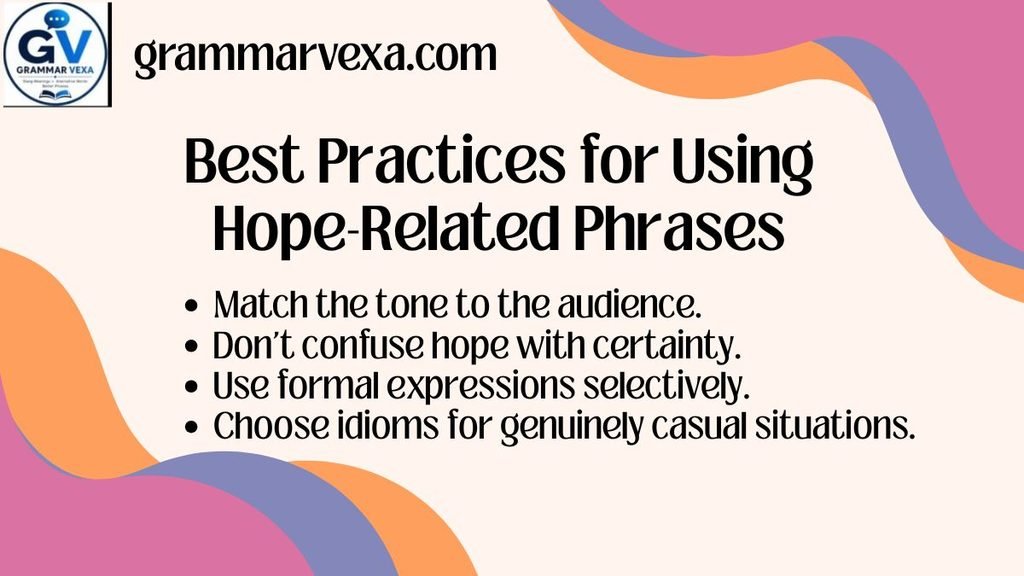
Best Practices for Using Hope-Related Phrases
- Science Words That Start With J: Scientific Terms and Their Meanings
- EMP Meaning in Text From a Girl: What It Really Means, Different Interpretations, and How to Respond
- 250+ Science Words That Start With Y (With Simple Meanings)
Good English phrases for hope should sound natural rather than artificially sophisticated.
Keep these principles in mind:
- Match the tone to the audience.
- Don’t confuse hope with certainty.
- Use formal expressions selectively.
- Choose idioms for genuinely casual situations.
- Consider emotional context before offering reassurance.
- Don’t force a synonym when “I hope” works perfectly.
- Use specific wording when the distinction matters.
- Avoid making promises about outcomes you can’t control.
A polished sentence isn’t necessarily a complicated sentence.
Often, the simplest expression communicates the message best.
Real-World Examples of “I Hope” Alternatives
Professional Email Example
Instead of:
“I hope the information helps with your decision.”
Try:
“I trust that the information will assist with your decision.”
This sounds more professional because “trust” conveys confidence in the usefulness of the information.
Workplace Example
Instead of:
“I hope we can finish the project on time.”
You could write:
“I’m optimistic that we can complete the project on schedule.”
This version communicates a positive assessment rather than merely a desire.
Encouragement Example
Instead of:
“I hope you do well in your interview.”
Try:
“I’m rooting for you in your interview!”
The second sentence provides stronger emotional encouragement.
Difficult Situation Example
Instead of:
“I hope everything gets better.”
Try:
“I remain hopeful that things will improve.”
This sounds more thoughtful and measured.
Future Event Example
Instead of:
“I hope to meet you at the conference.”
Try:
“I’m looking forward to meeting you at the conference.”
The second version emphasizes anticipation.
Case Study: Choosing the Right Phrase for One Situation
Imagine a colleague has applied for a promotion.
Several expressions could work, but they don’t communicate exactly the same thing.
Neutral:
“I hope you get the promotion.”
This expresses a simple desire.
Supportive:
“I’m rooting for you!”
This emphasizes personal support.
Confident:
“I’m confident you’ll get the promotion.”
This expresses a strong belief about the result.
Optimistic:
“I’m optimistic about your chances.”
This communicates a positive assessment without guaranteeing success.
Formal:
“I wish you every success in the selection process.”
This focuses on goodwill and sounds polished.
The lesson is simple: the best alternative depends on the intended message, not just the original word.
Quick Guide: Which Alternative Should You Use?
| If you want to… | Use this phrase |
|---|---|
| Express ordinary hope | I’m hoping that… |
| Sound concise | Hopefully… |
| Sound professional | I trust that… |
| Show optimism | I’m optimistic that… |
| Show strong confidence | I’m confident that… |
| Express a belief | I believe that… |
| Express expectation | I anticipate that… |
| Show enthusiasm | I’m looking forward to… |
| Offer good wishes | I wish you every success. |
| Encourage someone | I’m rooting for you. |
| Sound casual | I’m keeping my fingers crossed. |
| Offer emotional support | I’m holding out hope that… |
| Express faith-based hope | I’m praying that… |
| Sound reassuring | I’m sure that… |
| Show optimism based on evidence | I’m encouraged by… |
Frequently Asked Questions
What is a formal way to say “I hope”?
Some useful formal expressions include “I trust that,” “I anticipate that,” “I remain hopeful that,” “I’m optimistic that,” and “I wish you every success.” The best choice depends on whether you mean hope, expectation, confidence, or goodwill.
What is a professional alternative to “I hope”?
Agar aap is paragraph mein “that”, “for”, “I trust that” etc. ki jagah keywords lagana chahte hain, to natural replacements ye hain:
- I trust that → I believe that, I am confident that, I expect that
- I anticipate that → I expect that, I predict that, I foresee that
- I look forward to → I await, I am excited about, I eagerly anticipate
- I remain hopeful that → I still hope that, I continue to hope that, I am optimistic that
- expressing confidence → showing confidence, conveying confidence, showing trust
- expected events → future events, upcoming events, anticipated events
- future interactions → future communication, upcoming interactions, future contact
- outcome remains uncertain → result is uncertain, situation is unclear, result is still unknown
What can I say instead of “I hope you are doing well”?
For professional emails, try:
“I trust you’re doing well.”
You can also write:
“I trust all is well.”
For a warmer message:
“I hope things are going well for you.”
The original “I hope you are doing well” remains completely natural and professional.
What is a polite alternative to “I hope”?
“I trust that…” is a polished option for professional communication. “I wish you…” works well when you’re offering goodwill. “I’m hopeful that…” is useful when uncertainty remains.
Is “I trust that” the same as “I hope”?
No. “I trust that” generally communicates greater confidence.
“I hope the meeting goes well” expresses a desired outcome.
“I trust that the meeting will go well” suggests confidence that it will.
Is “I wish” the same as “I hope”?
Not always. “Hope” usually refers to something possible that you want to happen. “Wish” can describe an unlikely or impossible desire.
However, “I wish you the best” is a normal expression of goodwill.
Is “hopefully” a good replacement for “I hope”?
Yes, in many situations. For example:
“Hopefully, we’ll hear some good news soon.”
It sounds concise and natural. However, “hopefully” shouldn’t automatically replace “I hope” in every sentence.
What is a casual way to say “I hope”?
Try:
- “Hopefully…”
- “Fingers crossed!”
- “I’m keeping my fingers crossed.”
- “I’m rooting for you.”
- “I’m hoping for the best.”
These expressions work especially well in casual conversations and friendly messages.
How can I say “I hope things go well” differently?
You could say:
“I’m hoping everything goes well.”
“I’m optimistic that things will go smoothly.”
“I’m keeping my fingers crossed.”
“I trust everything will work out.”
“I’m confident things will go well.”
Each sentence has a different level of certainty and formality.
What can I say instead of “I hope you succeed”?
For formal situations:
“I wish you every success.”
Designed for professional encouragement:
“I’m confident you’ll succeed.”
For casual support:
“I’m rooting for you!”
For a neutral expression:
“I’m hopeful that you’ll succeed.”
Key Takeaways
There are plenty of other ways to say I hope, but they aren’t all interchangeable.
The most useful distinction is between desire, expectation, confidence, anticipation, and encouragement.
Use “I’m hoping that” when you want a natural variation that stays close to “I hope.” Choose “I trust that” for professional communication when confidence is appropriate. Use “I’m optimistic that” when you want to emphasize a positive outlook.
For stronger certainty, choose “I’m confident that” or “I’m sure that.” For future anticipation, “I’m looking forward to” often sounds better. When someone needs personal support, “I’m rooting for you” or “I’m cheering you on” adds warmth.
Ultimately, the best alternative phrases aren’t the fanciest ones. They’re the ones that express your exact meaning while fitting the situation.
In formal writing, precision matters. In friendly conversations, warmth matters. And in both cases, natural language beats forced vocabulary.
So, before replacing I hope, consider what you really want to say. In case you want to express a desire for a positive outcome, use a true expression of hope. If you want to communicate confidence in a future outcome, choose a stronger phrase. If you simply want to encourage someone, choose language that puts your personal support front and center.
That small adjustment can make your English clearer, warmer, and much more effective.

Wilson Parker is an English language writer and contributor at Grammar Vexa. I focus on exploring word meanings, slang, vocabulary, synonyms, and alternative words and phrases. My goal is to provide clear explanations and practical examples that help readers understand and use English more confidently.





3 thoughts on “30+ Other Ways to Say “I Hope” in English (Formal & Informal Alternatives)”