When you write a professional email, “Looking forward to speaking with you” is polite, natural, and widely understood. Still, using the same closing in every message can make your professional communication feel repetitive. The good news is that you have plenty of alternative ways to express the same idea without losing warmth or professionalism.
The best phrase depends on your relationship with the reader, the purpose of the message, and whether a conversation has already been scheduled. For example, “I look forward to our conversation” works well for a general business email, while “I look forward to our call” fits a confirmed phone or video appointment. A phrase such as “I appreciate the opportunity to speak with you” works especially well for interviews or formal meetings.
This guide covers more than 25 professional alternatives to looking forward to speaking with someone. You’ll also learn when each phrase works best, how formal it sounds, which expressions to avoid, and how to choose the right wording for interviews, clients, coworkers, networking, and scheduled meetings.
What Does “Looking Forward to Speaking With You” Mean?
“Looking forward to speaking with you” means that you feel positive about a future conversation. It shows that you expect or hope to speak with you soon and that you view the conversation as worthwhile.
In professional emails, the expression often appears near the end of a message:
I look forward to speaking with you on Thursday.
The phrase carries a positive but controlled tone. It doesn’t usually sound overly excited. That’s why it fits many professional settings, from job interviews to client meetings.
There is an important distinction, though. “Looking forward to speaking with you” suggests an anticipated conversation. It doesn’t necessarily mean that the meeting has already been scheduled.
Compare these examples:
- Scheduled: “I look forward to our meeting on Friday.”
- Expected soon: “I look forward to speaking with you soon.”
- Requesting future contact: “I’d welcome the opportunity to speak with you.”
- Waiting for a response: “I look forward to hearing from you.”
That small difference matters in business communication. Choosing the wrong phrase can make an email sound vague or imply that an appointment exists when it doesn’t.
Is “Looking Forward to Speaking With You” Professional?
Yes. “Looking forward to speaking with you” is a professional and courteous expression for most workplace situations.
The slightly more formal version is:
“I look forward to speaking with you.”
The version with “I’m” feels a little more conversational:
“I’m looking forward to speaking with you.”
Neither is inherently wrong. Your choice should match the professional tone of the message.
For a formal interview or client email, “I look forward to speaking with you” usually feels polished. For a colleague you already know, “I’m looking forward to speaking with you” can sound warmer and more relaxed.
“Speaking With You” vs. “Speaking To You”
Both “speaking with you” and “speaking to you” are grammatically acceptable.
However, “speaking with you” often feels more collaborative because “with” suggests a two-way exchange. “Speaking to you” can sometimes emphasize one person addressing another.
For professional writing, either can work:
- “I look forward to speaking with you.”
- “I look forward to speaking to you.”
When the conversation involves collaboration, feedback, or an exchange of ideas, “speaking with you” often sounds especially natural.
25+ Professional Alternatives to “Looking Forward to Speaking With You”
The right replacement isn’t simply the phrase with the most similar words. It should communicate the right tone, purpose, and relationship.
Here are practical alternative phrases you can use in real business emails.
“I look forward to our conversation.”
This is one of the safest professional alternatives to looking forward to speaking with someone.
It works when the conversation is planned but doesn’t require a specific format. You could use it for a phone call, video meeting, consultation, or in-person discussion.
Example:
Thank you for your time. I look forward to our conversation on Monday.
Best for: General professional emails, clients, interviews, and meetings.
“I look forward to speaking with you soon.”
This version keeps the original meaning while adding a sense of timing.
Use it when you expect the conversation to happen shortly. It works particularly well when the exact date hasn’t been emphasized.
Example:
Thank you for your response. I look forward to speaking with you soon.
Best for: Follow-ups, recruiters, clients, and business contacts.
“I look forward to our discussion.”
Choose this expression when the upcoming conversation has a clear subject.
It sounds slightly more formal than “conversation.” That’s useful when you’re discussing a proposal, strategy, project, contract, or important decision.
Example:
I’ve attached the revised proposal. I look forward to our discussion.
Best for: Meetings, proposals, negotiations, and formal communication.
“I’m looking forward to our conversation.”
This version feels warm while remaining professional.
The use of “I’m” makes the expression slightly more conversational. It works well when you already have some relationship with the recipient.
Example:
Thanks for arranging the meeting. I’m looking forward to our conversation.
Best for: Colleagues, clients, interviews, and established professional contacts.
“I look forward to connecting with you.”
Connecting with you is particularly useful in networking.
The word “connecting” doesn’t always mean a formal conversation. It can refer to an introduction, call, meeting, or broader professional connection.
Example:
Thank you for reaching out. I look forward to connecting with you.
Best for: Networking, LinkedIn messages, introductions, and new professional relationships.
“I look forward to our call.”
When a phone or video call is already scheduled, this option is direct and clear.
There’s no need to use a vague expression when you know exactly what will happen.
Example:
Thanks for confirming the time. I look forward to our call tomorrow.
Best for: Upcoming calls, consultations, interviews, and client meetings.
“I look forward to our meeting.”
This is another precise option.
Use it when a meeting has already been arranged. It works for both in-person and virtual meetings.
Example:
Thank you for confirming the appointment. I look forward to our meeting.
Best for: Meetings, interviews, client appointments, and workplace communication.
“I look forward to discussing this with you.”
Specificity makes this phrase particularly useful.
Rather than simply saying you anticipate a conversation, you identify the subject of the conversation.
Example:
I’ve reviewed the proposal and made several notes. I look forward to discussing this with you.
Best for: Projects, proposals, feedback, negotiations, and problem-solving.
“I look forward to discussing the next steps.”
This is an excellent choice when a conversation will lead to future actions.
It works especially well after an interview, project review, sales conversation, or proposal.
Example:
Thank you for reviewing the application. I look forward to discussing the next steps with you.
Best for: Interviews, hiring, projects, partnerships, and business decisions.
“I’m eager to speak with you.”
Also like:
This expression communicates stronger enthusiasm.
It can work well when you genuinely want the conversation to happen. However, it may sound more enthusiastic than the neutral “I look forward to speaking with you.”
Example:
I’m eager to speak with you about the new partnership opportunity.
Best for: Interviews, partnerships, opportunities, and important discussions.
“I’m pleased to have the opportunity to speak with you.”
This is a more formal expression.
It emphasizes appreciation for the opportunity rather than simply anticipating the conversation.
Example:
I’m pleased to have the opportunity to speak with you regarding the position.
Best for: Job interviews, senior-level communication, formal meetings, and applications.
“I appreciate the opportunity to speak with you.”
This phrase focuses on gratitude.
It is especially effective when someone has invited you to an interview, consultation, presentation, or professional discussion.
Example:
Thank you for considering my application. I appreciate the opportunity to speak with you.
Best for: Interviews, formal meetings, applications, and professional introductions.
“I welcome the opportunity to speak with you.”
This sounds confident and formal without becoming overly stiff.
It can be useful when you want to express willingness to discuss an issue.
Example:
I welcome the opportunity to speak with you about the proposed changes.
Best for: Formal emails, business discussions, proposals, and workplace issues.
“I’m glad we’ll have a chance to speak.”
This option adds warmth without becoming overly casual.
It works especially well when you already know the person.
Example:
Thanks for arranging the meeting. I’m glad we’ll have a chance to speak.
Best for: Colleagues, existing clients, managers, and professional contacts.
“I’m excited to speak with you.”
Excited to speak with you communicates clear enthusiasm.
It works best when the situation genuinely deserves an upbeat tone. For example, you might use it after receiving an interview invitation or starting an exciting project.
Example:
I’m excited to speak with you about the role and learn more about the team.
Best for: Interviews, creative projects, partnerships, and positive opportunities.
“I look forward to continuing our conversation.”
This phrase assumes that a conversation has already started.
It shouldn’t normally be used for someone you’ve never contacted before.
Example:
Thank you for sharing those details. I look forward to continuing our conversation.
Best for: Follow-ups, ongoing negotiations, clients, and project discussions.
“I look forward to discussing this further.”
This is a useful option when you’ve already introduced the topic.
It avoids repeating the full context while making the intended future discussion clear.
Example:
I’ve included the updated figures below. I look forward to discussing this further.
Best for: Follow-up emails, project work, proposals, and business conversations.
“I look forward to hearing your thoughts.”
Sometimes the purpose of the future conversation isn’t simply to talk. You want feedback.
This phrase makes that purpose obvious.
Example:
Please review the draft when you have time. I look forward to hearing your thoughts.
Best for: Feedback, creative work, proposals, reports, and collaborative projects.
“I look forward to exchanging ideas.”
This phrase gives the conversation a collaborative feel.
It works particularly well when both parties are expected to contribute.
Example:
I look forward to exchanging ideas about the upcoming campaign.
Best for: Networking, brainstorming, consulting, strategy, and collaboration.
“I look forward to catching up.”
This is warm and natural but less formal.
Use it when you already know the recipient. It can sound too casual in a first-contact email.
Example:
It’s been a while. I look forward to catching up next week.
Best for: Coworkers, former colleagues, clients, and professional contacts you know well.
“I’m looking forward to chatting with you.”
“Chatting” sounds friendly and relaxed.
It’s perfectly reasonable in an informal work environment, but it isn’t the strongest choice for a formal proposal or executive communication.
Example:
Thanks for making time. I’m looking forward to chatting with you tomorrow.
Best for: Coworkers, familiar clients, informal meetings, and internal communication.
“I look forward to our upcoming conversation.”
This wording works well when the conversation is already expected or scheduled.
The phrase upcoming conversation gives the closing a slightly more formal feel.
Example:
I’ve attached the background information for your review. I look forward to our upcoming conversation.
Best for: Interviews, consultations, client meetings, and formal emails.
“I’m glad we’ll be speaking soon.”
This expression sounds friendly without losing professionalism.
It works especially well when the appointment has already been arranged.
Example:
Thank you for confirming the time. I’m glad we’ll be speaking soon.
Best for: Interviews, clients, colleagues, and scheduled discussions.
“I look forward to connecting soon.”
Also like:
- NTM Meaning in Slang: What Does NTM Mean in Texting?
- SYFM Meaning: Definition, Origin, Uses, Examples, and Everything You Need to Know
This concise phrase works particularly well for networking.
It doesn’t lock the communication into a specific format. The future interaction could be a call, meeting, or professional introduction.
Example:
Thanks for reaching out. I look forward to connecting soon.
Best for: Networking, introductions, recruiters, and new business contacts.
“I look forward to continuing our work together.”
This expression goes beyond conversation and highlights the relationship.
It works best when both parties already collaborate.
Example:
Thank you for your continued partnership. I look forward to continuing our work together.
Best for: Clients, vendors, coworkers, partners, and ongoing projects.
“I’m pleased we’ll have the chance to discuss this.”
This is polished and measured.
It communicates interest without sounding overly enthusiastic.
Example:
I’m pleased we’ll have the chance to discuss this during Friday’s meeting.
Best for: Formal meetings, business communication, management, and sensitive topics.
Quick Comparison of Professional Alternatives
Choosing the right phrase becomes easier when you compare tone and context.
| Alternative phrase | Tone | Best use | Formality |
|---|---|---|---|
| I look forward to our conversation. | Professional | General emails | High |
| I look forward to our discussion. | Formal | Important topics | High |
| I look forward to our call. | Direct | Scheduled calls | High |
| I look forward to connecting with you. | Warm | Networking | Medium-High |
| I’m eager to speak with you. | Enthusiastic | Interviews | Medium-High |
| I appreciate the opportunity to speak with you. | Grateful | Interviews | High |
| I welcome the opportunity to speak with you. | Formal | Business matters | High |
| I’m excited to speak with you. | Enthusiastic | Opportunities | Medium |
| I look forward to discussing this further. | Professional | Follow-ups | High |
| I look forward to catching up. | Friendly | Existing contacts | Medium |
| I’m looking forward to chatting with you. | Casual | Coworkers | Medium |
| I look forward to exchanging ideas. | Collaborative | Networking | Medium-High |
Best Alternatives for Different Professional Situations
A phrase that works beautifully in one email may feel awkward in another. Context should drive your choice.
For Job Interviews
Interview communication usually benefits from a confident and respectful tone.
Strong choices include:
- I look forward to speaking with you.
- I look forward to our conversation.
- I appreciate the opportunity to speak with you.
- I’m eager to speak with you about the position.
- I look forward to discussing the next steps.
Avoid sounding excessively excited. You want enthusiasm, but you also want composure.
Example:
Thank you for inviting me to interview for the position. I appreciate the opportunity to speak with you and learn more about the role.
For Clients and Customers
Client communication requires warmth and precision.
Good choices include:
- I look forward to our conversation.
- I look forward to our call.
- I look forward to discussing this with you.
- I look forward to discussing the next steps.
- I look forward to continuing our work together.
For clients, specific language often beats generic wording.
Instead of:
I look forward to speaking with you.
Try:
I look forward to discussing the revised project timeline with you.
The second sentence tells the reader exactly why the conversation matters.
For Networking Emails
Networking is less formal than a legal or executive exchange. A warm phrase can make the message feel more human.
Good options include:
- I look forward to connecting with you.
- I look forward to connecting soon.
- I look forward to exchanging ideas.
- I’m glad we’ll have a chance to speak.
Here, connecting with you often feels more natural than “speaking with you” because networking involves building a relationship, not merely having a conversation.
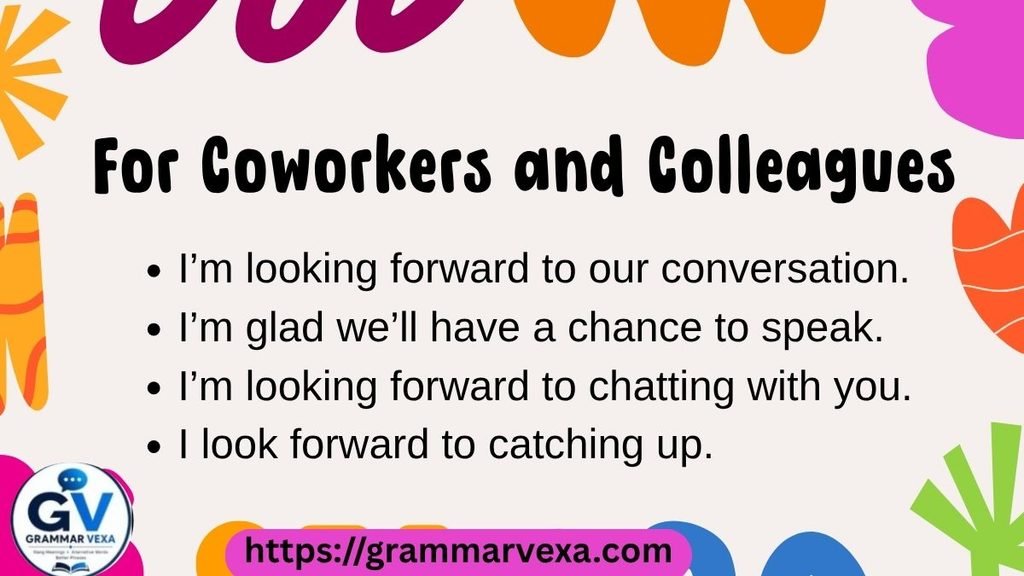
For Coworkers and Colleagues
Internal work messages can usually use a relaxed professional tone.
Consider:
- I’m looking forward to our conversation.
- I’m glad we’ll have a chance to speak.
- I’m looking forward to chatting with you.
- I look forward to catching up.
The relationship matters. “Catching up” makes sense between familiar colleagues. It may sound strange when addressing a new executive you’ve never met.
For Managers and Senior Professionals
When communicating upward, clarity and restraint usually work best.
Strong options include:
- I look forward to our discussion.
- I look forward to speaking with you.
- I welcome the opportunity to discuss this with you.
- I look forward to discussing the next steps.
Avoid overly casual language unless the organization’s culture clearly supports it.
For Scheduled Meetings and Calls
When a meeting already exists, be specific.
In terms of phone call:
I look forward to our call tomorrow.
When it comes tovideo meeting:
I look forward to our meeting tomorrow afternoon.
For a discussion:
I look forward to our discussion about the project.
Specificity removes ambiguity. That’s especially useful in formal communication.
Formal vs. Friendly Alternatives: Which Should You Choose?
Think of professional language as a sliding scale rather than a strict rule.
Most Formal Options
Use these when the relationship is new or the situation carries significant weight:
- I welcome the opportunity to speak with you.
- I’m pleased to have the opportunity to speak with you.
- I look forward to our discussion.
- I appreciate the opportunity to speak with you.
These expressions suit interviews, executive correspondence, formal applications, and important business matters.
Everyday Professional Options
These are reliable choices for most work situations:
- I look forward to our conversation.
- I look forward to speaking with you soon.
- I look forward to discussing this with you.
- I look forward to our meeting.
- I look forward to our call.
They are professional without sounding stiff.
Warm and Friendly Options
Use these with people you know or in relaxed workplace cultures:
- I’m glad we’ll have a chance to speak.
- I’m looking forward to chatting with you.
- I look forward to catching up.
- I’m glad we’ll be speaking soon.
The key is authenticity. Friendly wording should match the actual relationship.
“I Look Forward to” vs. “I’m Looking Forward to”
Both forms are correct, but they don’t create exactly the same impression.
“I look forward to speaking with you” often sounds more polished and conventional in professional writing.
“I’m looking forward to speaking with you” feels slightly more personal and conversational.
Compare:
I look forward to speaking with you during the interview.
versus:
I’m looking forward to speaking with you during the interview.
The first feels more formal. The second feels a little warmer.
Neither one needs to be treated as universally better. The surrounding email determines which sounds most natural.
Why “I Look Forward to Speaking With You” Is Correct
One common mistake is writing:
I look forward to speak with you.
That construction is incorrect.
The expression is “look forward to”, and the word “to” functions as a preposition in this phrase. A gerund follows it.
Correct:
I look forward to speaking with you.
Also correct:
I look forward to meeting you.
Incorrect:
I look forward to speak with you.
The same pattern appears in other expressions:
- I look forward to hearing from you.
- I look forward to meeting you.
- I look forward to discussing the proposal.
- I look forward to working with you.
When “I’m Looking Forward to Speaking With You” Works
The progressive form works naturally when you’re emphasizing your current anticipation.
For example:
I’m looking forward to speaking with you next week.
This sounds friendly and current. It’s especially natural in conversational workplace writing.
“Looking Forward to Hearing From You” Is Not the Same
This distinction causes frequent confusion in email communication.
“I look forward to speaking with you” focuses on a future conversation.
“I look forward to hearing from you” focuses on receiving a response.
Consider this situation:
You have already scheduled a call for Friday.
I look forward to our call on Friday.
That’s precise.
Now imagine you’ve sent a proposal and need the client to respond.
I look forward to hearing from you.
That’s more appropriate because you’re waiting for a reply.
If you use the second phrase when a call is already scheduled, the message can sound like you’re waiting for confirmation instead.
How to Choose the Right Alternative in Three Steps
Finding the best replacement phrase doesn’t need to be complicated.
Step 1: Identify the Relationship
First, consider who will read your message.
- Recruiter
- Hiring manager
- Client
- Customer
- Coworker
- Manager
- Business partner
- New networking contact
- Long-term professional contact
A new client usually calls for more formal wording than a colleague you’ve worked with for years.
Step 2: Identify the Conversation Type
Next, determine what you’re actually anticipating.
Is it a:
- Job interview?
- Phone call?
- Video meeting?
- In-person meeting?
- Networking conversation?
- Follow-up?
- Project review?
- Client consultation?
- Negotiation?
- Brainstorming session?
Then choose words that reflect the actual event.
Step 3: Match the Tone
Finally, decide how formal you need to sound.
A simple framework helps:
Formal + scheduled meeting:
“I look forward to our meeting.”
Networking + new contact:
“I look forward to connecting with you.”
Interview + professional opportunity:
“I appreciate the opportunity to speak with you.”
Project + decision pending:
“I look forward to discussing the next steps.”
Existing colleague + casual relationship:
“I look forward to catching up.”
This approach produces more natural professional communication phrases than simply replacing “speaking” with a random synonym.
Ready-to-Use Email Examples
Job Interview Email
Thank you for inviting me to interview for the position. I appreciate the opportunity to speak with you and learn more about the role and team. I look forward to our conversation on Thursday.
This version combines gratitude with a clear reference to the scheduled discussion.
Client Follow-Up Email
Thank you for reviewing the revised proposal. I’ve included the updated timeline for your reference. I look forward to discussing this with you and confirming the next steps.
This works because it connects the professional closing to a specific business outcome.
Networking Email
Thank you for reaching out and sharing your experience. I enjoyed learning more about your work in the industry. I look forward to connecting with you soon and exchanging ideas.
The wording feels approachable without becoming too casual.
Meeting Confirmation Email
Thank you for confirming the appointment. I’ve added the meeting to my calendar and reviewed the materials you shared. I look forward to our meeting tomorrow.
This is concise because the purpose is simply to confirm the planned conversation.
Internal Workplace Email
Thanks for sending the project updates. I’ve reviewed the main action items and added a few notes. I’m looking forward to chatting with you during tomorrow’s team meeting.
The tone is relaxed while remaining suitable for workplace communication.
Alternatives When You Don’t Have a Meeting Scheduled
Not every email should end with a phrase that assumes a conversation is already planned.
Sometimes you want to invite discussion without implying that an appointment exists.
When You Want a Response
Use:
- I look forward to hearing from you.
- I’d appreciate your thoughts.
- I’d be glad to discuss this further.
- I’d welcome your feedback.
These expressions create space for the recipient to decide the next step.
When You Want to Request a Conversation
Try:
- I’d welcome the opportunity to discuss this with you.
- I’d be happy to arrange a call.
- I’d appreciate the chance to speak with you.
- I’d be glad to discuss this further at your convenience.
These phrases are better when you haven’t agreed on a meeting yet.
That distinction is one of the most useful principles in professional emails: don’t imply that a scheduled talk exists unless it actually does.
Common Mistakes to Avoid
Small wording mistakes can change the tone of an otherwise strong email.
Using the Wrong Verb After “Look Forward To”
Avoid:
I look forward to speak with you.
Use:
I look forward to speaking with you.
The same grammar applies to “meeting,” “hearing,” “discussing,” and “working.”
Using “Hearing From You” for a Scheduled Call
If the recipient has already agreed to a call, “I look forward to hearing from you” may create unnecessary ambiguity.
Say:
I look forward to our call.
That’s much clearer.
Sounding Too Enthusiastic
Expressions such as:
I’m incredibly excited and absolutely thrilled to speak with you!
may feel excessive in an ordinary business email.
Enthusiasm isn’t bad. It simply needs context.
For most situations, this is enough:
I’m excited to speak with you.
Using “Chat” in a Formal Situation
“Chatting” can sound friendly, but formal settings may call for something more polished.
Instead of:
I look forward to chatting with you about the contract.
Consider:
I look forward to discussing the contract with you.
Forcing Different Wording
You don’t need a new synonym every time you write an email.
If “I look forward to speaking with you” accurately expresses your meaning, it’s perfectly acceptable to use it.
Variety should improve clarity, not become a vocabulary contest.
Making the Closing Too Vague
Compare:
I look forward to speaking with you.
with:
I look forward to discussing the revised timeline and next steps with you.
The second version gives the reader useful context. It connects the conversation to a real business purpose.
Best Practices for Professional Email Closings
A strong email closing should feel like a natural extension of the message.
Keep these principles in mind:
- Match the phrase to the relationship.
- Be specific when the conversation has a clear purpose.
- Use formal language when the situation requires it.
- Keep friendly language for appropriate workplace relationships.
- Don’t exaggerate enthusiasm.
- Don’t imply a meeting has been scheduled when it hasn’t.
- Mention the next step when that information helps the reader.
- Avoid repeating the same phrase when a more precise option exists.
- Keep the closing short enough to scan quickly.
- Make sure the phrase reflects what you actually want from the recipient.
The strongest polite ways to end an email aren’t necessarily the fanciest. They’re the ones that tell the reader what you mean without making them decode your wording.
A Simple Decision Guide
When you’re unsure, use this quick guide.
| Your situation | Recommended phrase |
|---|---|
| General professional conversation | I look forward to our conversation. |
| Formal discussion | I look forward to our discussion. |
| Scheduled phone call | I look forward to our call. |
| Scheduled meeting | I look forward to our meeting. |
| New networking contact | I look forward to connecting with you. |
| Job interview | I appreciate the opportunity to speak with you. |
| Strong enthusiasm | I’m eager to speak with you. |
| Existing colleague | I’m looking forward to chatting with you. |
| Existing professional relationship | I look forward to catching up. |
| Project discussion | I look forward to discussing this with you. |
| Decision or project progression | I look forward to discussing the next steps. |
| Waiting for a reply | I look forward to hearing from you. |
| Requesting a future discussion | I’d welcome the opportunity to speak with you. |
| Collaboration | I look forward to exchanging ideas. |
| Ongoing project | I look forward to continuing our work together. |
Expert Tips for More Natural Professional Communication
Specificity beats decoration. If you know what you’ll discuss, mention it.
Instead of:
I look forward to our conversation.
Try:
I look forward to discussing the project timeline during our conversation.
The second sentence gives the recipient a mental preview.
Use “connecting” when relationship-building matters. A networking exchange involves more than simply talking. You’re beginning a professional connection.
Use “discussion” when substance matters. “Discussion” suggests an exchange involving ideas, decisions, or analysis. It’s a stronger fit for strategy meetings than casual catch-ups.
Use “call” or “meeting” when the event is confirmed. Concrete wording reduces ambiguity and makes the email feel organized.
Use gratitude when someone gave you an opportunity. That’s why “I appreciate the opportunity to speak with you” works so well after interview invitations.
Don’t confuse warmth with informality. You can sound friendly while maintaining a polished professional tone.
For example:
I’m glad we’ll have a chance to speak.
That’s warm. It isn’t sloppy.
Key Takeaways
The phrase “Looking forward to speaking with you” remains an excellent choice for professional communication. You don’t need to replace it every time. However, context-specific wording can make your emails clearer and more natural.
The safest all-purpose alternatives include:
- I look forward to our conversation.
- I look forward to speaking with you soon.
- I look forward to our discussion.
- I look forward to connecting with you.
- I look forward to discussing this with you.
- I appreciate the opportunity to speak with you.
- I look forward to discussing the next steps.
The main lesson is simple: choose the phrase based on what you actually expect to happen next.
If a call is scheduled, say “I look forward to our call.” You’re waiting for a reply, say “I look forward to hearing from you.” If you’re building a new professional relationship, “I look forward to connecting with you” may fit better.
Good professional writing doesn’t rely on complicated vocabulary. It uses precise, respectful language that matches the situation.
Frequently Asked Questions
What is another professional way to say “Looking Forward to Speaking With You”?
A strong general alternative is “I look forward to our conversation.” Other options include “I look forward to our discussion,” “I look forward to connecting with you,” and “I look forward to speaking with you soon.” The best choice depends on the purpose and formality of the email.
Is “I look forward to speaking with you” formal?
Yes. “I look forward to speaking with you” is professional and appropriate for interviews, clients, business partners, recruiters, managers, and many other formal situations. It has a polished tone without sounding excessively formal.
Is “I’m looking forward to speaking with you” grammatically correct?
Yes. “I’m looking forward to speaking with you” is grammatically correct. It sounds slightly more conversational than “I look forward to speaking with you.” Both forms work well in professional communication.
Should I say “speaking with you” or “speaking to you”?
Both are correct. “Speaking with you” often has a more collaborative feel because “with” suggests a two-way conversation. In professional emails, either expression can work depending on personal style and context.
Can I use “looking forward to connecting with you” in a business email?
Yes. “Looking forward to connecting with you” works especially well in networking, introductions, recruiting, and relationship-building situations. It sounds warm while remaining professional.
What should I say instead of “looking forward to hearing from you”?
If you specifically want a future conversation, use “I look forward to speaking with you” or “I look forward to our conversation.” Use “hearing from you” when you’re mainly waiting for a response, confirmation, or feedback.
What is the best phrase for a job interview?
For an interview, strong choices include “I look forward to speaking with you,” “I appreciate the opportunity to speak with you,” and “I look forward to discussing the next steps.” Choose based on whether the interview is already scheduled and what you want to emphasize.
What is the best alternative for a client email?
“I look forward to our conversation” is a reliable choice. If the purpose is more specific, use “I look forward to discussing this with you” or “I look forward to discussing the next steps.” Specific wording often sounds more attentive than a generic closing.
What is a friendly alternative to “I look forward to speaking with you”?
For someone you already know, try “I’m looking forward to chatting with you,” “I’m glad we’ll have a chance to speak,” or “I look forward to catching up.” These expressions add warmth while keeping the message suitable for many workplace situations.
What is the most formal alternative to “Looking Forward to Speaking With You”?
For a highly formal setting, “I welcome the opportunity to speak with you” or “I’m pleased to have the opportunity to speak with you” works well. These expressions emphasize respect and professional courtesy.
Can “I look forward to our discussion” replace “I look forward to speaking with you”?
Yes. In fact, “I look forward to our discussion” can be better when the conversation has a specific business purpose. It sounds polished and focuses attention on the subject rather than the act of speaking.
How can I avoid repeating “looking forward” in every email?
Use different wording based on the actual purpose rather than replacing the phrase randomly. Try “I appreciate the opportunity,” “I welcome the chance,” “I’m glad we’ll have a chance,” or “I look forward to discussing the next steps.” The goal isn’t maximum variation. It’s accurate and natural professional communication.
Final Takeaway
There are plenty of other ways to say “Looking Forward to Speaking With You”, but the strongest option depends on the situation. A scheduled call deserves a direct phrase. A networking message benefits from warmer language. An interview may call for gratitude or measured enthusiasm. A project follow-up should often mention the next steps.
For most professional situations, “I look forward to our conversation” remains one of the safest choices. When you need more precision, make the closing reflect the actual purpose of the upcoming interaction.
Good email language doesn’t try to impress the reader with unusual synonyms. It makes the intended meaning clear, respectful, and natural. That small shift can turn an ordinary email sign-off into polished business communication that feels purposeful rather than routine.

Wilson Parker is an English language writer and contributor at Grammar Vexa. I focus on exploring word meanings, slang, vocabulary, synonyms, and alternative words and phrases. My goal is to provide clear explanations and practical examples that help readers understand and use English more confidently.




2 thoughts on “25+ Other Ways to Say “Looking Forward to Speaking With You””