If you’ve ever scrolled through a pre-med subreddit, a study-group group chat, or a TikTok about finals week and seen the word orgo thrown around like everyone’s supposed to know what it means, here’s the short version: orgo is student shorthand for organic chemistry, and orgo slang is the informal vocabulary that grows up around that one brutal, unavoidable course.
This isn’t internet slang in the usual sense, like a meme phrase that appears out of nowhere and dies in six months. It’s closer to workplace jargon. It’s what happens when thousands of organic chemistry students, semester after semester, need a fast way to talk about the same hard material — so they borrow real chemistry terms, shorten them, and turn them into everyday conversation.
By the end of this guide, you’ll know exactly what orgo meaning covers, where the nickname came from, the real chemistry concepts hiding behind terms like SN1 reaction, SN2 reaction, and curly arrows, and how to use (or avoid) this language depending on who you’re talking to.
What Does “Orgo” Mean? (Quick Answer)
Orgo is a shortened, informal name for organic chemistry — the branch of chemistry that studies carbon-based compounds and how they react. It’s used almost exclusively by students, especially in pre-med, biology, and chemistry programs, where organic chemistry is a required and famously difficult course.
You’ll see it used two ways:
- As a stand-in for the course itself: “I have orgo at 9am,” “orgo lab runs three hours,” “I’m failing orgo.”
- As a label for the broader shorthand language that students use to discuss organic chemistry topics: orgo slang covers everything from real technical abbreviations (SN1, SN2, E1, E2) to casual phrases about the workload itself.
Both uses are correct. Context tells you which one someone means, and in practice the two blend together constantly in the same conversation.
Key Takeaways
- Orgo is shorthand for organic chemistry, used mainly by organic chemistry students in pre-med, biology, and chemistry programs.
- Orgo slang covers two distinct categories: casual, workload-related phrases about the course itself, and genuine technical organic chemistry terminology like SN1, SN2, E1, E2, and curly arrows.
- The technical terms aren’t internet-invented — they’re real, standardized reaction mechanisms and chemistry concepts taught in every organic chemistry curriculum.
- Other course nicknames (O-Chem, P-Chem, A-Chem, Quant) show that this kind of shorthand is a normal, ongoing part of academic culture, not unique to organic chemistry.
- Match your language to your audience: technical terms work in labs and among orgo students, but casual, stress-focused phrases don’t belong in formal or professional settings.
Where “Orgo” Comes From: A Brief History of the Nickname
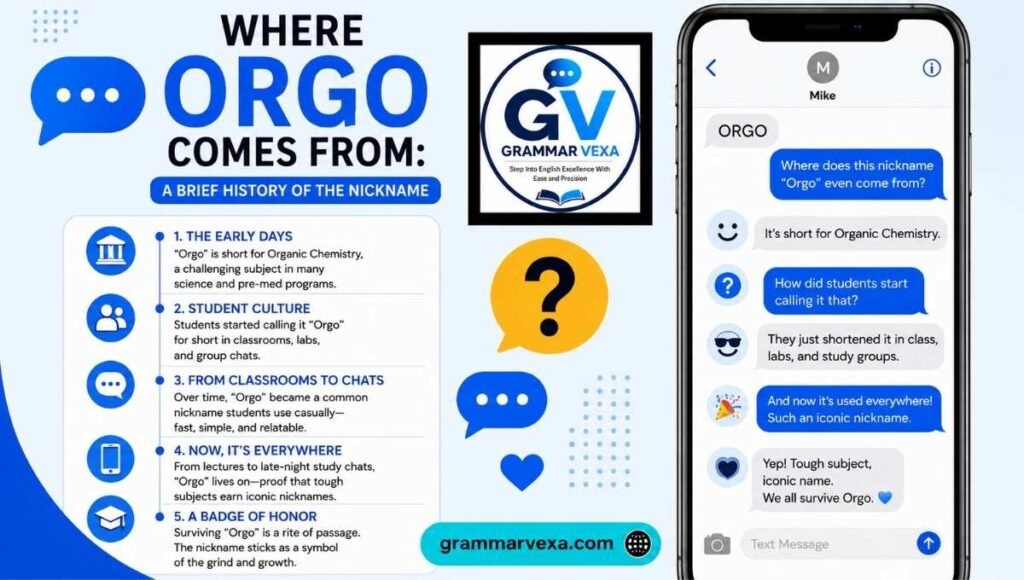
Orgo slang didn’t start online. It started the way most academic shorthand starts: in classrooms, lecture halls, and study groups, long before social media had anything to do with it.
Academic Origins in Pre-Med and Chemistry Programs
Organic chemistry has been a required prerequisite for medical school, dental school, and most biology and chemistry degrees for decades. Because so many students must take it—often for two full semesters, plus a lab component—it creates one of the highest levels of shared, repeated stress among undergraduate courses.
That combination (a huge number of students, taking the same hard class, at the same time, for the same high-stakes reason) is exactly the environment where shorthand develops. Saying “organic chemistry” five times in one sentence during a late-night study session is slower than just saying orgo. The abbreviation spread the same way most classroom slang does: professionally, informally, and by repetition, long before it had any presence on the internet.
Other Course Nicknames That Work the Same Way
Orgo isn’t an isolated case. It’s part of a broader pattern where students shorten long, intimidating course names into something quicker to say. This context matters, because it shows orgo slang isn’t a random internet invention — it’s part of a normal, ongoing tradition in science education.
| Course Nickname | Full Course Name |
|---|---|
| Orgo / O-Chem / Org Chem | Organic Chemistry |
| P-Chem | Physical Chemistry |
| A-Chem | Analytical Chemistry |
| Quant | Quantitative Analysis |
| Bio | Biology |
| Gen Chem | General Chemistry |
Notice that organic chemistry alone has three interchangeable nicknames — orgo, O-Chem, and Org Chem — which is a strong sign of just how frequently students need to reference this specific course.
What Is “Orgo Slang”? Two Different Meanings People Mix Up
Most articles about this topic blur two very different things together. To actually understand orgo terminology, you need to separate them.
Casual Use: Orgo as Shorthand for the Course Itself
This is emotional, workload-focused language. It’s not really about chemistry — it’s about the experience of taking the class. Examples:
- “Orgo is killing me this semester.”
- “I have an orgo exam Monday and I haven’t slept.”
- “Just survived orgo lab, I smell like acetone.”
This category of student slang shows up constantly in texts, DMs, and social captions, and it’s the version most non-chemistry people encounter first.
Technical Use: Real Organic Chemistry Jargon Students Shorten in Conversation
This is the more interesting half, and it’s genuine chemistry mechanisms and reaction mechanisms terminology — not invented internet slang. Terms like SN1, SN2, E1, E2, and curly arrows are legitimate, standardized organic chemistry notation taught in every orgo class and every textbook. Students don’t make these up; they simply drop the full formal names in casual speech because everyone in the room already knows what SN2 means.
Key distinction: casual orgo slang describes the experience of the course. Technical orgo slang describes the content of the course. Understanding both is what makes someone fluent in how organic chemistry students actually talk.
Core Orgo Slang Terms and What They Mean

This is the heart of orgo terminology — the actual vocabulary you’ll hear in an orgo lab, lecture hall, or study group. Below, terms are grouped by category so you can see how they connect to real chemistry concepts rather than as one long, disconnected list.
Reaction Mechanism Terms
Reaction mechanisms are the step-by-step pathways showing how molecules transform during a chemical reaction. This is the single densest, most tested part of any organic chemistry course, so it produces the most shorthand.
| Term | What It Actually Means |
|---|---|
| SN1 | Unimolecular nucleophilic substitution reaction — the rate depends on only one reactant, and it proceeds through a carbocation intermediate. |
| SN2 | Bimolecular nucleophilic substitution reaction — the rate depends on two reactants, and it happens in a single, concerted step. |
| E1 | Unimolecular elimination reaction, also proceeding through a carbocation intermediate, often competing with SN1. |
| E2 | Bimolecular elimination reaction, a single concerted step, often competing with SN2. |
| Elim | Shorthand for “elimination reaction” in general — used when a student isn’t specifying E1 vs. E2. |
| Curly arrows / arrow pushing | The curved arrow notation used to show electron movement during a mechanism step. This is the core visual language of organic chemistry — every mechanism is built from these electron arrows. |
Expert tip: If you’re new to organic chemistry, the SN1/SN2/E1/E2 distinction is one of the most commonly tested comparisons on any orgo exam. Instructors love asking students to predict which pathway a reaction will favor based on the substrate, nucleophile strength, and solvent — so knowing the shorthand and the underlying logic matters far more than memorizing the letters alone.
Structural and Conformational Terms
Beyond reactions, organic chemistry also deals heavily with the 3D shape of molecules, which comes with its own shorthand.
- Chair flip (also called a ring flip): the interconversion between the two stable “chair” shapes of a cyclohexane ring. This is a real, well-documented structural process in organic chemistry — not slang for something else. During a chair flip, substituents that were axial (pointing up or down) become equatorial (pointing outward), and vice versa.
- Newman projection: a way of drawing a molecule looking straight down a carbon-carbon bond, used to analyze rotation and steric strain.
- R group: a generic placeholder symbol representing an alkyl or substituent group when the exact identity of that group doesn’t matter to the point being made.
Lab and Process Terms
Because most organic chemistry courses pair lectures with a hands-on organic chemistry lab, there’s a separate layer of shorthand tied to lab work.
- Workup: the purification steps performed after a reaction is complete — extraction, drying, and isolating the final product. This term is standard across laboratory techniques in real research settings, not just classrooms.
- Reags: short for reagents, the chemicals used to drive a reaction forward.
Course-Life Terms
This is where casual and technical slang blend together — phrases about surviving the course rather than the chemistry itself.
- Weeder class: a common term (not unique to orgo, but heavily applied to it) for a course known to filter out students from a competitive major or pre-med track due to its difficulty.
- The curve: how a professor adjusts grades relative to overall class performance — a frequent topic of conversation given how difficult orgo exams tend to be.
- “Orgo is killing me”: the emotional catch-all phrase, used constantly, that has nothing to do with a specific chemistry concept and everything to do with workload and stress.
Orgo Slang in Real Conversations
Seeing these terms in a table is one thing. Hearing how they actually get used is what makes them click. Here’s how orgo slang shows up across different everyday settings.
In Study Groups and Labs
This is where the technical vocabulary is used most precisely, because everyone in the room is working through the same material and needs speed over explanation.
“Weak nucleophile, protic solvent — that’s SN1, not SN2.”
“Don’t forget the curly arrows on the second step or you’ll lose points for mechanism.”
“We still need to do the workup before we can weigh the product.”
In Texts and Group Chats
Here the tone shifts toward the emotional, course-life side of orgo slang.
“Studying for orgo all night 😭” “I have an orgo midterm Monday, I’m not okay.” “Orgo lab ran three hours over, I’m never getting that time back.”
On Reddit, Discord, and TikTok
Online spaces mix both layers together — technical questions sitting right next to workload venting, often in the same thread.
“Can someone explain why this substrate favors E2 over SN2? Studying for my orgo final and losing my mind.”
This mix is exactly why the term can look confusing to an outsider. In a single conversation, “orgo” might refer to the class, the exam, a specific reaction, or the general state of academic suffering — and organic chemistry students switch between all four meanings without even noticing.
Why the Slang Exists — What It Actually Does for Students
Orgo slang isn’t decorative. It solves real, practical problems that come up specifically in organic chemistry, more than in most other undergraduate courses.
- Speed under pressure. Organic chemistry exams are famous for being long and detail-heavy. Saying “SN2” instead of “bimolecular nucleophilic substitution reaction” saves real time during a timed study session or a rushed lab discussion.
- Memory aid. Shorthand terms like curly arrows or chair flip are concrete, visual, and easy to picture — which makes them easier to recall than the formal, multi-syllable chemistry names during high-pressure recall situations like an orgo exam.
- In-group identity. Organic chemistry has a reputation as one of the hardest prerequisite courses in undergraduate science, particularly for pre-med and science students. Shared, insider vocabulary is a natural byproduct of a group of people going through something difficult together — it signals “I’ve been through this too.”
- Lab efficiency. In an organic chemistry lab, time is often limited by the length of a lab session, not just personal pace. Quick terms like reags and workup keep communication moving without slowing down actual lab work.
Is It OK to Use Orgo Slang Outside the Classroom?

This depends heavily on who you’re talking to and where. Below is a practical breakdown.
In Labs, Research, or Professional Settings
Yes, with a caveat. Technical terms like SN1, SN2, curly arrows, workup, and reagents are standard, real chemistry vocabulary — they’re used by researchers, lab technicians, and chemistry professionals, not just undergraduates. Using them correctly in a lab or professional science setting is completely normal and expected.
The caveat: casual, workload-venting phrases like “orgo is killing me” don’t belong in a professional email, a conference presentation, or an interview. Save that register for peers, not supervisors or interviewers.
Best practice: match the formality of your audience. A colleague in a research lab will understand “SN2” instantly. A hiring manager outside science will not — spell it out as “a type of substitution reaction” if you’re explaining your background to someone without a chemistry degree.
In Casual Conversation With Non-Chemistry People
Here, technical terms mostly won’t land, but the course-life phrases usually will, since most people understand “brutal required class” as a concept even without a chemistry background. If you say “I have orgo lab tonight” to a friend outside your major, expect to follow up with “organic chemistry” for clarity.
Common Mistakes to Avoid
- Using technical shorthand without context. Dropping “it’s definitely E1” into a conversation with someone who’s never taken organic chemistry will just confuse them — clarify first.
- Assuming “orgo” always means the same thing. Remember it can mean the course, an exam, a lab session, or the general workload, depending on context. Don’t assume the narrowest meaning.
- Overusing casual slang in academic writing. Lab reports and formal write-ups should use full, correct terminology (e.g., “unimolecular nucleophilic substitution”) even if you’d say “SN1” out loud.
Pros and Cons of Using Orgo Slang
| Pros | Cons |
|---|---|
| Speeds up communication during study sessions and lab work | Can sound unclear or overly casual in formal academic writing |
| Builds community among orgo students facing the same workload | Confusing to anyone outside chemistry or biology programs |
| Reinforces memory of real chemistry mechanisms through repetition | Easy to misuse if a student hasn’t yet learned the underlying concept |
| Widely understood across university students in science programs | Doesn’t fully replace precise terminology required on exams or in reports |
Orgo Slang on Urban Dictionary
Urban Dictionary’s oldest and most upvoted entries for “orgo” confirm what students already know: the top definition is straightforward — “short for organic chemistry… an extremely difficult course that one takes, usually during the second year of college for prospective pre-med students,” commonly tagged as a weeder class because so many students drop it before finishing.
A second popular entry pokes fun at regional habits, joking that East Coast students say orgo while West Coast students favor O-Chem — a small but telling detail that shows this shorthand isn’t perfectly uniform; it varies by campus and region the same way any spoken slang does.
One thing worth flagging for accuracy: because Urban Dictionary is crowdsourced, it also hosts a handful of unrelated, informal entries that use “orgo” as a name or coin an unrelated slang phrase with no connection to chemistry at all. If you search the term there, expect the chemistry-related definitions to sit alongside a few unrelated, informal ones — the organic chemistry meaning is by far the dominant and most-used one.
Orgo Slang on Reddit
Reddit is one of the main places the technical side of orgo terminology gets used in public, searchable form. Threads in premed-focused communities and general chemistry discussion spaces regularly mix the two registers covered earlier in this guide:
- Technical questions: students posting a mechanism and asking whether a reaction proceeds via SN1 or SN2, or why a particular substrate favors E1 reaction pathways over E2 reaction pathways.
- Workload venting: posts about failing an orgo exam, surviving an orgo lab practical, or asking how to study for a cumulative final.
Reddit threads are also one of the best real-world places to see orgo slang used exactly as intended — quickly, informally, and assuming the reader already has baseline organic chemistry knowledge, which is very different from how a textbook explains the same reaction mechanisms.
Orgo Slang on TikTok

TikTok’s contribution to orgo slang is almost entirely on the casual, course-life side rather than the technical side. Common patterns include:
- Study-with-me videos captioned with phrases like “orgo grind” or “orgo szn.”
- Meme-style clips about orgo exam stress, often set against exaggerated reaction footage.
- Hashtags such as #orgo, #orgolife, and #premed, used to tag content about the difficulty of the course.
Very little genuine chemistry teaching happens under these hashtags — TikTok mostly amplifies the emotional, shared-suffering side of the slang rather than the technical vocabulary used in labs and study groups. If you’re looking to actually learn chemistry concepts like mechanism-drawing, a lecture, textbook, or dedicated study resource will serve you far better than a TikTok search.
Orgo Slang Funny Examples
Some of the more lighthearted expressions that circulate among orgo students, mixing real chemistry vocabulary with student humor:
- “My carbocation is about as stable as my sleep schedule.”
- “SN1, SN2, E1, E2 — pick your fighter.”
- “Orgo lab: where three hours of your life become one tiny vial of impure product.”
- “Chair flip more like my mental state flip.”
These jokes work precisely because they lean on real terminology (carbocations, SN1/SN2, chair flips) rather than made-up words — the humor comes from applying accurate chemistry concepts to the exhausting experience of the course itself.
Orgo Meaning in Spanish
In Spanish, “orgo” is not a standard, dictionary-recognized word tied to organic chemistry. Spanish-speaking students typically use química orgánica for the subject itself, and there isn’t a widely adopted Spanish equivalent nickname the way English has “orgo.”
Interestingly, orgo does exist as a genuine word in Galician (a regional language of northwestern Spain), where it means barley (the cereal grain, scientific name Hordeum vulgare) — completely unrelated to chemistry or student slang. It’s a good example of why context matters so much with short words: the same four letters can be organic-chemistry shorthand in an English-speaking classroom and a plant name in a Galician dictionary, with zero connection between the two.
Why Is Organic Chemistry Called Orgo?
Organic chemistry is called orgo simply because “organic chemistry” is long and gets said constantly in academic settings — in lectures, lab sections, study groups, and casual conversation. Shortening it to one quick syllable is faster to say and faster to type, and the habit caught on the same way similar course nicknames did (O-Chem, P-Chem, A-Chem, Quant).
This isn’t a recent or internet-driven habit, either. Documented references to “Orgo” as student shorthand for the course appear in university publications going back decades, including a 1973 Princeton Alumni Weekly article describing the course simply as “Orgo,” and it continues to appear in later academic and popular science writing describing organic chemistry’s reputation as a demanding weeder class for pre-med students. In short: the nickname is old, it’s widespread across universities, and it exists purely for convenience — not because of any deeper meaning behind the word itself.
Orgo AI: A Different “Orgo” Worth Knowing About
If your search for orgo led you to something about AI agents, virtual desktops, or cloud computing, you’ve run into a completely separate, unrelated entity: Orgo (Organic Intelligence, Inc.), a San Francisco-based AI infrastructure company. It has nothing to do with organic chemistry or orgo slang — it provides cloud-based virtual desktop environments that AI agents can control to complete computer-based tasks.
This is purely a naming coincidence, not a connection. If you’re researching student orgo terminology, that company isn’t relevant to you; if you’re researching AI infrastructure tools, this article about organic chemistry slang isn’t what you’re looking for. It’s worth mentioning only so you don’t confuse the two if both show up in the same search results.
Conclusion
That’s the full Orgo Slang Meaning: What Does Orgo Mean in Text? story in plain terms. Orgo is just short for organic chemistry. Students use it for the class, the lab, and the exam. Real terms like SN1, SN2, and curly arrows aren’t internet slang. They’re actual chemistry words, just shortened for speed. Casual phrases like “orgo is killing me” are different. They talk about stress, not chemistry.
So next time you see Orgo Slang Meaning: What Does Orgo Mean in Text? pop up in a chat or a search bar, you’ll know exactly what’s going on. Context tells you the meaning. It could be the course, an exam, a lab, or just the workload. Use technical terms around chemistry people. Save the casual phrases for friends. That one small habit will make you sound like you actually know the subject.
FAQs
What is orgo slang meaning in simple terms?
Orgo slang meaning refers to informal shorthand used mostly by organic chemistry students, covering both the course nickname and real chemistry terms like SN1 and SN2.
Is “orgo” the same as “organic chemistry”?
Yes, orgo is just a shorter, casual way of saying organic chemistry — nothing changes in meaning.
Why do students find orgo so difficult?
Organic chemistry demands heavy memorization plus pattern recognition for reaction mechanisms, which is why it’s widely known as a weeder class for pre-med students.
What’s the benefit of using orgo slang in study groups?
It speeds up communication, since terms like curly arrows or E2 reaction say in one word what would otherwise take a full sentence.
Does “orgo” mean anything outside of chemistry?
Rarely — outside chemistry, “orgo” has no widely recognized meaning in English, though unrelated words spelled the same exist in other languages, like Galician.
Is it OK to use orgo slang in a lab report or exam answer?
No, formal write-ups should use full terms like “unimolecular nucleophilic substitution” instead of casual shorthand like SN1.
How is “orgo” different from “O-Chem”?
They mean exactly the same thing — organic chemistry — and the choice between them usually just comes down to regional or personal habit.
Are SN1, SN2, E1, and E2 slang or real chemistry terms?
They’re real, standardized chemistry terms taught in every organic chemistry course, not slang invented by students.
Where is orgo slang most commonly used today?
It shows up most in study groups, labs, texts between classmates, and platforms like Reddit and TikTok among pre-med and science students.

Jessica Morgan is an English language writer and researcher at Grammar Vexa. I enjoy exploring slang, vocabulary, word meanings, synonyms, and alternative phrases. Through my work, I aim to make English easier to understand by providing clear explanations, useful examples, and practical language tips.








3 thoughts on “Orgo Slang Meaning: What Does Orgo Mean in Text?”