
Science words that start with J: scientific terms and their meanings refers to the specialized vocabulary across physics, biology, chemistry, astronomy, and geology that happens to begin with one of the alphabet’s least common starting letters. From the joule, the standard unit of energy, to Jupiter, the solar system’s largest planet, these terms span nearly every scientific discipline despite their rarity.
J is scarce in scientific naming for a simple reason: most terminology traces back to Latin and Greek roots, neither of which produced a letter functioning like the modern English J. That gap makes the handful of surviving J-words unusually concentrated with meaning, often tied directly to a scientist’s name, a defining unit, or a pivotal discovery that reshaped an entire field.
This guide organizes every major scientific term starting with J by discipline, pairs each one with a clear, accurate definition, and explains why it matters in real research and everyday life. Readers will find physics units, anatomical structures, astronomical bodies, geological periods, and genetic concepts covered with practical context, comparison tables, and grade-level breakdowns for students building vocabulary from scratch.
Why the Letter J Is Rare in Scientific Vocabulary
Before diving into the list, it helps to understand why J-words are so uncommon in science. The letter J is a relatively young addition to the alphabet. It didn’t fully separate from the letter “I” until the 16th century, and classical Latin — the language that gave us the majority of scientific and medical terminology — didn’t use J at all. Greek, the other major source of scientific vocabulary, doesn’t have a letter that maps directly to the English J sound either.
As a result, most J-words in modern science come from one of three sources:
- Proper names — units and effects named after scientists (Joule, Jansky, Josephson, Jahn-Teller)
- Everyday English words repurposed for science — jet, joint, jerk
- Later scientific coinages — terms invented well after Latin and Greek stopped being the default naming languages (Jacobian, Julia set)
This is also why you’ll notice something interesting as you read through the list: a large share of science terms starting with J are named after specific people. That’s a useful pattern to recognize, because it often tells you the term describes a discovered effect, unit, or relationship rather than a naturally occurring substance or structure.
Physics Terms That Start With J
Physics contributes the largest cluster of science words that start with J, and for good reason — many of the field’s foundational units and effects happen to be named after scientists whose surnames start with J.
Joule (Unit of Energy)
The joule (symbol: J) is the SI unit of energy, named after English physicist James Prescott Joule, who conducted pioneering experiments on the relationship between heat, work, and mechanical energy in the 1840s. One joule is defined as the amount of energy transfer that occurs when a force of one newton moves an object one meter in the direction of that force.
The joule shows up everywhere in physics because it’s the common currency for measuring energy, regardless of form:
| Type of Energy | Example in Joules |
|---|---|
| Kinetic energy of a thrown baseball | ~140 J |
| Energy to lift a 1 kg object 1 meter | ~9.8 J |
| Energy in one calorie (food) | ~4.184 J |
| Daily human energy expenditure | ~8-10 million J |
Whether you’re calculating heat energy, chemical energy released in a reaction, or electrical energy consumed by a device, the joule is the unit that ties it all together. This is why the joule is often considered the single most important entry on any list of physics terms starting with J.
Joule-Thomson Effect
The Joule-Thomson effect describes what happens to the temperature of a real gas when it expands or is compressed without exchanging heat with its surroundings. Unlike an ideal gas, which wouldn’t change temperature under these conditions, real gases do — and depending on the gas and the starting temperature, that temperature change can go in either direction.
This effect isn’t just a textbook curiosity. It’s the working principle behind:
- Refrigeration and air conditioning systems
- Industrial gas liquefaction processes (used to produce liquid oxygen and liquid nitrogen)
- Natural gas processing plants that rely on controlled cooling systems
James Prescott Joule (again) and William Thomson (Lord Kelvin) discovered this thermodynamic behavior together in the 1850s, and it remains a core concept in industrial thermodynamics today.
Jerk (Rate of Change of Acceleration)
In physics, jerk is the rate at which acceleration itself changes over time. If velocity tells you how fast something is moving and acceleration tells you how quickly that speed is changing, jerk tells you how abruptly the acceleration is changing.
This matters more than it might sound. Engineers designing elevators, roller coasters, and even car suspension systems pay close attention to jerk because a high jerk value is what makes acceleration feel sudden and uncomfortable — even when the acceleration itself isn’t extreme. Smooth rides are, in large part, low-jerk rides.
Josephson Junction
A Josephson junction is a component made of two superconducting materials separated by a thin insulating barrier, through which electric current can “tunnel” without resistance — a quantum mechanical phenomenon predicted by physicist Brian Josephson in 1962 (a discovery that earned him a share of the 1973 Nobel Prize in Physics).
Josephson junctions are now foundational to several advanced technologies:
- Quantum computing — many superconducting qubits are built from Josephson junctions
- Extremely precise voltage standards used in metrology labs
- SQUID (Superconducting Quantum Interference Device) sensors, which can detect incredibly faint magnetic fields, including those produced by the human brain
Jansky (Radio Astronomy Unit)
The jansky (symbol: Jy) is a unit used in radio astronomy to measure the strength, or spectral flux density, of radio signals coming from space. It’s named after Karl Jansky, the engineer who accidentally discovered radio emissions from the Milky Way in 1932 while investigating radio static for Bell Labs — a discovery widely credited as the birth of radio astronomy.
Radio telescopes today, including major arrays like the Very Large Array (VLA) in New Mexico, still report signal strength in janskys when cataloging distant radio sources such as pulsars, quasars, and galaxies.
J-Integral (Fracture Mechanics)
The J-integral is a mathematical tool used in fracture mechanics to measure the energy required for a crack to grow through a material. It’s a critical concept in structural safety engineering because it allows engineers to predict whether a crack in a material — a bridge beam, an aircraft component, or industrial machinery — is likely to remain stable or propagate into full structural failure.
Developed by James Rice in 1968, the J-integral is now a standard tool in safety engineering and industrial design, particularly for materials that don’t behave in a perfectly brittle or perfectly ductile way.
Expert insight: In real-world engineering, the J-integral is especially valuable because it works for both linear-elastic and elastic-plastic materials, which makes it far more broadly applicable than older, simpler fracture criteria that only worked for brittle materials.
Chemistry Terms That Start With J
Chemistry has fewer J-terms than physics, but the ones that exist are important in specialized fields like spectroscopy and materials chemistry.
Jahn-Teller Effect
The Jahn-Teller effect describes a geometric distortion that occurs in certain molecules and ions when their electronic configuration would otherwise leave them in an unstable, highly symmetric state. Named after Hermann Arthur Jahn and Edward Teller, who described the phenomenon in 1937, this effect is especially important in coordination chemistry, where it explains distorted shapes in many transition metal complexes — most famously copper(II) complexes.
Understanding the Jahn-Teller effect helps chemists predict and explain:
- Why certain metal complexes have distorted octahedral geometries instead of perfectly symmetric ones
- Color and magnetic properties of transition metal compounds
- Behavior of materials used in solid-state chemistry and catalysis
J-Coupling (NMR Spectroscopy)
J-coupling, also called scalar coupling, is the interaction between nuclear spins that are connected through chemical bonds, observed in Nuclear Magnetic Resonance (NMR) spectroscopy. It shows up as splitting patterns in NMR spectra, and it’s one of the most useful pieces of information chemists use to figure out how atoms in a molecule are connected to one another.
If you’ve ever seen a chemist interpret a complex NMR spectrum to determine an unknown molecule’s structure, J-coupling values (measured in Hertz) are often central to that analysis. This makes it a quiet but essential term across organic chemistry, biochemistry, and pharmaceutical research.
Biology and Anatomy Terms That Start With J
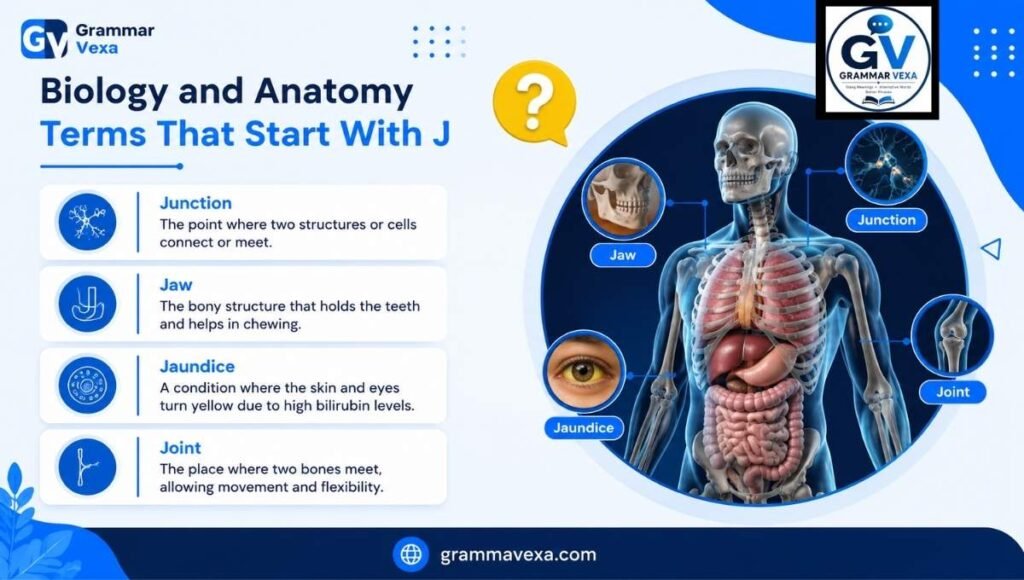
Anatomy and human biology offer some of the most practically relevant science words that start with J, since several of these terms describe parts of your own body.
Joint (Anatomical Structure)
A joint is the point where two or more bones meet, allowing the skeletal system to move. Joints are classified based on the type and range of movement they allow:
| Joint Type | Example | Range of Motion |
|---|---|---|
| Hinge joint | Elbow, knee | One-directional bending |
| Ball-and-socket joint | Hip, shoulder | Rotational, multi-directional |
| Pivot joint | Neck (atlas-axis) | Rotational only |
| Gliding joint | Wrist, ankle | Limited sliding motion |
| Saddle joint | Base of the thumb | Two-directional |
Healthy joint function depends on supporting structures like ligaments, cartilage, and synovial fluid, which reduces friction between bones during movement. When these structures break down — due to age, injury, or conditions like osteoarthritis — it can lead to musculoskeletal disorders that limit mobility.
Common mistakes people make regarding joint health:
- Ignoring early joint pain instead of seeking evaluation, which can allow injury prevention windows to close
- Assuming all joint pain is arthritis, when it may be tendon or ligament-related
- Skipping strength training, which is one of the best ways to support long-term joint stability
Modern orthopedic surgery and physical therapy have made major advances in joint care, from minimally invasive arthroscopic procedures to advanced prosthetics for joint replacement.
Jejunum (Small Intestine)
The jejunum is the middle section of the small intestine, located between the duodenum and the ileum. It’s where the majority of nutrient absorption takes place, thanks to a lining covered in tiny finger-like projections called villi that dramatically increase the surface area available for absorbing digested food.
Medical professionals pay close attention to the jejunum in conditions like celiac disease, where damage to this section of the intestine directly impairs the body’s ability to absorb nutrients.
Jugular Vein
The jugular vein refers to a pair of veins in the neck that carry deoxygenated blood from the head back toward the heart. There are actually several jugular veins (internal, external, and anterior), but the internal jugular vein is the one most frequently referenced in medicine because it’s commonly used for central venous catheter placement and is monitored to assess jugular venous pressure — a key indicator of heart function.
Juvenile Hormone (Insect Biology)
Juvenile hormone is a group of hormones found in insects that regulate development, metamorphosis, and reproduction. As long as juvenile hormone levels remain high, an insect larva continues molting into another larval stage instead of progressing to pupation or adulthood. Once juvenile hormone levels drop, metamorphosis can proceed.
This hormone has real-world applications in environmental science and pest control — synthetic juvenile hormone analogs are used in some insecticides to disrupt the normal development cycle of pest insects, preventing them from reaching reproductive maturity.
J-Protein (Molecular Chaperones)
J-proteins, also called Hsp40 proteins, are a family of molecular chaperones that assist in protein folding inside cells. They work closely with another chaperone family, Hsp70 proteins, to help newly made or misfolded proteins fold correctly, and to prevent protein clumping that can damage cells.
J-proteins are especially active during the cellular stress response, such as heat shock or other environmental stress, when the risk of protein misfolding increases. Because misfolded and clumped proteins are strongly linked to neurodegenerative disorders like Alzheimer’s and Parkinson’s disease, J-proteins are an active area of medical research aimed at protecting cellular health.
Junk DNA (Non-Coding DNA)
Junk DNA is an informal — and increasingly outdated — term for sections of an organism’s genome that don’t code for proteins. The term was coined decades ago when scientists assumed these regions had no biological function. Ongoing research in molecular genetics has shown that many of these “non-coding” regions actually play important regulatory roles, controlling when and how genes are switched on or off.
Because of this, many researchers today prefer more accurate terms like “non-coding DNA” over “junk DNA,” though the older term still appears frequently in general science writing and remains useful for explaining the concept to non-specialists.
Jaundice (Physiological Condition)
Jaundice is a yellowing of the skin and eyes caused by an excess buildup of bilirubin, a byproduct of the breakdown of old red blood cells. It’s not a disease itself but a symptom that can point to underlying issues in the liver, gallbladder, or blood, including hepatitis, gallstones, or certain types of anemia. Jaundice is especially common — and usually harmless — in newborns, whose livers are still maturing enough to process bilirubin efficiently.
Astronomy and Space Science Terms That Start With J
Few science words that start with J are more recognizable than the name of our solar system’s largest planet.
Jupiter
Jupiter is the fifth planet from the Sun and by far the largest planet in the solar system — its mass is more than twice that of all the other planets combined. As a gas giant, Jupiter is composed primarily of hydrogen and helium, with no true solid surface.
Some standout facts about Jupiter:
- Its Great Red Spot is a massive storm that has raged for at least 350 years and is larger than Earth
- Jupiter has an extraordinarily powerful magnetic field — about 20,000 times stronger than Earth’s
- It has 95 confirmed moons as of recent counts, including the four largest, called the Galilean moons: Io, Europa, Ganymede, and Callisto
- NASA’s Juno spacecraft has been orbiting Jupiter since 2016, gathering data on its atmospheric chemistry, internal structure, and planetary formation history
Jupiter’s gravitational influence is so strong that many astronomers believe it plays a protective role for the inner solar system, helping to deflect or capture comets and asteroids that might otherwise threaten Earth.
Jovian Planets
The term Jovian planets refers to the four outer gas and ice giants of our solar system — Jupiter, Saturn, Uranus, and Neptune — grouped together because of their shared Jupiter-like characteristics: large size, low density, thick atmospheres, and ring systems (though Saturn’s rings are by far the most visible). The term contrasts with “terrestrial planets,” which describes the smaller, rocky inner planets like Earth and Mars.
Janus (Moon of Saturn)
Janus is one of Saturn’s moons, notable for sharing nearly the same orbit as another moon, Epimetheus. Every four years, the two moons swap orbital positions in a rare gravitational dance rather than colliding — a phenomenon that offers astronomers valuable data on orbital mechanics and planetary moons interaction.
Julian Date and Julian Calendar
The Julian date is a continuous count of days used in astronomy, starting from a fixed reference point (noon, January 1, 4713 BCE). Because it doesn’t reset annually the way a standard calendar does, it’s extremely useful for calculating time spans between astronomical events without worrying about leap years or month lengths.
This is related to, but distinct from, the Julian calendar, introduced by Julius Caesar in 45 BCE as a reform to the Roman calendar. The Julian calendar was eventually replaced in most of the world by the more accurate Gregorian calendar, but the Julian date system used in astronomical research still nods to that same naming legacy.
Earth and Geological Science Terms That Start With J
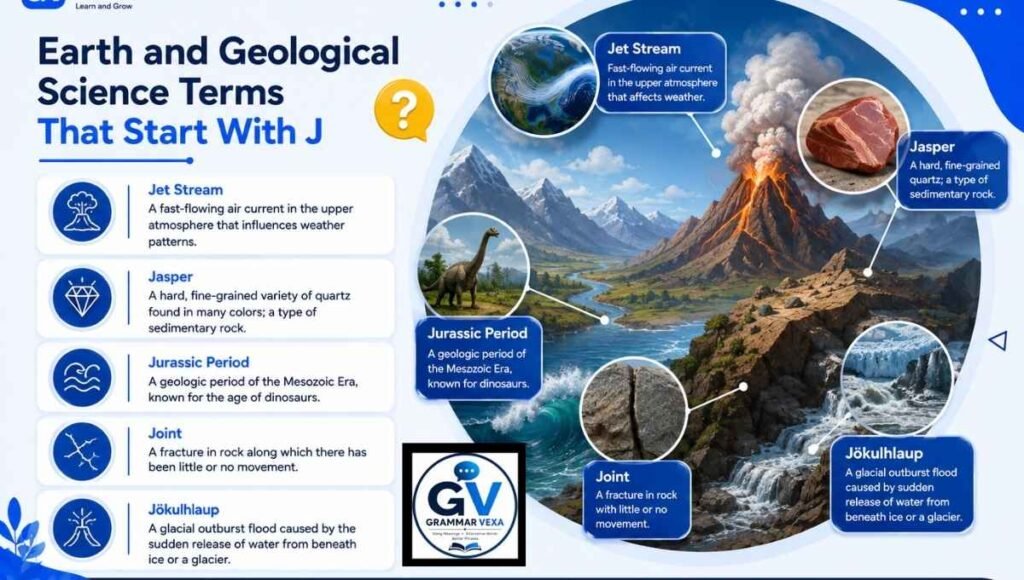
Jet Stream
The jet stream refers to narrow bands of fast-moving air found high in the atmosphere, typically near the tropopause, the boundary between the troposphere and stratosphere. These strong winds — often exceeding 100 mph — form because of temperature differences between polar regions and tropical regions.
Jet streams matter for far more than academic atmospheric science. They directly affect:
- Weather forecasting and storm formation, since the jet stream steers major weather systems
- Flight turbulence and aviation planning, as pilots often route flights to fly with the jet stream (saving fuel consumption) or avoid the roughest turbulence
- Seasonal climate patterns and long-range climate modeling
Meteorologists track the position and strength of jet streams closely because shifts in the jet stream are linked to significant changes in climate behavior, including the increasingly discussed connection between a wavier, more erratic jet stream and extreme weather events tied to climate change. Some research has also connected jet stream disruptions to shifts in atmospheric rivers, the narrow corridors of concentrated moisture responsible for major rain and flooding events on the U.S. West Coast.
Jurassic Period
The Jurassic period lasted from roughly 201 to 145 million years ago and forms the middle chapter of the Mesozoic Era, sandwiched between the Triassic and Cretaceous periods. It’s the period most associated in the public imagination with dinosaurs, thanks in large part to its use as a namesake for a certain famous film franchise — but the real scientific picture is even richer than the movies suggest.
During the Jurassic:
- The supercontinent Pangaea continued breaking apart, opening new oceans and reshaping global habitats
- Warm, humid conditions supported lush vegetation, including ferns, cycads, and the first true conifers
- Large sauropod dinosaurs like Brachiosaurus and Diplodocus reached enormous sizes, supported by these climate conditions and abundant plant life
- The earliest known birds, including Archaeopteryx, appeared toward the end of the period, representing a crucial evolutionary link between dinosaurs and modern avian species
Paleontologists rely on fossils from Jurassic rock layers to reconstruct evolutionary patterns, ancient ecosystems, and shifts in biodiversity that eventually shaped many groups of modern species still around today.
Joint (Geological Fracture)
In geology, a joint refers to a fracture in rock where there’s been no significant movement parallel to the fracture surface (which distinguishes it from a fault, where the rock has visibly shifted). Joints form due to stress from processes like cooling, uplift, or erosion, and they often occur in regular, parallel patterns across rock formations.
Geological joints matter beyond pure academic interest — they influence groundwater movement, are a factor in slope stability assessments, and are closely studied in mining and quarrying operations because they affect how rock breaks apart.
Mathematics and Data Science Terms That Start With J
Jacobian Matrix
The Jacobian matrix is a matrix that organizes all the first-order partial derivatives of a vector-valued function. In simpler terms, it describes how a small change in the input of a multi-variable function affects each output, all at once.
The Jacobian is heavily used in:
- Data analysis and machine learning, particularly in optimization algorithms and neural network training (backpropagation relies on Jacobian-like calculations)
- Robotics, where it relates joint movements of a robotic arm to the resulting movement of its end effector
- Engineering system analysis, where it helps model how complex, interconnected systems respond to small changes
Julia Set
A Julia set is a type of fractal generated from a simple mathematical formula applied repeatedly to complex numbers. Named after French mathematician Gaston Julia, who studied these sets in the early 20th century, Julia sets produce strikingly intricate, often beautiful patterns that reveal deep structure hidden within seemingly simple equations.
Julia sets are closely related to the more famous Mandelbrot set — in fact, every point in the Mandelbrot set corresponds to a different, uniquely shaped Julia set. Beyond their visual appeal, Julia sets are studied in scientific modeling and chaos theory as examples of complex, nonlinear system behavior.
J-Curve
A J-curve describes a graph pattern where a value initially declines before sharply rising well above its starting point, creating a shape resembling the letter J. It’s a concept used across multiple fields:
- Population growth: In biology, a J-curve can represent exponential growth in a population that has abundant resources and no significant limiting factors — very different from the S-shaped curve seen when growth eventually levels off
- Economics: A J-curve is often used to describe how a country’s trade balance initially worsens after a currency devaluation before improving
- Public health and epidemiology: Certain risk-outcome relationships (like alcohol consumption and cardiovascular risk in some studies) have been described with J-curve shaped data patterns
Understanding a J-curve is useful in data interpretation because it’s a classic example of a nonlinear pattern — one where the trend can’t be judged from the early data alone, since future outcomes may look completely different from initial trends. This makes J-curves a valuable case study in predictive modeling and system behavior analysis.
Genetics and Immunology Terms That Start With J
J Region (Immunoglobulin Gene Segment)
The J region, or joining region, is a segment of DNA involved in the genetic recombination process that produces the enormous diversity of antibodies in the immune system. During the development of B cells, gene segments known as V (variable), D (diversity), and J (joining) regions are shuffled and combined through a process called V(D)J recombination.
This process is central to cellular processes in immunology, because it’s what allows the immune system to generate millions of unique antibody structures from a relatively limited set of genetic building blocks — giving the body the flexibility to recognize an almost unlimited range of pathogens.
Science words that start with J
Quick Reference Table: Science Words That Start With J
| Term | Field | One-Line Definition |
|---|---|---|
| Joule | Physics | SI unit of energy |
| Joule-Thomson Effect | Physics/Thermodynamics | Temperature change in expanding real gases |
| Jerk | Physics | Rate of change of acceleration |
| Josephson Junction | Physics | Superconducting quantum tunneling junction |
| Jansky | Astronomy | Unit of radio signal strength |
| J-Integral | Engineering | Measures energy needed for crack growth |
| Jahn-Teller Effect | Chemistry | Distortion in symmetric molecular structures |
| J-Coupling | Chemistry | Spin-spin interaction seen in NMR spectroscopy |
| Joint (Anatomy) | Biology | Connection point between bones |
| Jejunum | Biology | Middle section of the small intestine |
| Jugular Vein | Biology | Neck vein returning blood to the heart |
| Juvenile Hormone | Biology | Regulates insect metamorphosis |
| J-Protein | Biology | Molecular chaperone aiding protein folding |
| Junk DNA | Genetics | Non-coding regions of the genome |
| Jaundice | Medicine | Yellowing from bilirubin buildup |
| Jupiter | Astronomy | Largest planet in the solar system |
| Jovian Planets | Astronomy | Gas/ice giants: Jupiter, Saturn, Uranus, Neptune |
| Janus | Astronomy | Saturn moon with a co-orbital neighbor |
| Julian Date | Astronomy | Continuous day-count system |
| Jet Stream | Earth Science | Fast-moving high-altitude air currents |
| Jurassic Period | Geology | Mesozoic era spanning ~201-145 million years ago |
| Joint (Geology) | Geology | Rock fracture with no lateral movement |
| Jacobian Matrix | Mathematics | Matrix of partial derivatives |
| Julia Set | Mathematics | Fractal generated from complex numbers |
| J-Curve | Math/Statistics | J-shaped decline-then-rise data pattern |
| J Region | Genetics/Immunology | Gene segment enabling antibody diversity |
How to Remember and Use These Terms
Common Mistakes People Make With J-Words in Science
- Confusing anatomical and geological joints — they share a name but describe completely unrelated concepts in different fields
- Assuming “junk DNA” has no function — modern genetics has shown many non-coding regions play regulatory roles
- Mixing up Julian date and Julian calendar — one is a continuous day-counting system used in astronomy, the other is a historical calendar reform
- Overlooking joule-based unit conversions — forgetting that 1 watt equals 1 joule per second, which trips up a lot of students moving between energy and power calculations
Best Practices for Learning Scientific Vocabulary
- Group new terms by discipline, the same way this guide does, rather than trying to memorize an alphabetical list in isolation
- Connect each term to a real-world example (Jupiter’s Great Red Spot, a swollen knee joint, a weather map showing the jet stream)
- Revisit units like the joule and jansky in context — seeing them used in an actual calculation or dataset makes them stick far better than a definition alone
Science Words That Start With J for Students
Middle school science classes often ask students to build vocabulary lists letter by letter, and J tends to trip students up because so many of the “advanced” J-terms (like the Joule-Thomson effect or J-integral) are too specialized for a general classroom. Here’s a breakdown suited to different grade levels, using plain-English meanings instead of technical definitions.
Science Words That Start With J for 7th Grade
Seventh-grade science tends to focus on Earth science, basic physical science, and life science fundamentals, so these terms fit that level well:
| Word | Simple Meaning |
|---|---|
| Jupiter | The largest planet in our solar system |
| Jet stream | A fast-moving river of air high above the Earth that affects weather |
| Joint | The place where two bones meet and allow movement, like your elbow or knee |
| Jurassic | A period of time millions of years ago when large dinosaurs lived |
| Joule | A unit used to measure energy |
Science Words That Start With J for 8th Grade
Eighth-grade science usually introduces more abstract physics and chemistry concepts, so the vocabulary can go a step further:
| Word | Simple Meaning |
|---|---|
| Joule | The scientific unit for measuring energy, named after physicist James Prescott Joule |
| Watt (Joule per second) | A unit of power that shows how fast energy is being used |
| Jovian planets | The four large, gas-based outer planets: Jupiter, Saturn, Uranus, and Neptune |
| J-curve | A graph shape where a value drops first, then rises sharply, forming a “J” |
| Junk DNA | Older term for parts of DNA that don’t directly code for proteins |
Science Words That Start With J With Meaning (Quick-Study List)
For a fast study sheet that pairs each word with a plain meaning in one line, this condensed list works well for flashcards or quizzes:
- Joule — a unit of energy
- Jet stream — a high-altitude band of fast wind
- Jupiter — the largest planet in the solar system
- Jurassic — a dinosaur-era geological period
- Joint — where two bones connect
- Jaundice — yellowing of skin from bilirubin buildup
- Jerk — the rate at which acceleration changes
- J-curve — a graph that dips before rising sharply
Science Words That Start With J in Biology (Focused List)
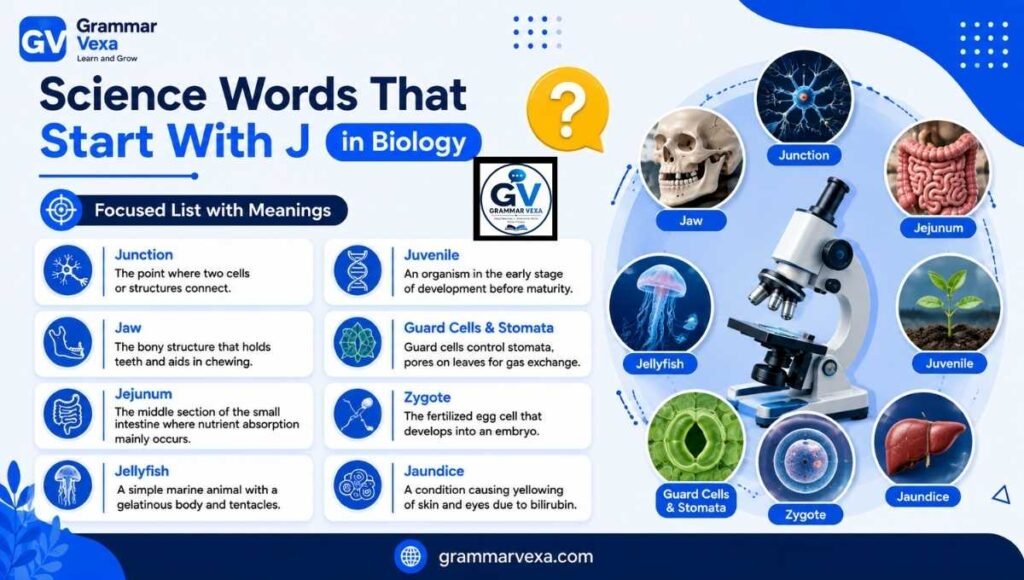
Biology classes and biology-focused searches usually want a list narrowed to living systems, without the physics and astronomy terms mixed in. Here’s that dedicated biology terms starting with J list, pulled together in one place for quick reference:
| Term | What It Means in Biology |
|---|---|
| Joint | The connection point between two bones that enables movement |
| Jejunum | The middle section of the small intestine, key for nutrient absorption |
| Jugular vein | A major vein in the neck that returns blood from the head to the heart |
| Juvenile hormone | A hormone controlling metamorphosis and development in insects |
| J-protein | A molecular chaperone that helps other proteins fold correctly |
| Junk DNA | Older term for non-coding regions of the genome, some of which have regulatory roles |
| Jaundice | A yellowing of skin and eyes caused by excess bilirubin |
| J region | A gene segment involved in producing antibody diversity in the immune system |
Related Science Word Lists by Letter
If J isn’t the only letter you’re building a vocabulary list around, here are the neighboring letters with their own set of important scientific terms.
Science words that start with J
Science Words That Start With I
| Word | Field | Meaning |
|---|---|---|
| Ion | Chemistry | An atom or molecule with a positive or negative electric charge |
| Isotope | Chemistry/Physics | Atoms of the same element with different numbers of neutrons |
| Inertia | Physics | The tendency of an object to resist changes in motion |
| Igneous rock | Geology | Rock formed from cooled and solidified magma or lava |
| Invertebrate | Biology | An animal without a backbone |
| Infrared | Physics | A type of light with wavelengths longer than visible light, felt as heat |
| Insulator | Physics | A material that resists the flow of electricity or heat |
| Ionosphere | Earth Science | A layer of the atmosphere containing charged particles |
The Science Words That Start With K
| Word | Field | Meaning |
|---|---|---|
| Kelvin | Physics | The SI base unit of temperature, starting at absolute zero |
| Kinetic energy | Physics | The energy an object has because it’s in motion |
| Kingdom | Biology | A major classification level in the taxonomy of living things |
| Karyotype | Genetics | A picture of an organism’s complete set of chromosomes |
| Keratin | Biology | A structural protein found in hair, nails, and skin |
| Krebs cycle | Biology | A series of chemical reactions cells use to release stored energy |
| Kilojoule | Physics | A unit of energy equal to 1,000 joules |
| Kinetic theory | Chemistry/Physics | A model explaining gas behavior based on moving particles |
The Science Words That Start With L
| Word | Field | Meaning |
|---|---|---|
| Lipid | Biology/Chemistry | A fat or fat-like molecule that stores energy in cells |
| Larva | Biology | An early developmental stage of many insects and amphibians |
| Lava | Geology | Molten rock that has reached the Earth’s surface |
| Latitude | Earth Science | A measurement of distance north or south of the equator |
| Lymph | Biology | A fluid that carries white blood cells through the body |
| Light-year | Astronomy | The distance light travels in one year, used to measure space distances |
| Luminosity | Astronomy | The total amount of energy a star emits |
| Lichen | Biology | An organism formed from a fungus and algae living together |
Science Words That Start With N
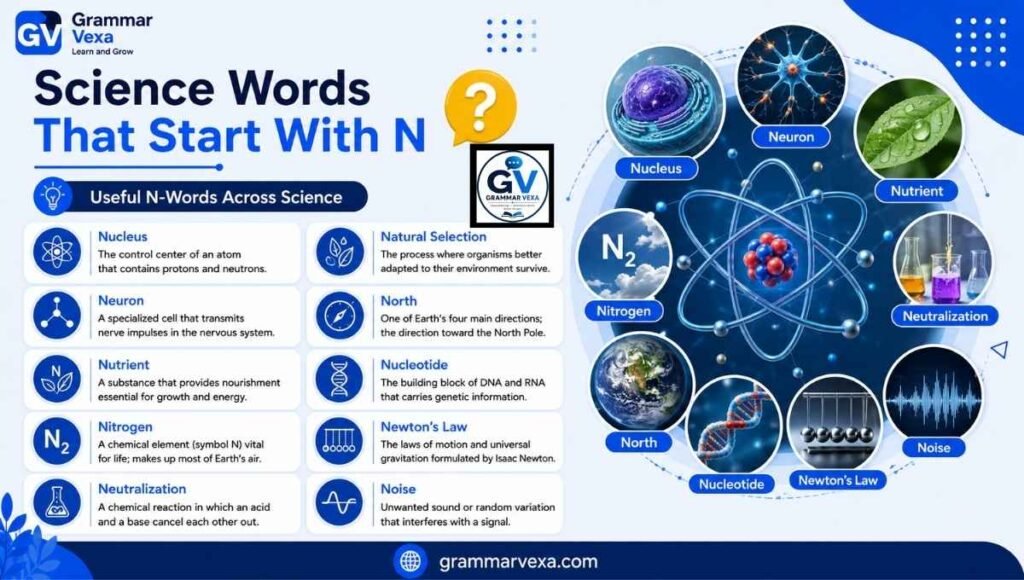
| Word | Field | Meaning |
|---|---|---|
| Neutron | Physics/Chemistry | A neutral particle found in the nucleus of an atom |
| Nucleus | Biology/Chemistry | The control center of a cell, or the core of an atom |
| Nebula | Astronomy | A cloud of gas and dust in space where stars are often born |
| Natural selection | Biology | The process by which organisms best suited to their environment survive and reproduce |
| Niche | Ecology | The specific role an organism plays in its environment |
| Nanotechnology | Physics/Engineering | Science and engineering conducted at an extremely small, molecular scale |
| Neuron | Biology | A nerve cell that transmits electrical and chemical signals |
| Nitrogen cycle | Ecology/Chemistry | The process by which nitrogen moves through air, soil, and living things |
Final Thoughts
The letter J may be rare in scientific terminology, but the words it does give us punch well above their weight. From the joule powering unit conversions across every branch of physics, to Jupiter anchoring our understanding of the outer solar system, to the humble joint that lets you bend your knee, these terms show up in research labs, medical clinics, weather reports, and classrooms every single day.
Whether you’re a student building your scientific vocabulary, a writer looking for accurate science terms and meanings, or just someone who enjoys a good trivia challenge, this list of science words that start with J should give you a solid, dependable reference — one grounded in how these terms are actually used across physics, biology, chemistry, astronomy, geology, and beyond.
FAQs
How many science words start with J?
There are roughly two to three dozen recognized scientific terms starting with J across all disciplines combined, making J one of the least productive letters in scientific vocabulary.
Is Jupiter the only planet that starts with J?
Yes, Jupiter is the only planet in our solar system whose name starts with J, though “Jovian planets” is a broader term used for Jupiter, Saturn, Uranus, and Neptune together.
What does the J stand for in J-curve?
The J-curve simply describes the shape the graph forms — a value dips first, then rises sharply, resembling the letter J — it isn’t an abbreviation for a word.
Why is the joule important in everyday life?
The joule underlies energy measurements you encounter daily, from food calorie labels to electricity bills, since it’s the base SI unit of energy used across science and industry.
What’s the difference between a joint in anatomy and a joint in geology?
An anatomical joint is where two bones meet to allow body movement, while a geological joint is a rock fracture with no lateral displacement — the two terms are unrelated despite sharing a name.
Are J-words common in middle school science curricula?
Yes, terms like joule, Jupiter, jet stream, joint, and Jurassic appear regularly in 7th and 8th grade science standards, particularly in physical science and Earth science units.
Is “junk DNA” still an accurate scientific term?
Not entirely — modern genetics research has shown many non-coding DNA regions once labeled “junk” actually play regulatory roles, so scientists increasingly prefer the term “non-coding DNA.”
What field has the most science words starting with J?
Physics has the largest cluster of J-terms, including the joule, jerk, Josephson junction, Joule-Thomson effect, and J-integral, largely due to several units and effects named after physicists.

Jessica Morgan is an English language writer and researcher at Grammar Vexa. I enjoy exploring slang, vocabulary, word meanings, synonyms, and alternative phrases. Through my work, I aim to make English easier to understand by providing clear explanations, useful examples, and practical language tips.








5 thoughts on “Science Words That Start With J: Scientific Terms and Their Meanings”