
Science Words That Start With Y
Science words that start with Y refer to the specialized vocabulary used across biology, chemistry, physics, earth science, and astronomy that begins with the letter Y, ranging from foundational terms like Y chromosome and yeast to technical entries like Young’s modulus and yttrium. Compared to almost any other letter, Y produces a noticeably shorter list of science words that start with Y, which makes each entry carry more weight in classrooms, research papers, and everyday scientific conversation.
That scarcity is exactly what makes science words that start with Y worth exploring. Two full chemical elements trace their names back to a single Swedish mining village, an astronomer’s offhand term for the early universe still shows up in cosmology textbooks, and a mosquito-borne virus first identified centuries ago remains a global health priority today. Few letters pack this much genuine scientific weight into so few words.
This guide organizes science words that start with Y by subject, giving biology terms, chemistry vocabulary, physics concepts, and astronomy entries their own focused sections instead of one long, unsorted list. We explain every definition in plain language and provide real-world context to show where and why each term matters. By the end, you’ll have a working reference covering the science words that start with Y you’ll actually encounter in coursework, research, and scientific reading.
How to Use This Glossary
This list covers three types of entries, and it helps to know the difference before you start scanning:
- General scientific vocabulary — common scientific terms used across multiple fields, like yield or Y-axis.
- Proper nouns and named entities — things like Yersinia (a genus of bacteria) or the Yerkes Observatory, which are capitalized because they’re specific names, not general concepts.
- Units, symbols, and prefixes — measurement-related science terms such as yotta- and yocto-.
Each section below groups science words by subject area, with a table for quick scanning and expanded explanations for the words that need more context. If you’re searching for a specific term, use Ctrl+F (or Cmd+F on a Mac) and jump straight to it.
Biology & Life Science Words That Start With Y
Biology has more Y words than any other branch of science, mostly thanks to genetics, embryology, and microbiology. Words like Y chromosome and yeast show up constantly in both classrooms and real research, so this is a good place to start.
Genetics & Cell Biology
The Y chromosome is probably the single most recognizable entry on this entire list.The Y chromosome is one of two sex chromosomes in humans and many other animals. It passes from father to child, so a person inherits a Y chromosome only from their father. Compared with the X chromosome, the Y chromosome is much smaller and carries only about 55 protein-coding genes, while the X chromosome carries roughly 900.
| Term | Simple Meaning |
|---|---|
| Y chromosome | The sex chromosome that, combined with an X chromosome, typically determines male biological sex in humans |
| Y chromosome gene | Any gene located specifically on the Y chromosome, such as the SRY gene that triggers male development |
| Y chromatin | A small, fluorescent spot visible in a cell nucleus under UV light, used historically to detect the presence of a Y chromosome |
| Y-linked inheritance | A pattern where a trait is passed only from father to son because the responsible gene sits on the Y chromosome |
| Yeast | A single-celled microscopic fungus used in baking, brewing, and as a model organism in genetics research |
| Yeast cell | An individual unit of yeast, studied widely because it shares many cellular processes with human cells |
| Yeast fermentation | The biological production process where yeast converts sugars into alcohol and carbon dioxide, used in bread, beer, and wine making |
| Yeast metabolism | The chemical processes yeast cells use to break down nutrients and generate energy |
| Yeast extract | A concentrated product made from breaking down yeast cells, used in food science and microbiology culture media |
Here’s something most glossaries skip: yeast isn’t just a kitchen ingredient. Saccharomyces cerevisiae, or baker’s yeast, is one of the most studied living organisms in all of biology because its cells behave enough like human cells to model genetic traits, aging, and disease — without the ethical complications of testing on animals or people.
Embryology & Development
| Term | Simple Meaning |
|---|---|
| Yolk | The nutrient-rich portion of an egg that feeds a developing embryo |
| Yolk sac | A membrane-lined sac attached to an embryo that supplies early nutrition before the placenta takes over |
| Yolk sac membrane | The thin protective layer surrounding the yolk sac |
| Yolk protein | Proteins such as vitellogenin stored in the yolk to nourish the embryo |
| Yolk granules | Small nutrient-storage structures within yolk material |
| Yolk platelet | A dense, protein-rich particle found in egg yolk, especially studied in amphibian embryo development |
| Yolk formation | The biological process by which nutrients accumulate to form yolk before an egg is laid |
| Yolk absorption | The process where a developing embryo gradually uses up its yolk supply for energy and growth |
| Young organism | A general term for any organism still in early developmental or juvenile stages |
Yolk-related vocabulary matters far beyond chicken eggs. In embryo development across birds, reptiles, fish, and amphibians, the size and composition of the yolk sac directly affects how independent a newborn organism is at birth — species with large yolk reserves tend to hatch more developed than those with small ones.
Organisms, Microbiology & Disease
| Term | Simple Meaning |
|---|---|
| Yersinia | A genus of rod-shaped bacteria that includes several disease-causing species |
| Yersinia pestis | The specific bacterium responsible for plague, including the historic Black Death |
| Yellow fever | A viral disease spread by mosquitoes, causing fever, jaundice, and in severe cases, organ failure |
| Yellow fever virus | The flavivirus responsible for yellow fever, transmitted primarily by Aedes aegypti mosquitoes |
| Yak | A large, long-haired bovine mammal adapted to high-altitude environments in the Himalayas |
| Yeti crab | A deep-sea crustacean with hair-like bristles on its claws, discovered near hydrothermal vents |
| Yucca | A genus of drought-tolerant flowering plants native to hot, dry regions of North America |
According to the World Health Organization, yellow fever remains a serious public-health concern in parts of Africa and South America, with an estimated 200,000 cases and 30,000 deaths occurring globally each year before widespread vaccination efforts.
Expert Tip: If you’re studying for a microbiology exam, remember that Yersinia is a genus name — always capitalized and italicized in formal writing — while “yeast” is a general biological term and stays lowercase.
Chemistry Words That Start With Y

Doesn’t offer’s chemistry many Y words, but the ones it does have are important. Two entire chemical elements start with Y, and the word “yield” is one of the most-used scientific terms in any chemistry lab.
Elements & Compounds
| Term | Simple Meaning |
|---|---|
| Yttrium (Y) | A silvery rare earth element, atomic number 39, used in LED lights, camera lenses, and superconductors |
| Ytterbium (Yb) | A soft, silvery rare earth element, atomic number 70, used in atomic clocks and fiber lasers |
| Yttria | The common name for yttrium oxide (Y₂O₃), used in ceramics and phosphors |
| Yttrium oxide | A white, chemically stable chemical compound used in TV screens, lasers, and ceramic coatings |
| Yttrium aluminum garnet (YAG) | A synthetic crystal used in solid-state lasers and as a diamond simulant in jewelry |
| Yttrium nitrate | A yttrium salt used in the production of phosphors and specialty ceramics |
| Ytterbium chloride | An ytterbium salt used in chemical research and materials synthesis |
| Ytterbium fluoride | A compound used in optical coatings and fiber-laser applications |
Both yttrium and ytterbium were discovered near the same Swedish village — Ytterby — which is also where the elements terbium and erbium got their names. It’s a rare case where a single small mining town lent its name to four different chemical elements.
Chemical Processes & Reaction Terms
| Term | Simple Meaning |
|---|---|
| Yield (chemistry) | The amount of product actually produced by a chemical reaction |
| Theoretical yield | The maximum possible amount of product a reaction could produce, calculated mathematically |
| Actual yield | The real, measured amount of product obtained after running the reaction |
| Percent yield | A comparison of actual output to expected output, expressed as a percentage, showing reaction efficiency |
| Ylide | A neutral molecule with a positively and negatively charged atom sitting next to each other, important in organic synthesis reactions |
| Yellowcake | A concentrated uranium powder produced during uranium ore processing, an intermediate step before nuclear fuel production |
Percent yield is one of the most practical scientific concepts a chemistry student will ever calculate. The formula is straightforward:
Percent Yield = (Actual Yield ÷ Theoretical Yield) × 100
A yield below 100% is completely normal — side reactions, incomplete reactions, and product loss during purification all reduce actual output compared to the theoretical maximum.
Physics Words That Start With Y
Physics contributes some of the most functionally important Y words in all of science, especially in mechanics and materials science.
Mechanics, Motion & Materials
| Term | Simple Meaning |
|---|---|
| Young’s modulus | A number that measures how stiff a material is — how much it stretches or compresses under stress |
| Young elasticity | Another way of referring to the elastic stiffness a material shows under Young’s modulus |
| Yield point | The exact point where a material stops bending back to its original shape and starts deforming permanently |
| Yield strength | The maximum stress a material can handle before it permanently deforms |
| Yield stress | The stress level at which a material begins to behave plastically instead of elastically |
| Yield load | The specific load or force at which a material reaches its yield point |
| Yield limit | The upper boundary of stress a material can take before permanent deformation begins |
| Elastic limit | The maximum stress a material can experience and still return to its original shape |
Engineers rely on yield strength constantly. It’s the number that tells a bridge designer, for example, exactly how much load a steel beam can bear before it bends and never springs back. Go past the yield point, and you’re no longer dealing with elastic behavior — you’re dealing with permanent, structural damage.
Rotational Motion & Aerospace
| Term | Simple Meaning |
|---|---|
| Yaw | Rotational movement around a vertical axis, like a car spinning sideways or a plane’s nose swinging left and right |
| Yaw angle | The specific angle of rotation measured during yaw motion |
| Yaw rate | How fast an object is rotating around its vertical axis, usually measured in degrees per second |
| Yaw stability | An object’s tendency to resist unwanted rotation around its vertical axis |
| Yaw control | Systems (like a rudder or thrusters) used to manage and correct yaw motion |
| Yaw dynamics | The overall study of how and why an object rotates around its vertical axis |
Yaw is one of the three fundamental types of rotational movement in aerospace engineering, alongside pitch and roll. Every commercial aircraft, drone, and spacecraft has dedicated yaw control systems, because uncontrolled yaw motion can send a vehicle spinning off its intended flight path.
Graphing, Optics & Classic Experiments
| Term | Simple Meaning |
|---|---|
| Y-axis | The vertical line on a graph, used to plot dependent variables |
| Y-axis rotation | Rotation that occurs around the vertical axis in a three-dimensional coordinate system |
| Y-intercept | The point where a line on a graph crosses the Y-axis |
| Young’s experiment | A historic physics experiment demonstrating light behaves as a wave |
| Young’s double slit | The specific setup Thomas Young used, shining light through two narrow slits to produce an interference pattern |
| Light interference | The pattern that results when two light waves overlap, reinforcing or canceling each other out |
Thomas Young’s double-slit experiment, first performed in 1801, is still taught in nearly every introductory physics course because it provided the first strong evidence for the wave nature of light — decades before quantum mechanics complicated the picture further by showing light also behaves like a particle.
Earth & Environmental Science Words That Start With Y
There aren’t many Y words in earth science, but the ones that exist are genuinely useful science terms for geology, climatology, and agriculture.
| Term | Simple Meaning |
|---|---|
| Yardang | A streamlined ridge of rock or sediment carved by wind erosion in arid, desert environments |
| Yazoo stream | A tributary that runs parallel to a larger river for a long distance before finally joining it, common in flat floodplains |
| Younger Dryas | A sharp, roughly 1,200-year cold period around 12,900 years ago that interrupted the Earth’s warming after the last Ice Age |
| Year | The time it takes Earth to complete one orbit around the Sun — about 365.25 days |
| Yield (agriculture) | The measurable amount of crop produced per unit of farmland, a core metric in agricultural productivity |
| Yellow dust | Wind-blown dust storms originating from deserts in Mongolia and northern China, affecting air quality across East Asia |
The Younger Dryas is a favorite topic in climate science because it shows how fast climate can shift. Ice core data from Greenland indicates temperatures in the North Atlantic region dropped several degrees within just a few decades — a pace that’s still debated and studied by climatologists trying to understand abrupt climate change.
Crop yield, meanwhile, is one of the most closely tracked numbers in global agriculture. According to the USDA, U.S. corn yields have climbed from around 20 bushels per acre in the 1930s to well over 170 bushels per acre in recent years, largely due to advances in hybrid seed genetics, fertilization, and farming technology.
Astronomy & Space Science Words That Start With Y
Astronomy offers a small but fascinating set of Y words, ranging from star classification to the mechanics of asteroid orbits.
| Term | Simple Meaning |
|---|---|
| Year (astronomical) | The time required for a planet to complete one full orbit around its star |
| Light-year | The distance light travels in one year — roughly 5.88 trillion miles — used to measure vast cosmic distances |
| Yellow dwarf star | A medium-sized, main-sequence star (like our Sun) that fuses hydrogen into helium in its core |
| Yellow giant | An aging, expanding star that has left the main sequence and grown significantly larger and cooler |
| Yellow supergiant | A rare, extremely luminous and massive star in a late stage of stellar evolution |
| Young stellar object (YSO) | A star still in its early formation stages, often surrounded by a disk of gas and dust |
| Yarkovsky effect | A subtle force caused by uneven heating and re-radiation of sunlight that slowly shifts an asteroid’s orbit over time |
| Ylem | A term coined by physicist George Gamow for the dense, hot primordial matter thought to have existed just after the Big Bang |
| Yerkes Observatory | A historic astronomical observatory in Wisconsin, home to the world’s largest refracting telescope |
| Yerkes spectral classification | An early stellar classification system, developed at Yerkes Observatory, that groups stars by luminosity |
Our Sun is a textbook yellow dwarf star, though its color actually appears white from space — the “yellow” label comes from how sunlight scatters through Earth’s atmosphere. The Yarkovsky effect is a favorite among asteroid researchers because it explains orbital shifts too small to spot in a single human lifetime but significant enough to matter over millions of years, which is why NASA factors it into long-term asteroid-tracking models like those used for the Near-Earth Object program.
Math & Data Science Words That Start With Y
Beyond geometry class, Y words in math and data science mostly involve units, prefixes, and statistical notation.
| Term | Simple Meaning |
|---|---|
| Y-axis | The vertical axis of a coordinate plane or graph |
| Y-intercept | The value where a graphed line crosses the Y-axis |
| Yotta- | A metric prefix meaning 10²⁴ (one septillion), the largest standard SI prefix currently in use |
| Yocto- | A metric prefix meaning 10⁻²⁴, representing an extremely tiny fraction |
| Yottabyte | A unit of digital storage equal to one septillion bytes |
Yotta- and yocto- sit at the extreme ends of the International System of Units (SI). To put yotta- in perspective, one yottabyte of data would be roughly equal to the estimated total amount of information stored by every computer system on Earth combined — a scale that data scientists are only now starting to approach as global data generation accelerates.
Medicine & Anatomy Words That Start With Y
A handful of Y words show up regularly in medical and anatomical contexts.
| Term | Simple Meaning |
|---|---|
| Yellow fever | A mosquito-borne viral illness, discussed above in the biology section, that remains a major topic in tropical medicine |
| Yellow bone marrow | Fat-storing marrow found in the central cavities of long bones, distinct from blood-producing red marrow |
| Yellow fever vaccine | A live-attenuated vaccine offering long-lasting, often lifetime, immunity after a single dose |
| Yawning | An involuntary reflex involving a wide opening of the mouth and deep inhalation, linked to brain temperature regulation |
| Yttrium-90 | A radioactive isotope of yttrium used in targeted radiotherapy for liver and other cancers |
Yawning is a genuinely interesting example of an everyday involuntary action that scientists still don’t fully understand. According to one leading theory, supported by research from Princeton University, yawning may help cool the brain by increasing blood flow and drawing in cooler air. As a result, this could explain why people tend to yawn more when they feel tired or overheated.
Technology & Computing Words That Start With Y
A short but relevant list for anyone working in tech or data fields.
| Term | Simple Meaning |
|---|---|
| YAML | A human-readable data format commonly used for configuration files in software development |
| Yottabyte | The largest standard unit of digital storage, equal to 10²⁴ bytes |
| Y2K | Short for “Year 2000,” referring to the software bug risk tied to two-digit date formatting in older computer systems |
| Yield (programming) | A keyword used in programming languages to pause a function and return a value without fully exiting it |
Tricky Y-Words: Commonly Confused or Mispronounced
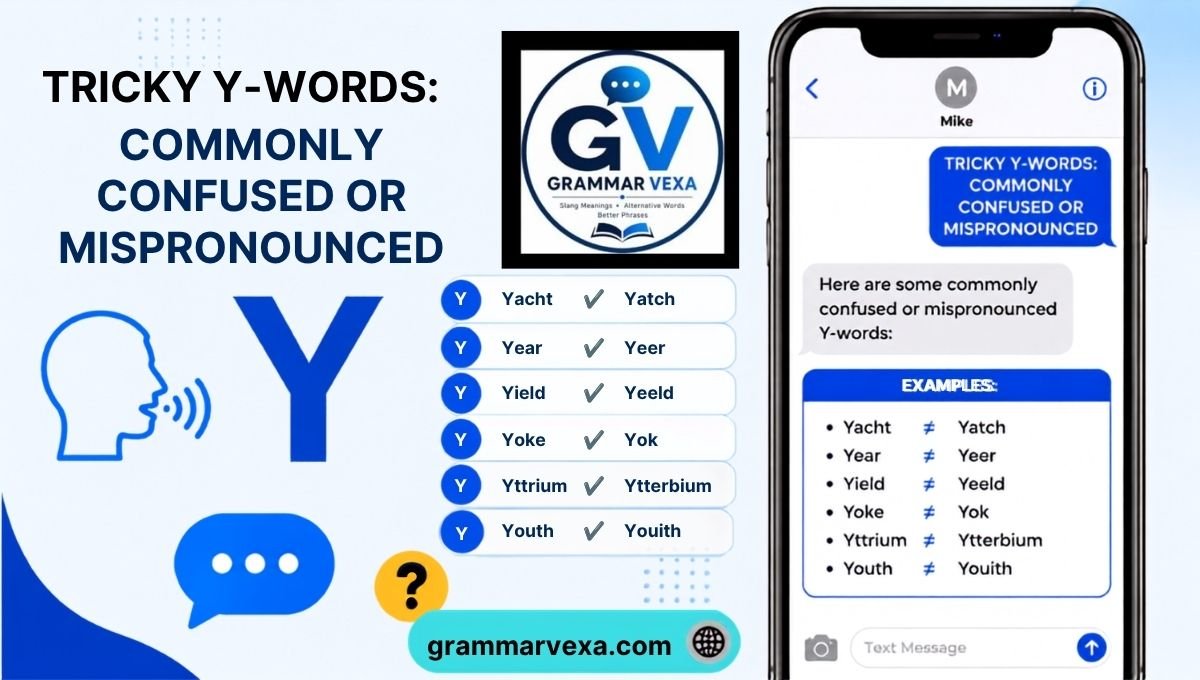
A few Y words trip people up consistently, so here’s a quick reference to clear up the confusion.
- Yttrium and ytterbium are both rare earth elements that scientists discovered near the same Swedish village. However, they are distinct elements with different atomic numbers—39 and 70—and they serve different industrial purposes.
- Yolk vs. Yoke — Yolk is the nutrient-rich part of an egg; yoke is a completely unrelated word for a wooden farming harness. They’re homophones, not variants of the same term.
- Yield (chemistry) vs. Yield (physics) — In chemistry, yield refers to the amount of product from a reaction. In physics and engineering, yield refers to the point where a material permanently deforms. Same word, two very different scientific meanings.
- Yaw vs. Pitch vs. Roll — All three describe rotational motion, but around different axes. Yaw is side-to-side (vertical axis), pitch is up-and-down (lateral axis), and roll is tilting (longitudinal axis).
Key Takeaways
- The letter Y produces fewer science words than most letters, but the words that exist are used constantly across biology, chemistry, physics, and astronomy.
- Y chromosome, yeast, and yield are among the most frequently searched and studied Y science words.
- Two full chemical elements — yttrium and ytterbium — start with Y and share a discovery origin in the same Swedish village.
- Yaw, Young’s modulus, and yield strength are core physics vocabulary used daily in engineering.
- Astronomy contributes unique terms like the Yarkovsky effect and yellow dwarf star, both directly tied to real, ongoing research.
Frequently Asked Questions
Are there any scientific units that start with Y?
Yes. The metric prefixes yotta- (10²⁴) and yocto- (10⁻²⁴) are official SI prefixes, currently representing the largest and smallest standard prefixes in the International System of Units.
Why are there so few science words that start with Y?
Y is one of the least common starting letters in English, and this pattern also appears in scientific vocabulary. In general, many Y-based scientific terms come from Old English roots, such as “year” and “yield.” Additionally, some terms come from proper nouns, including element names linked to Ytterby, Sweden.
What does “Y” mean in science formulas and graphs?
In graphing and coordinate geometry, “Y” typically refers to the Y-axis, the vertical line representing the dependent variable. In physics equations, a lowercase y often represents vertical position or displacement.
Is “yeast” considered a scientific term?
Yes. Yeast is a formal biological classification referring to single-celled fungi in the kingdom Fungi, and it’s a heavily studied living organism in genetics, cell biology, and biochemistry research, not just a baking ingredient.
What science words starting with Y are used in astronomy?
Astronomy uses terms like yellow dwarf star, young stellar object, and the Yarkovsky effect, along with foundational time-related terms like year and light-year.
Conclusion
Science words that start with Y cover more ground than most people expect. From the Y chromosome in biology to yield strength in physics, these terms show up in real classrooms, labs, and research every day. Yttrium and ytterbium prove that even rare chemical elements can share surprising origins. Yaw, yeast, and yolk each carry specific meanings that matter far beyond a single subject.
This list gives you a clear, organized reference for science words that start with Y, sorted by field so you can find exactly what you need. You now know the difference between yield in chemistry and yield in physics, why yeast matters in genetics, and how the Yarkovsky effect shapes asteroid orbits. Keep this glossary handy. Whether you’re studying, teaching, or just curious, these science words that start with Y are ready whenever you need them.

Jessica Morgan is an English language writer and researcher at Grammar Vexa. I enjoy exploring slang, vocabulary, word meanings, synonyms, and alternative phrases. Through my work, I aim to make English easier to understand by providing clear explanations, useful examples, and practical language tips.








3 thoughts on “250+ Science Words That Start With Y (With Simple Meanings)”