Science uses a huge range of specialized terms to describe matter, energy, life, motion, Earth, and space. This guide brings together important science words that start with V, with simple definitions, examples, and scientific context. You’ll find familiar terms such as velocity, volume, voltage, virus, vaccine, viscosity, valence, vector, and vertebrate, along with less common terms used in chemistry, biology, medicine, Earth science, and astronomy.
Learning these science words beginning with V isn’t just an exercise in memorizing vocabulary. Each term connects to a larger idea. Velocity describes motion, voltage explains electrical potential difference, viscosity helps describe fluid behavior, and valence helps explain chemical bonding. In biology, virus, vaccine, and vertebrate open the door to infectious disease, immunity, anatomy, and evolution.
Whether you’re a student, teacher, science writer, or simply curious about the natural world, this collection provides a practical reference to scientific vocabulary. Each definition focuses on what the word means, where it’s used, and why the concept matters.
Science Words That Start With V at a Glance
The letter V appears across nearly every major branch of science. Some V words in science describe measurable quantities, while others name organisms, processes, materials, or scientific disciplines.
| Science word | Simple meaning | Main field |
|---|---|---|
| Velocity | Rate of change of position with direction | Physics |
| Volume | Amount of three-dimensional space occupied | Physics/Chemistry |
| Vibration | Repeated motion around a position | Physics |
| Voltage | Electrical potential difference | Physics/Electrical engineering |
| Vacuum | Region with extremely low pressure or little matter | Physics |
| Viscosity | Resistance of a fluid to flow | Physics/Chemistry |
| Vector | Quantity with magnitude and direction | Physics/Mathematics |
| Valence | Bonding capacity associated with an atom | Chemistry |
| Vaporization | Change from liquid to gas | Chemistry/Physics |
| Virus | Infectious biological entity that replicates using host cells | Biology/Medicine |
| Vaccine | Preparation that trains immune defenses against a disease | Medicine |
| Vertebrate | Animal with a vertebral column | Biology |
| Virion | Complete virus particle outside a host cell | Virology |
| Volcano | Geological feature through which magma or volcanic material erupts | Earth science |
| Variable star | Star whose observed brightness changes | Astronomy |
The range is impressive. That’s one reason scientific words starting with V are useful for building broad academic vocabulary.
Physics and Physical Science Words That Start With V
Physics gives us some of the most familiar science terms that start with V. Many describe quantities that scientists measure or mathematical ideas used to model the physical world.
Velocity Definition in Science
Velocity describes how quickly an object’s position changes and includes its direction.
Unlike speed, velocity is a vector quantity. That distinction matters because two objects can have the same speed while traveling in different directions.
For example, imagine two cars traveling at 60 miles per hour. One travels north and the other travels south. Their speeds are equal, but their velocities differ because their directions differ.
In SI units, velocity is measured in meters per second (m/s). NIST identifies meter per second as the SI derived unit for speed and velocity.
A basic relationship is:
Velocity = displacement ÷ time
For changing motion, physicists use instantaneous velocity, which describes an object’s velocity at a particular moment. OpenStax expresses instantaneous velocity as the derivative of position with respect to time.
Real-world examples include:
- A spacecraft changing its trajectory.
- A runner moving around a track.
- Air moving through a ventilation system.
- Water flowing through a pipe.
- A planet moving around the Sun.
Volume in Physics and Chemistry
Volume measures the three-dimensional space occupied by matter or enclosed by a surface.
It applies to solids, liquids, and gases. The SI unit is the cubic meter (m³), although liters and milliliters are common for laboratory measurements. NIST notes that one liter equals one cubic decimeter and one milliliter equals one cubic centimeter.
For a rectangular object:
Volume = length × width × height
For a cylinder:
Volume = πr²h
Volume plays an important role in several other measurements. For example, density is calculated by dividing mass by volume:
Density = mass ÷ volume
This relationship makes volume especially important in chemistry, fluid dynamics, engineering, and materials science.
Vibration and Sound Waves
A vibration is repeated motion around an equilibrium position.
Think about a guitar string. When plucked, the string moves back and forth around its resting position. That movement creates changes in the surrounding air, producing sound.
Vibrations can occur in:
- Strings
- Machine components
- Buildings
- Molecules
- Sound-producing objects
- Earth’s crust
The characteristics of vibration often include frequency, amplitude, and period.
Frequency tells you how many cycles occur per second. Amplitude describes the size of the displacement.
In sound science, vibration connects directly with wave motion. A vibrating source can create pressure variations that travel through a medium.
Voltage and Electrical Circuits
Voltage is the electrical potential difference between two points.
It’s measured in volts (V). In a simple circuit, voltage provides the potential difference that drives electric current through components when a conducting path exists.
A useful relationship from basic circuit theory is:
V = IR
Here:
- V = voltage
- I = electric current
- R = resistance
Voltage appears everywhere in electrical engineering. Batteries, power supplies, sensors, circuits, and electronic devices all rely on controlled electrical potential differences.
For example, a battery creates a potential difference between its terminals. When a circuit is completed, that difference helps drive charge through the circuit.
Vacuum in Physics
A vacuum is a region containing very little matter and therefore having extremely low pressure compared with ordinary atmospheric conditions.
A perfect vacuum is an idealized concept. Real laboratory systems generally contain some residual particles.
Vacuum technology matters in many areas, including:
- Semiconductor manufacturing
- Electron microscopy
- Space simulation
- Particle physics
- Materials research
- Vacuum coating
- Scientific instrumentation
Outer space is not a perfect vacuum either. Even interplanetary and interstellar regions contain particles, radiation, magnetic fields, and other forms of matter and energy.
Viscosity of Fluids
Viscosity describes a fluid’s resistance to flow.
Honey flows slowly because it has a much higher viscosity than water under comparable conditions. Water moves more easily because its viscosity is lower.
Viscosity matters in fluid dynamics, chemical processing, medicine, petroleum engineering, and manufacturing.
NIST distinguishes between dynamic viscosity and kinematic viscosity. Dynamic viscosity uses the SI unit pascal-second (Pa·s), while kinematic viscosity uses square meters per second (m²/s).
Temperature can also affect viscosity. For many liquids, increasing temperature lowers viscosity because molecules can move more readily past one another.
This matters when designing:
- Lubricants
- Hydraulic systems
- Pipelines
- Paints
- Medicines
- Food-processing equipment
Vector in Physics and Biology
A vector is a quantity described by both magnitude and direction.
Velocity is one example. Displacement, acceleration, and force are other important vector quantities.
Suppose someone walks 10 meters east. Saying “10 meters” gives the magnitude of the displacement. Adding “east” provides its direction.
That’s what makes displacement different from distance.
Vectors are also important in biology. A biological vector is an organism that transmits an infectious agent between hosts. Mosquitoes, for example, can act as vectors for certain pathogens.
So the word “vector” has different meanings depending on the scientific field.
Chemistry Words That Start With V
Chemistry contains several important scientific terms starting with V. Many relate to atoms, molecules, chemical bonding, and changes of state.
Valence in Chemistry
Valence describes an atom’s combining capacity and is closely related to how its electrons participate in chemical bonding.
Atoms form chemical bonds because their electron arrangements influence their stability and interactions with other atoms.
For example, carbon commonly forms four covalent bonds. Oxygen commonly forms two. These patterns help chemists understand the structure of molecules and compounds.
Valence becomes especially useful when studying:
- Chemical bonding
- Molecular structure
- Reactivity
- Lewis structures
- Periodic trends
- Organic chemistry
Valence Electron
A valence electron is an electron in an atom’s outer occupied shell that can participate in chemical interactions.
These electrons strongly influence an element’s chemical behavior.
For example, elements in the same group of the periodic table often have similar valence-electron arrangements. That similarity helps explain why they can show related chemical properties.
Vaporization and Evaporation
Vaporization is the change of a substance from liquid to gas.
It can happen through different mechanisms, including evaporation and boiling.
Evaporation occurs at the surface of a liquid. It can happen below the liquid’s boiling point.
Boiling occurs throughout the liquid when conditions allow vapor bubbles to form within it.
Consider water in a glass. Some molecules escape from its surface even when the water isn’t boiling. That’s evaporation.
Place the same water over sufficient heat and eventually it can boil. That’s another form of vaporization.
Vapor Pressure
Vapor pressure describes the pressure exerted by a vapor when it is in equilibrium with its condensed phase at a given temperature.
Temperature affects vapor pressure strongly. As temperature rises, more molecules can enter the gas phase, generally increasing vapor pressure.
Vapor pressure helps explain why some liquids evaporate more readily than others.
It also matters in:
- Distillation
- Atmospheric chemistry
- Chemical storage
- Environmental science
- Industrial processing
Volatile
In chemistry, a volatile substance tends to vaporize relatively easily.
Volatility depends on factors such as intermolecular forces and temperature.
A liquid with weak intermolecular attractions often escapes into the gas phase more readily than a liquid with stronger attractions.
Volatility is important when handling solvents, fuels, fragrances, and other chemicals.
Van der Waals Forces
Van der Waals forces are relatively weak intermolecular attractions.
They aren’t the same as strong covalent or ionic bonds. Instead, they help explain interactions between molecules and atoms.
These forces become especially important when examining:
- Molecular behavior
- Gas condensation
- Surface interactions
- Biological molecules
- Nanomaterials
Even weak interactions can become significant when many of them act together.
Vulcanization
Vulcanization is a chemical process used to improve the properties of rubber.
It commonly involves forming cross-links between polymer chains. This changes the material’s mechanical behavior and can improve strength, elasticity, durability, and resistance to deformation.
The process played a major role in making rubber useful for tires, seals, hoses, and other engineered products.
Biology and Life Science Words That Start With V
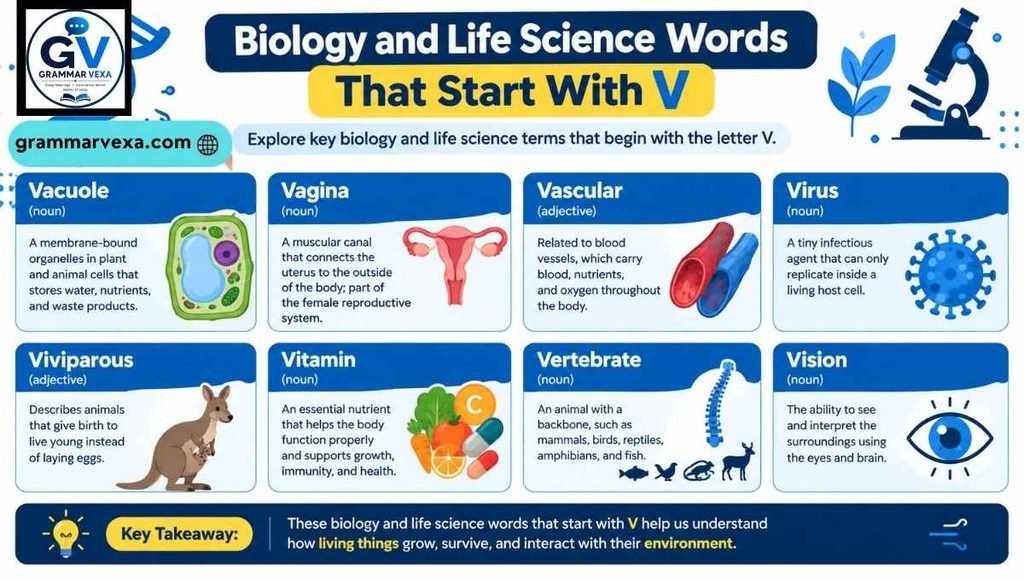
The Biology offers some of the most recognizable words beginning with V. Several connect directly to human health, ecosystems, evolution, and cellular processes.
Virus and Infectious Diseases
A virus is an infectious biological entity that depends on host cells for replication.
Viruses contain genetic material surrounded by structures that help protect and deliver that material. Depending on the virus, the genetic material can be DNA or RNA.
Unlike cellular organisms, viruses don’t carry out independent cellular metabolism in the way cells do. They use host-cell machinery during replication.
Viruses can infect:
- Humans
- Other animals
- Plants
- Fungi
- Bacteria
The relationship between viruses and host cells is central to virology, biotechnology, medicine, and public health.
Research on antiviral immunity shows that organisms use both innate and adaptive immune mechanisms to respond to viral infections.
Vaccine and Immunity
A vaccine prepares the immune system to recognize a specific disease-causing organism or component.
Vaccination can create immune memory without requiring a person to experience the full disease caused by an infectious agent.
The CDC explains that vaccines work by engaging the body’s natural defenses and exposing the immune system to an antigen in a controlled way.
Depending on the vaccine, the antigen may come from:
- A weakened microorganism
- An inactivated microorganism
- A component of a microorganism
- Genetic instructions for producing an antigen
- Another carefully designed antigenic preparation
The immune response can involve antibodies, B cells, T cells, and immune memory.
Importantly, vaccination doesn’t mean that infection becomes impossible in every case. Protection varies by disease and vaccine. The CDC notes that vaccinated people can sometimes still become infected, while vaccination can reduce the risk of severe disease for many vaccine-preventable infections.
Virion
A virion is a complete virus particle outside a host cell.
This term helps distinguish the physical infectious particle from the broader concept of a virus and its life cycle.
A virion can contain:
- Viral genetic material
- A protein capsid
- An envelope in some viruses
- Surface proteins or other structural components
Virion structure varies substantially among viruses. That structural diversity is one reason virology has such a wide vocabulary.
Virology
Virology is the scientific study of viruses.
Virologists investigate questions such as:
- How viruses replicate
- How viruses enter cells
- How immune systems recognize viruses
- How viral diseases spread
- How antiviral medicines work
- How vaccines generate protection
- How viruses evolve
Virology overlaps with microbiology, genetics, immunology, epidemiology, biotechnology, and medicine.
Vertebrate Animals
A vertebrate is an animal with a vertebral column or backbone.
Vertebrates include:
- Fish
- Amphibians
- Reptiles
- Birds
- Mammals
The vertebrate body plan includes a complex internal skeleton and a spinal column associated with the central nervous system.
The category is important in anatomy, evolution, ecology, zoology, and comparative biology.
For example, studying vertebrate anatomy can reveal both major differences and evolutionary relationships between a fish, bird, and mammal.
Vasodilation
Vasodilation occurs when blood vessels widen.
When certain blood vessels dilate, resistance to blood flow can decrease. This process contributes to the regulation of blood flow and cardiovascular function.
Vasodilation can occur in response to several physiological signals and conditions.
It works in opposition to vasoconstriction, where blood vessels narrow.
Understanding both processes is important in physiology and medicine because blood-vessel diameter influences circulation and tissue perfusion.
Vesicle
A vesicle is a small membrane-bound compartment inside or outside a cell.
Cells use vesicles for several forms of transport and communication.
For example, vesicles can carry molecules from one part of a cell to another. Some vesicles also participate in secretion by carrying substances toward the cell membrane.
Vesicle biology is important in:
- Cell signaling
- Membrane trafficking
- Protein transport
- Neurobiology
- Cellular waste handling
Vacuole
A vacuole is a membrane-bound compartment found in cells.
Plant cells often contain a large central vacuole that helps with storage and contributes to maintaining internal pressure.
Vacuoles can store:
- Water
- Ions
- Pigments
- Metabolic products
- Other dissolved substances
Their roles vary among organisms and cell types.
Vegetative Reproduction
Vegetative reproduction is a form of asexual reproduction in plants that uses vegetative structures rather than seeds.
Examples include reproduction through:
- Runners
- Tubers
- Bulbs
- Rhizomes
- Cuttings
A strawberry plant producing new plants through runners provides a familiar example.
This process allows plants to reproduce without sexual fertilization and can produce genetically similar offspring.
Earth and Environmental Science Words That Start With V
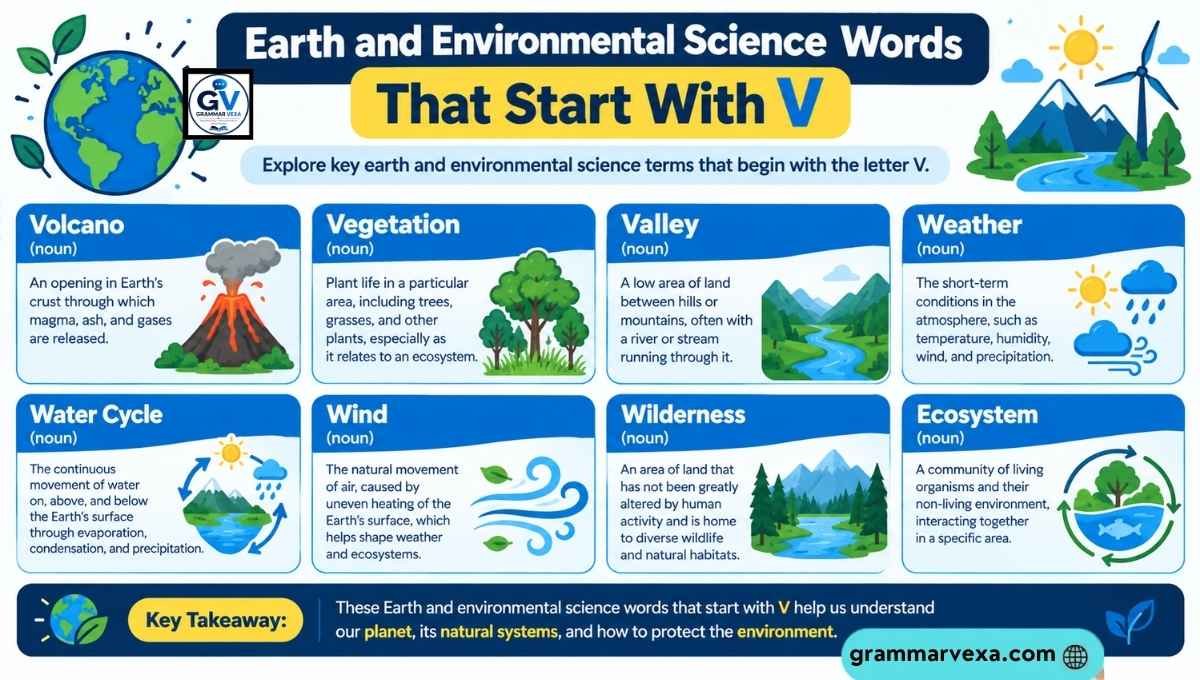
The letter V also appears in Earth science terminology, especially when studying volcanoes, groundwater, plants, and environmental systems.
Volcano
A volcano is a geological feature or opening through which molten rock, gases, and other volcanic materials reach Earth’s surface.
USGS describes volcanoes as structures built through the accumulation of eruptive products such as lava and tephra around volcanic vents.
Volcanic eruptions can produce:
- Lava flows
- Ash
- Volcanic gases
- Tephra
- Pyroclastic material
Volcanology examines these processes to understand volcanic behavior and hazards.
Volcanic
The adjective volcanic refers to processes, rocks, materials, or features associated with volcanoes.
For example, volcanic rock forms from magma or lava that cools and solidifies.
Basalt is one important volcanic rock. It commonly forms from relatively fluid lava.
Volcanology
Volcanology is the scientific study of volcanoes and volcanic processes.
Researchers monitor volcanoes using multiple measurements, including:
- Earthquake activity
- Ground deformation
- Gas emissions
- Thermal observations
- Lava movement
- Satellite imagery
USGS monitoring of Kīlauea demonstrates how seismic activity and ground deformation can help scientists understand changes beneath an active volcano.
This work has practical value because better monitoring can support hazard assessment and emergency planning.
Vegetation
Vegetation refers broadly to plant life covering an area.
Scientists study vegetation to understand:
- Ecosystem structure
- Climate patterns
- Soil conditions
- Water availability
- Carbon cycling
- Habitat quality
Vegetation can also act as an indicator of environmental change.
For instance, changes in vegetation patterns can reflect shifts in temperature, rainfall, land use, or disturbance.
Vernalization
Vernalization is the process through which exposure to prolonged cold promotes or enables flowering in certain plants.
The phenomenon is important in plant biology and agriculture.
Some plants use seasonal temperature cues to determine when reproduction should occur. This helps align flowering with favorable environmental conditions.
Vadose Zone
The vadose zone is the unsaturated region above the groundwater table.
Water and air occupy pore spaces within this zone. Water moves through it toward deeper groundwater under suitable conditions.
The vadose zone is important when scientists study:
- Groundwater recharge
- Soil moisture
- Contaminant movement
- Agricultural water use
- Hydrology
Astronomy and Space Science Words That Start With V
Some of the most interesting scientific words starting with V come from astronomy.
Variable Star
A variable star is a star whose observed brightness changes over time.
The changes can occur for different reasons.
Some stars physically expand and contract. Others vary because something passes in front of them and changes the amount of light reaching observers.
Studying variable stars helps astronomers understand stellar properties and can provide useful information about astronomical distances.
Void
A cosmic void is a large region of space containing relatively few galaxies compared with denser regions of the cosmic web.
The universe isn’t distributed evenly. Galaxies tend to form large-scale structures separated by lower-density regions.
Cosmic voids therefore help astronomers study the large-scale structure and evolution of the universe.
Venus
Venus is the second planet from the Sun.
Although Venus is similar to Earth in size and bulk composition, its surface environment is dramatically different. Its dense atmosphere and powerful greenhouse effect produce extremely high surface temperatures.
Venus is an important target for planetary science because comparing it with Earth helps scientists investigate atmospheric evolution, climate processes, and planetary geology.
Vesta
Vesta is a large asteroid located in the main asteroid belt between Mars and Jupiter.
NASA’s Dawn mission studied Vesta in detail and found a differentiated body with a crust, mantle, and core-like internal structure.
Vesta is particularly interesting because it preserves evidence about early Solar System processes.
Medical and Applied Science Terms Starting With V
Some science terms beginning with V are especially useful in medicine and health science.
Vitamin
A vitamin is an organic compound needed in small amounts for normal physiological functions.
Humans require different vitamins because they perform different biochemical roles.
Vitamins are commonly grouped as:
Fat-soluble:
- Vitamins A
- D
- E
- K
Water-soluble:
- Vitamin C
- B vitamins
Vitamins aren’t interchangeable. Each has specific biological functions, and excessive intake of some vitamins can also cause problems.
Virulence
Virulence describes the degree to which a pathogen can cause damage or disease in a host.
It isn’t simply another word for “infectious.”
A pathogen can be capable of infection while producing different levels of disease severity depending on its characteristics and the host environment.
Understanding virulence helps researchers study infectious disease mechanisms.
Vasoconstriction
Vasoconstriction occurs when blood vessels narrow.
It generally increases vascular resistance and can contribute to changes in blood pressure and blood distribution.
Vasoconstriction and vasodilation work together as part of the body’s regulation of circulation.
Ventilation
In respiratory science, ventilation refers to the movement of air into and out of the lungs.
Ventilation differs from gas exchange.
Ventilation physically moves air. Gas exchange transfers oxygen and carbon dioxide between respiratory surfaces and blood.
This distinction is important when studying respiratory physiology and disorders affecting breathing.
Visual Cortex
The visual cortex is a region of the brain involved in processing visual information.
It receives and processes signals associated with vision after information from the eyes passes through neural pathways.
The visual system doesn’t simply create a photograph-like image. Instead, different neural regions process features such as edges, orientation, motion, and other visual properties.
Related V Science Terms You Should Know
Learning related terms together can make scientific vocabulary easier to remember.
Velocity vs. Speed
| Feature | Velocity | Speed |
|---|---|---|
| Type | Vector | Scalar |
| Includes direction? | Yes | No |
| Example | 20 m/s east | 20 m/s |
| Related concept | Displacement | Distance |
The easiest memory trick is simple:
Speed tells you how fast. Velocity tells you how fast and where.
NIST groups speed and velocity under the same physical quantity family but distinguishes the broader vector interpretation used in physics.
Vector vs. Scalar
A scalar has magnitude only.
A vector has magnitude and direction.
Examples of scalar quantities include:
- Mass
- Temperature
- Time
- Speed
Examples of vectors include:
- Velocity
- Force
- Acceleration
- Displacement
Vaporization vs. Evaporation vs. Boiling
These terms are related but shouldn’t be treated as identical.
Vaporization is the broader phase change from liquid to gas.
Evaporation occurs at the liquid surface.
Boiling occurs throughout the liquid when the required conditions for bubble formation are reached.
This distinction becomes particularly useful when studying thermodynamics and the state of matter.
Virus vs. Virion
A virus refers to the infectious biological entity and its broader biological context.
A virion refers specifically to a complete virus particle.
The distinction is especially useful in virology and molecular biology.
Vasodilation vs. Vasoconstriction
These processes have opposite effects on blood-vessel diameter.
| Term | Basic action | General vascular effect |
|---|---|---|
| Vasodilation | Vessel widens | Can reduce vascular resistance |
| Vasoconstriction | Vessel narrows | Can increase vascular resistance |
Both are important parts of cardiovascular regulation.
How to Remember Science Words That Start With V
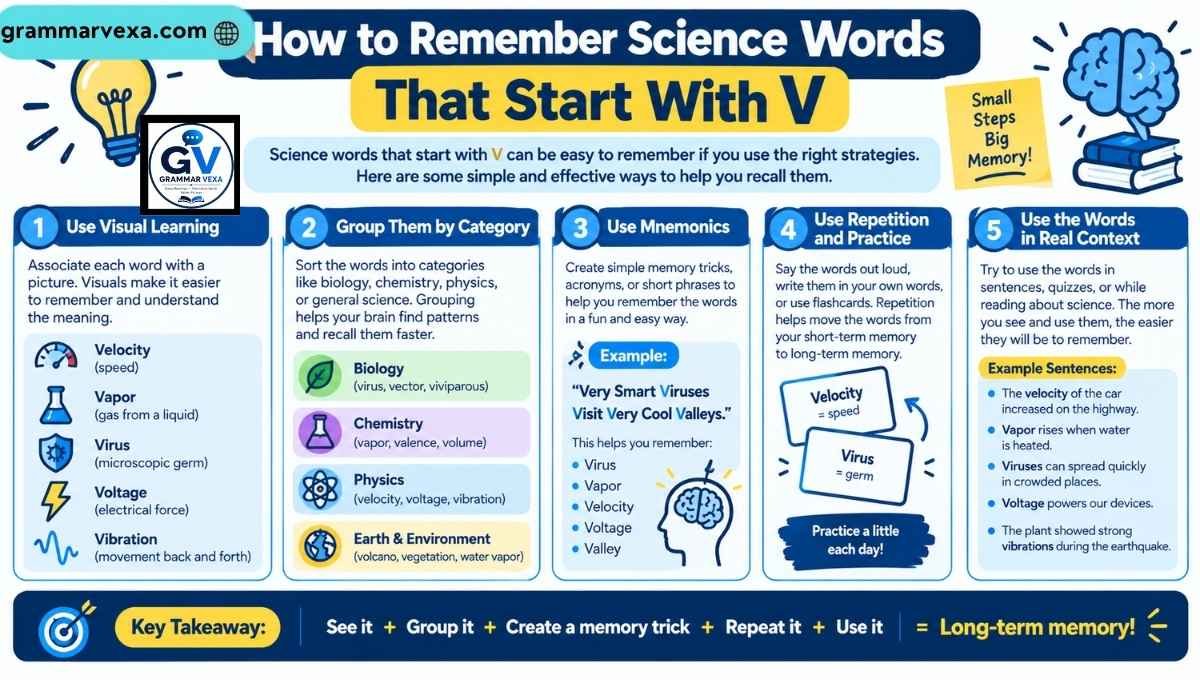
Memorizing a long vocabulary list can feel like trying to drink from a fire hose. A better strategy is to organize related concepts.
Group Terms by Scientific Field
Start with small clusters:
Physics: velocity, vector, voltage, vibration, vacuum, volume
Chemistry: valence, valence electron, vaporization, vapor pressure, volatile
Biology: virus, vaccine, vertebrate, vesicle, vacuole
Earth science: volcano, volcanic, volcanology, vegetation, vadose zone
Astronomy: Venus, Vesta, variable star, cosmic void
Grouping terms gives your memory a framework.
Connect Each Word to a Real Example
Abstract definitions become easier when attached to something familiar.
- Velocity: a car traveling east
- Viscosity: honey flowing slowly
- Voltage: a battery powering a circuit
- Vibration: a guitar string moving
- Vaporization: water becoming steam
- Virus: an infectious agent replicating inside host cells
- Vertebrate: a dog with a spinal column
- Volcano: lava emerging from a volcanic vent
The goal isn’t just memorization. It’s conceptual association.
Learn Related Terms Together
Pairing related concepts can prevent common mistakes.
For example:
velocity ↔ speed
vector ↔ scalar
evaporation ↔ boiling
vasodilation ↔ vasoconstriction
virus ↔ virion
These pairs turn isolated vocabulary into connected scientific concepts.
Common Mistakes When Learning V Science Terms
Confusing Velocity With Speed
Speed doesn’t include direction. Velocity does.
A car traveling 50 km/h doesn’t have a complete velocity description until its direction is specified.
Treating a Virus Like a Cell
Viruses aren’t simply tiny cells.
They have fundamentally different biological organization and depend on host cells for replication.
Confusing Valence With Valence Electrons
Valence describes bonding capacity or combining behavior. Valence electrons are electrons associated with an atom’s outer shell that participate in chemical interactions.
The concepts are connected, but they aren’t interchangeable.
Using Viscosity and Density as Synonyms
Viscosity describes resistance to flow.
Density describes mass per unit volume.
A dense liquid isn’t necessarily highly viscous. These properties measure different things.
Confusing Vaporization With Evaporation
Evaporation is one mechanism of vaporization.
Vaporization is the broader category.
Best Practices for Learning Scientific Vocabulary
A strong approach to scientific literacy involves more than knowing dictionary definitions.
Use the Definition in Context
Instead of memorizing:
“Viscosity means resistance to flow.”
Connect it to a situation:
“Honey has greater viscosity than water, so it flows more slowly under comparable conditions.”
The second version gives your brain something concrete to remember.
Learn the Measurement or Unit
Units make scientific vocabulary more precise.
For example:
- Velocity → m/s
- Volume → m³
- Dynamic viscosity → Pa·s
- Voltage → V
NIST provides standardized information on SI quantities and units used across science and engineering.
Ask What the Term Explains
A useful question is:
“What scientific problem does this word help describe?”
Velocity describes motion.
Voltage describes electrical potential difference.
Valence helps describe chemical bonding.
Virulence describes pathogen-related disease-causing capacity.
This approach turns academic vocabulary into working knowledge.
Key Takeaways About Science Words That Start With V
The letter V contains an unusually broad collection of science words. Some are everyday terms, while others belong to specialized research fields.
The most useful terms to remember include:
- Velocity — motion with direction
- Volume — three-dimensional space
- Vibration — repeated motion
- Voltage — electrical potential difference
- Vacuum — extremely low-pressure region
- Viscosity — resistance to fluid flow
- Vector — magnitude plus direction
- Valence — chemical combining capacity
- Vaporization — liquid-to-gas transition
- Virus — infectious biological entity
- Vaccine — preparation that trains immune defenses
- Vertebrate — animal with a vertebral column
- Volcano — geological feature associated with eruptions
- Variable star — star whose observed brightness changes
Together, these science words beginning with V demonstrate how scientific terminology connects different disciplines. Physics describes motion and energy. Chemistry explains atoms and molecular interactions. Biology examines life and disease. Earth science investigates geological processes, while astronomy studies objects and structures beyond Earth.
That interconnectedness is what makes scientific vocabulary so useful. Once you understand the terms, scientific explanations become easier to read, discuss, and apply.
FAQs About Science Words That Start With V
What are some common science words that start with V?
Common examples include velocity, volume, vibration, voltage, vacuum, viscosity, vector, valence, vaporization, virus, vaccine, and vertebrate.
What is the most important V word in physics?
There isn’t one universally “most important” V term. Velocity, voltage, volume, viscosity, vibration, and vector each describe different physical concepts and appear in different areas of physics.
What science words starting with V are related to biology?
Important biology terms include virus, vaccine, virion, virology, vertebrate, vesicle, vacuole, vasodilation, and vegetative reproduction.
What is the difference between velocity and speed?
Speed measures how fast something moves. Velocity measures how fast it moves and includes direction.
What is the difference between valence and valence electrons?
Valence describes an atom’s bonding capacity or combining behavior. Valence electrons are outer-shell electrons that can participate in chemical interactions.
What is the difference between evaporation and vaporization?
Vaporization is the general change from liquid to gas. Evaporation is surface vaporization that can occur below a liquid’s boiling point.
What are some chemistry words that start with V?
Chemistry includes valence, valence electron, vaporization, vapor pressure, volatile, viscosity, and van der Waals forces.
What are some Earth science words that start with V?
Examples include volcano, volcanic, volcanology, vegetation, vernalization, and vadose zone.
What are some astronomy words that start with V?
Astronomy includes Venus, Vesta, variable star, and cosmic void. Each term represents a different astronomical object or concept.
Why is scientific vocabulary important for students?
Scientific vocabulary gives students precise language for describing scientific principles, observations, processes, and relationships. A strong vocabulary also makes textbooks, research papers, laboratory instructions, and scientific discussions easier to understand.
Conclusion
Science Words That Start With V: Vital Scientific Vocabulary covers useful terms from physics, chemistry, biology, medicine, Earth science, and astronomy. Words like velocity, voltage, viscosity, valence, virus, vaccine, vector, and vertebrate describe important scientific ideas. Understanding their meanings makes complex topics easier to read and discuss.
Science Words That Start With V: Vital Scientific Vocabulary also shows how scientific vocabulary connects related concepts. Learning terms in groups can improve your understanding and memory. Use simple examples to connect each word with a real process, object, or observation. With regular practice, these science terms can strengthen your vocabulary and support clearer scientific thinking.

Jessica Morgan is an English language writer and researcher at Grammar Vexa. I enjoy exploring slang, vocabulary, word meanings, synonyms, and alternative phrases. Through my work, I aim to make English easier to understand by providing clear explanations, useful examples, and practical language tips.






1 thought on “Science Words That Start With V: Vital Scientific Vocabulary”