Science becomes easier to understand when you know the language behind it. This guide to science words that start with R brings together important terms from physics, chemistry, biology, Earth science, environmental science, astronomy, medicine, and technology. Instead of presenting random definitions, it explains how these terms work and where you may encounter them.
From radiation and refraction to DNA replication, cellular respiration, renewable energy, and relativity, R introduces some of science’s most useful concepts. Some describe invisible forces. Others explain processes inside living cells or changes across planets and ecosystems. A few help scientists investigate objects billions of miles away.
Whether you’re building science vocabulary, studying for an exam, writing a research assignment, or simply curious about the natural world, these scientific terms provide a useful starting point. The sections below organize the most important science words beginning with R by scientific discipline and connect each term with practical examples.
Science Words That Start With R: Quick Reference List
The letter R appears throughout almost every major scientific discipline. The table below gives you a quick way to understand the most useful science words starting with R before exploring them in greater depth.
| R Science Word | Field | Simple Meaning |
|---|---|---|
| Radiation | Physics, medicine, astronomy | Energy that travels as waves or particles |
| Radioactivity | Physics, chemistry | Spontaneous decay of unstable atomic nuclei |
| Reaction | Chemistry, biology | A process in which substances or molecules change |
| Reactant | Chemistry | A starting substance in a chemical reaction |
| Refraction | Physics, optics | Bending of a wave as it enters a different medium |
| Reflection | Physics | Bouncing of a wave from a surface |
| Resistance | Physics | Opposition to electric current |
| Relativity | Physics | Einstein’s theories describing space, time, motion, and gravity |
| Resonance | Physics | Strong response when a system is driven near a natural frequency |
| Replication | Biology, genetics | Copying genetic material |
| Respiration | Biology | Cellular processes that release usable energy |
| Reproduction | Biology | Biological production of new organisms |
| Regulation | Biology | Control of biological processes |
| Receptor | Biology, medicine | Molecule or structure that detects a signal |
| RNA | Molecular biology | Nucleic acid involved in gene expression and regulation |
| Radiocarbon Dating | Earth science, archaeology | Dating method based on carbon-14 decay |
| Renewable Energy | Environmental science | Energy from naturally replenished sources |
| Runoff | Environmental science | Water flowing across land |
| Remote Sensing | Earth science | Gathering information about Earth without direct contact |
| Regolith | Planetary science | Loose rock and dust covering a planetary surface |
| Redshift | Astronomy | Shift of light toward longer wavelengths |
| Retrograde Motion | Astronomy | Apparent backward motion of an astronomical object |
This range shows why R words in science are so useful. They describe everything from microscopic molecular activity to cosmic levels of the universe.
R Words in Physics
Physics contains some of the most recognizable scientific words that start with R. Many describe energy, waves, matter, electricity, and the structure of space and time.
Radiation
Radiation is energy transmitted through space or matter. It can travel as electromagnetic waves or as moving particles.
Electromagnetic radiation includes radio waves, microwaves, infrared radiation, visible light, ultraviolet radiation, X-rays, and gamma rays. Particle radiation includes forms such as alpha particles, beta particles, and neutrons.
Radiation isn’t automatically harmful. Visible light and radio signals are forms of radiation that people use every day. The biological effects depend heavily on the type of radiation, its energy, exposure, and dose.
Radiation also plays an important role in medical imaging technologies, cancer treatments, astronomy, communications, and nuclear science. The International Atomic Energy Agency emphasizes the importance of controlling medical radiation exposure while preserving the diagnostic or therapeutic benefit.
Refraction
Refraction occurs when a wave changes direction because its speed changes as it enters a different medium.
Light provides the classic example. When light passes from air into glass or water, its speed changes. This change can alter its direction.
Refraction explains several familiar optical phenomena:
- Eyeglasses focusing light
- Magnifying glasses enlarging objects
- Microscopes producing magnified images
- Telescopes collecting and focusing distant light
- Light appearing bent inside water
- Lenses forming images
The amount of bending depends on the properties of the materials and the angle at which the wave enters them.
Reflection
Reflection happens when a wave encounters a surface and returns into the original medium.
A mirror provides the easiest example. Light strikes the mirror and reflects toward your eyes, allowing you to see an image.
Reflection and refraction often occur together. A glass surface, for example, can reflect some incoming light while allowing the rest to pass through and refract.
Understanding both concepts forms a foundation for optics, photography, imaging, microscopy, and telescope design.
Resistance
Electrical resistance describes how strongly a material opposes electric current.
In a simple circuit, resistance influences how much current flows for a given voltage. Engineers measure resistance in ohms, represented by the symbol Ω.
A component called a resistor deliberately provides resistance. Engineers use resistors to control current, divide voltage, protect components, and shape signals in electrical circuits.
Resistance depends on factors such as:
- Material
- Length
- Cross-sectional area
- Temperature
This makes resistance more than a classroom formula. It is an important property behind countless electrical devices.
Resonance
Resonance occurs when a system responds strongly to periodic driving near one of its natural frequencies.
Think about pushing a swing. If each push arrives at the right point in the swing’s motion, the movement becomes larger. That simple example captures the basic idea of resonance.
Engineers use resonance in areas such as:
- Musical instruments
- Radio systems
- Sensors
- Mechanical systems
- Electrical circuits
- Magnetic resonance technologies
However, resonance can also create unwanted vibrations. Engineers therefore study it carefully when designing bridges, buildings, machines, and aircraft.
Relativity
Relativity refers primarily to Albert Einstein’s special and general theories of relativity.
Special relativity describes physics when objects move at constant velocity relative to one another and establishes the importance of the speed of light. General relativity extends the framework to gravity, describing gravity through the geometry of spacetime.
Relativity changed the scientific understanding of space, time, motion, energy, and gravity. It also has practical relevance. Modern satellite navigation systems must account for relativistic effects when calculating precise timing.
Einstein’s theories remain central to modern physics and astronomical research. NASA’s educational material also describes relativistic effects involving gravity, light, and spacecraft trajectories.
Radius
A radius is the distance from the center of a circle or sphere to its edge.
The concept becomes especially useful in astronomy. Scientists describe the sizes of planets, stars, and other roughly spherical objects using their radii.
Radius also appears in equations involving:
- Circular motion
- Orbital mechanics
- Rotational motion
- Geometry
- Gravitational systems
A planet’s radius, for example, helps scientists calculate quantities such as surface area and volume.
R Words in Chemistry
Chemistry provides another rich collection of science vocabulary words starting with R. These terms often describe transformations of matter, molecular interactions, and changes in energy.
Chemical Reaction
A chemical reaction transforms one set of substances into another. The starting substances are called reactants, while the resulting substances are products.
During a reaction, atoms are rearranged. Chemical bonds may break and new bonds may form.
Common types include:
- Synthesis
- Decomposition
- Combustion
- Acid-base reactions
- Redox reactions
For example, combustion involves rapid chemical reactions between fuel and an oxidizing agent, commonly oxygen.
Chemical reactions can produce or absorb energy changes. Depending on the process, energy may appear as heat, light, electrical energy, or other forms.
Reactant
A reactant is a substance present at the beginning of a chemical reaction.
Consider a simple reaction between hydrogen and oxygen:
2H₂ + O₂ → 2H₂O
Hydrogen and oxygen are the reactants. Water is the product.
Knowing the difference between reactants and products makes chemical equations much easier to read.
Redox Reaction
A redox reaction combines two linked processes: oxidation and reduction.
Oxidation involves the loss of electrons, while reduction involves the gain of electrons. Because electrons move between chemical species, both processes occur together.
Redox chemistry supports many important systems, including:
- Batteries
- Cellular respiration
- Corrosion
- Metal processing
- Fuel cells
- Industrial chemistry
The biological importance is particularly striking. Cellular energy production relies heavily on electron-transfer reactions. OpenStax identifies the electron transport chain as a sequence involving redox reactions that helps drive ATP production.
Reduction
Reduction means gain of electrons in the standard redox framework.
A useful memory aid is OIL RIG:
- Oxidation Is Loss
- Reduction Is Gain
The “gain” refers to electrons.
Reduction doesn’t mean that a substance physically becomes smaller. It describes a change in electron balance or oxidation state.
Radioactivity
Radioactivity describes the spontaneous transformation of unstable atomic nuclei.
During radioactive decay, a nucleus can emit radiation. Different decay processes include alpha decay, beta decay, and gamma emission.
Radioactivity has important applications in:
- Medical treatment
- Medical imaging
- Industrial inspection
- Scientific research
- Nuclear energy
- Dating geological and archaeological materials
The key distinction is simple: radioactivity is a property or process involving unstable nuclei, while radiation is the energy or particles emitted or transferred.
Reaction Rates
The rate of a chemical reaction describes how quickly reactants are converted into products.
Several factors can affect reaction rates:
- Temperature
- Concentration
- Surface area
- Pressure for certain gaseous systems
- Catalysts
- Chemical properties of the reactants
A catalyst can speed up a reaction by providing a different pathway with lower activation energy. It isn’t simply “extra energy added to the reaction.”
R Words in Biology
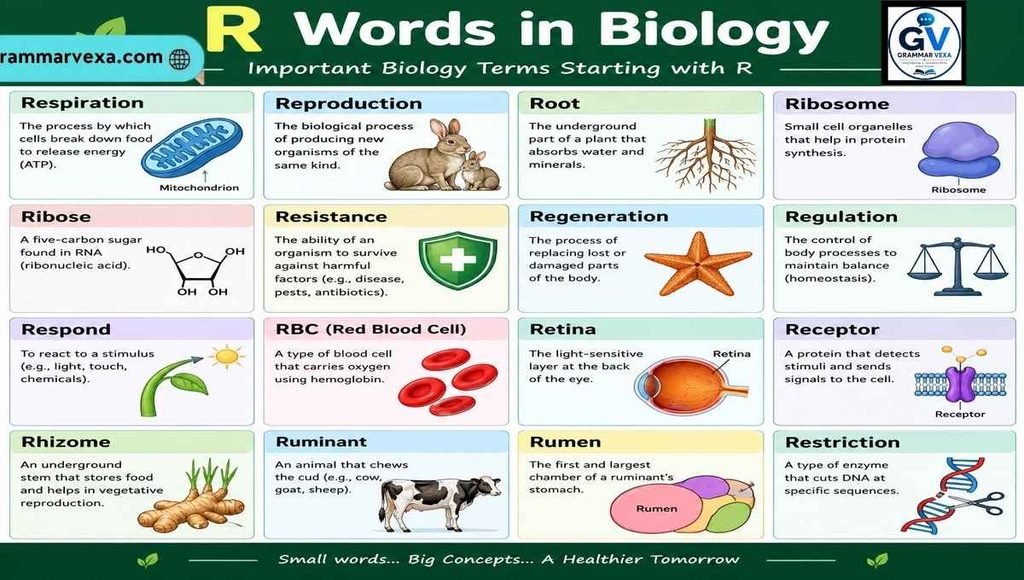
Biology contains some of the most important biology words that start with R. These terms help explain how cells reproduce, communicate, obtain energy, and maintain internal balance.
Respiration
Cellular respiration is a set of biochemical processes that allows cells to extract usable energy from nutrients.
In aerobic respiration, cells use oxygen as the final electron acceptor in the electron transport chain. Glycolysis breaks glucose into smaller molecules. The resulting products can enter the Krebs cycle and oxidative phosphorylation.
A simplified pathway is:
Glucose → Glycolysis → Krebs Cycle → Electron Transport Chain → ATP
ATP serves as a major energy currency for cellular work.
Importantly, respiration isn’t simply another word for breathing. Breathing moves gases into and out of an organism. Cellular respiration describes biochemical reactions that transfer energy.
OpenStax explains that much of the ATP generated during aerobic glucose metabolism comes through oxidative phosphorylation rather than directly from glycolysis or the Krebs cycle.
Replication
DNA replication is the process by which DNA is copied before cell division.
The double-stranded DNA molecule separates, and each original strand serves as a template for a new complementary strand.
Important molecular players include:
- Helicase, which helps separate DNA strands
- DNA polymerase, which synthesizes new DNA
- Primers, which provide starting points for synthesis
- Other proteins that stabilize and process the replication machinery
Accurate replication preserves genetic information from one generation of cells to the next. Errors can occasionally occur, producing mutations.
Replication also forms the conceptual foundation for laboratory techniques such as PCR.
RNA
RNA is a nucleic acid with many roles in molecular biology.
Messenger RNA can carry information copied from DNA to cellular machinery involved in protein production. Transfer RNA helps bring amino acids into the protein-building process, while ribosomal RNA forms a major structural and functional component of ribosomes.
RNA can also regulate gene activity and participate directly in molecular processes.
The relationship among DNA, RNA, and proteins is central to modern molecular biology. NCBI’s Molecular Biology of the Cell explains that transcription produces RNA using a DNA strand as a template.
Reproduction
Reproduction is the biological process through which organisms produce new individuals.
Two broad forms are:
- Asexual reproduction, involving reproduction without the fusion of gametes
- Sexual reproduction, involving genetic contributions from reproductive cells
Reproduction is fundamental to the persistence of populations and species.
Sexual reproduction can increase genetic variation, which provides populations with different combinations of inherited traits. Such variation can influence how populations respond to environmental pressures and contributes to evolutionary processes such as natural selection.
Regulation
Biological regulation controls the timing and intensity of cellular and physiological processes.
For example, cells regulate metabolic pathways rather than producing maximum amounts of every molecule continuously.
Cellular respiration provides a useful example. When ATP levels are already high, several metabolic pathways can slow down. When cellular energy demand increases, pathway activity can rise.
OpenStax describes this type of metabolic regulation through changes involving ATP, ADP, enzymes, and feedback mechanisms.
Receptor
A receptor is a molecule or cellular structure that detects a particular signal.
Receptors can respond to:
- Hormones
- Neurotransmitters
- Growth factors
- Sensory stimuli
- Chemical messengers
For example, receptors on or inside cells allow biological systems to respond to signals from their surroundings.
Receptors are therefore central to the nervous system, endocrine signaling, immune responses, and many medical treatments.
Ribosome
A ribosome is a molecular machine that helps build proteins.
Ribosomes read information carried by messenger RNA and coordinate the addition of amino acids to a growing protein chain.
Because proteins perform structural, catalytic, transport, and signaling functions, ribosomes sit near the center of cellular activity.
Genetics and Molecular Biology: R Terms With Real Applications
Some of the most powerful R science words become clearer when connected to biotechnology.
PCR and Polymerase Chain Reaction
Polymerase chain reaction, or PCR, is a laboratory method used to amplify a selected DNA sequence.
A basic PCR cycle contains three major stages:
- Denaturation separates the DNA strands.
- Annealing allows primers to bind target sequences.
- Extension allows DNA polymerase to synthesize new DNA.
Repeated cycles can produce enormous numbers of copies of a target sequence.
PCR is widely used in molecular biology, research, diagnostics, genetic testing, forensics, and biotechnology. NCBI describes PCR as a method for producing large amounts of specific DNA or RNA fragments from small starting quantities.
A useful conceptual connection is:
Replication → DNA polymerase → PCR → biotechnology
PCR doesn’t reproduce an entire organism. Instead, it repeatedly copies a selected nucleic-acid region in a controlled laboratory reaction.
DNA Replication vs. PCR
| Feature | DNA Replication | PCR |
|---|---|---|
| Location | Living cells | Laboratory |
| Purpose | Copy cellular DNA | Amplify selected DNA |
| Main enzyme | DNA polymerases | Thermostable DNA polymerase |
| Template | Cellular DNA | Target DNA sample |
| Control | Cellular machinery | Laboratory conditions |
| Result | Complete genome replication | Target sequence amplification |
This distinction prevents a common mistake: treating PCR as simply “DNA replication outside the body.” PCR borrows the basic copying principle but uses a highly controlled artificial system.
R Words in Earth and Environmental Science
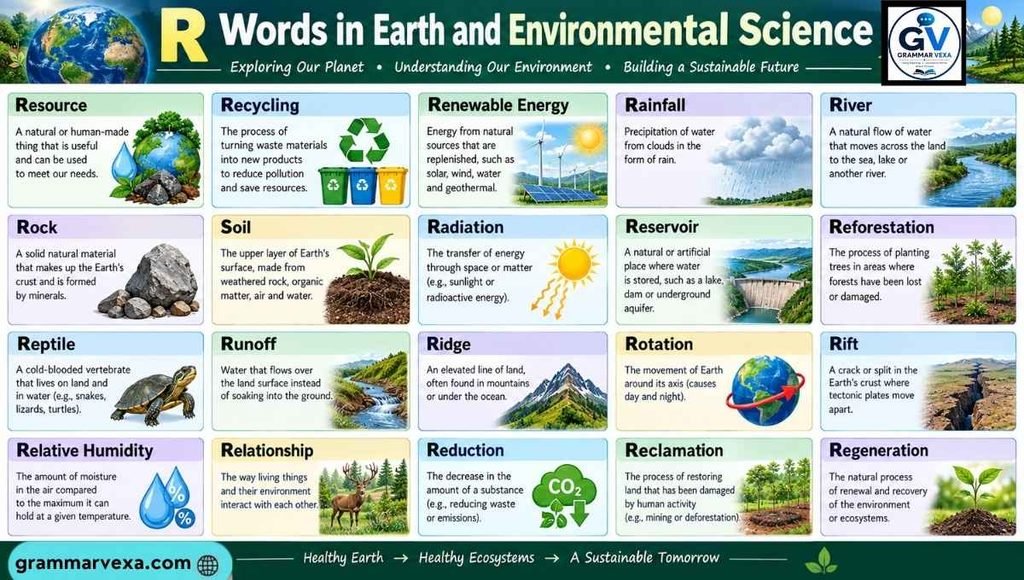
The natural world provides another major group of environmental science words that start with R.
Radiocarbon Dating
Radiocarbon dating estimates the age of once-living material using radioactive carbon-14.
Carbon-14 forms naturally in Earth’s atmosphere and becomes incorporated into living organisms. While an organism remains alive, carbon cycles through its tissues. After death, carbon-14 gradually decreases through radioactive decay.
Carbon-14 has a half-life of about 5,730 years.
Scientists can use measurements of remaining carbon-14 to estimate when suitable organic material stopped exchanging carbon with its environment.
Radiocarbon dating is especially useful in:
- Archaeology
- Geology
- Paleoclimate research
- Dating organic materials
- Studying past environments
It isn’t a universal dating method. Its usefulness depends on the age and type of material being examined and on appropriate calibration and contamination controls.
Renewable Energy
Renewable energy comes from sources that are naturally replenished.
Common examples include:
- Solar energy
- Wind energy
- Hydroelectric power
- Geothermal energy
- Biomass
- Marine energy in some classifications
The U.S. Department of Energy defines renewable energy around naturally replenished resources such as sunlight, wind, water, biomass, and geothermal sources.
Each technology works differently.
Solar power converts sunlight into useful energy. Photovoltaic cells convert light directly into electricity.
Wind power uses moving air to turn turbine blades. The turbine’s mechanical motion drives an electrical generator.
Hydroelectric power uses moving water and elevation differences to turn turbines and generate electricity. In 2024, hydropower accounted for about 27% of U.S. utility-scale renewable electricity generation, according to the U.S. Department of Energy.
Renewable energy therefore connects physics, engineering, environmental science, economics, and infrastructure.
Runoff
The Runoff is water that flows over the land surface after precipitation or other water inputs.
Runoff plays an important role in:
- River formation
- Flooding
- Soil erosion
- Nutrient transport
- Sediment movement
- Water pollution
- Watershed processes
Heavy runoff can carry fertilizers, sediment, oils, and other pollutants into streams and lakes.
Understanding runoff helps scientists study ecosystems, water quality, and environmental systems.
Remote Sensing
Remote sensing gathers information about an object or environment without physically touching it.
Satellites provide one of the best examples. Sensors can measure reflected or emitted electromagnetic radiation to study Earth’s surface and atmosphere.
Applications include:
- Weather monitoring
- Agricultural mapping
- Forest monitoring
- Glacier observation
- Urban growth
- Disaster assessment
- Climate research
Remote sensing combines physics, computer science, geography, atmospheric science, and Earth observation technology.
R Words in Astronomy and Space Science
Some of the most fascinating space science words that start with R describe planets, distant galaxies, and extraterrestrial surfaces.
Redshift
Redshift refers to a shift toward longer wavelengths in light or spectral lines.
In astronomy, redshift can arise from several causes. NASA explains that cosmological redshift occurs because expanding space stretches the wavelengths of light traveling through the universe.
Astronomers use redshift to study:
- Galaxy motion
- Cosmic expansion
- Distant galaxies
- Large-scale structure
- The history of the universe
The idea is especially powerful because distant astronomical observations also look back in time. Light from a remote galaxy may have traveled for billions of years before reaching a telescope.
Regolith
Regolith is loose, fragmented material covering a solid planetary surface.
The Moon’s regolith consists of broken rock fragments, dust, impact material, and other particles created largely by meteorite impacts and bombardment by charged particles.
NASA notes that lunar regolith differs significantly from Earth’s soil. Lunar particles can remain sharp because the Moon lacks the wind and flowing water that weather Earth’s surface materials.
Regolith matters for space exploration because it can affect:
- Spacesuits
- Landing systems
- Robots
- Scientific instruments
- Surface construction
- Dust-control technologies
NASA’s Artemis-related research also examines ways to manage lunar dust and regolith during future exploration.
Retrograde Motion
Retrograde motion describes apparent backward movement against the background stars.
The effect becomes especially interesting when observed from Earth because planets move around the Sun at different speeds and orbital distances.
When Earth overtakes an outer planet in its orbit, that planet can appear to move backward temporarily against distant stars. The planet hasn’t literally reversed its orbital direction.
This is an excellent example of why scientific observations must be interpreted within a physical model.
Radiation in Space
Astronomers rely heavily on radiation to study the universe.
Stars, galaxies, planets, nebulae, and other objects emit, absorb, or reflect electromagnetic radiation. Different wavelengths reveal different physical processes.
Visible light can reveal stars and structures. Infrared observations can reveal cooler objects and distant galaxies. X-rays can reveal extremely energetic environments.
Telescopes are therefore more than magnifying glasses. They are sophisticated instruments for collecting and analyzing radiation.
Important R Science Terms That Are Often Confused
Science terminology can become confusing when two related terms sound interchangeable. These distinctions make scientific vocabulary much easier to use correctly.
Radiation vs. Radioactivity
Radiation refers broadly to energy or particles traveling through space or matter.
Radioactivity refers specifically to spontaneous nuclear transformations involving unstable nuclei.
A radioactive material can emit radiation. The two terms describe related but different ideas.
Reaction vs. Reactant
A reaction is the process in which substances undergo chemical transformation.
A reactant is one of the starting substances involved in that process.
In simple terms:
Reaction = what happens
Reactant = what starts the chemical change
Reflection vs. Refraction
Reflection sends a wave back from a surface.
Refraction changes the direction of a wave as it moves into another medium.
A window can demonstrate both at once. Some light reflects from its surface while some enters the glass and refracts.
Respiration vs. Breathing
Breathing involves the physical movement of air and gases.
Cellular respiration involves biochemical reactions that transfer energy from nutrients into forms the cell can use.
They are connected, but they’re not synonyms.
Rotation vs. Revolution
Rotation means spinning around an internal axis.
Revolution means orbital movement around another object or point.
Earth rotates once approximately every 24 hours and revolves around the Sun once approximately every year.
How R Science Words Connect Across Disciplines
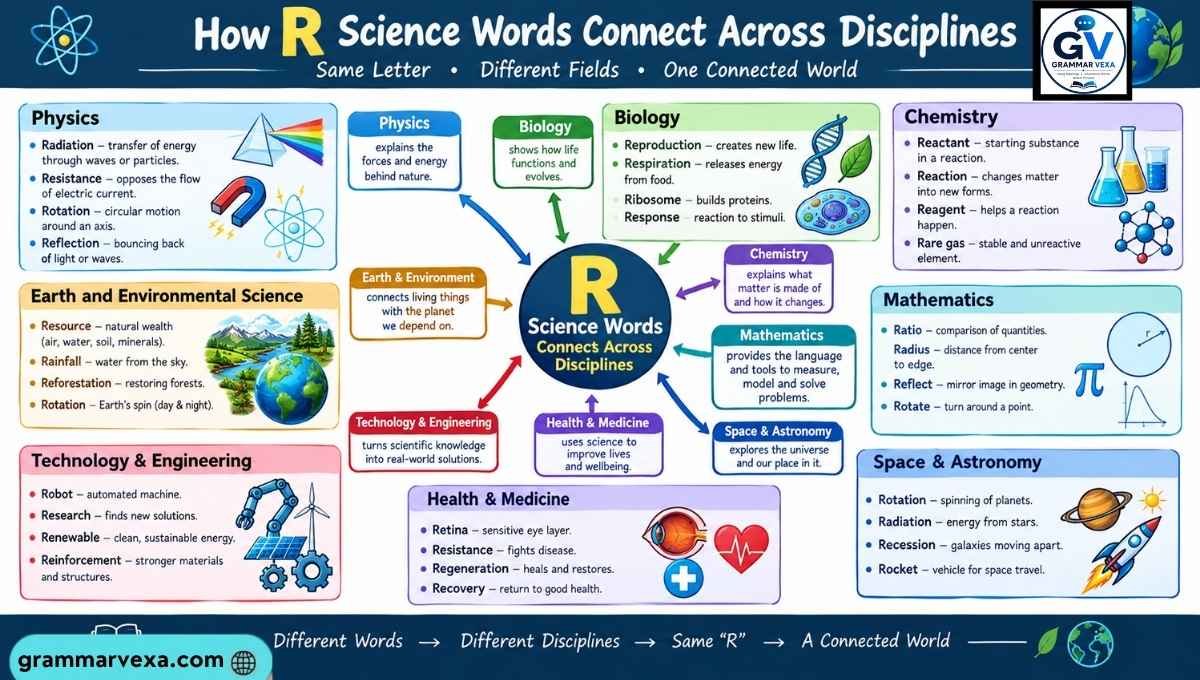
The most interesting feature of science words that start with R is how many connect different scientific fields.
Radiation Connects Physics, Medicine, and Astronomy
Physics explains how radiation behaves. Medicine uses radiation for imaging and treatment. Astronomy uses radiation to investigate distant objects.
One concept therefore travels from the laboratory to the hospital and then into deep space.
Reactions Connect Chemistry and Biology
Chemical reactions don’t stop at the chemistry classroom.
Cells depend on thousands of chemical reactions. Metabolism, DNA synthesis, protein production, and energy generation all rely on carefully controlled biochemical processes.
Renewable Energy Connects Physics and Environmental Science
Renewable energy systems depend on physical principles involving energy conversion.
Environmental science then examines their effects on ecosystems, emissions, resources, and sustainability.
Engineering turns those principles into working technologies.
Remote Sensing Connects Technology and Earth Science
Remote sensing combines electromagnetic physics with sensors, satellites, data analysis, and environmental research.
Scientists can therefore study huge areas without physically visiting every location.
Real-World Examples of R Science Terms
These examples show how the vocabulary appears outside textbooks.
| Real-World Situation | R Science Term | Scientific Connection |
|---|---|---|
| Eyeglasses focus light | Refraction | Optics and lenses |
| MRI-related physics | Resonance | Electromagnetic interactions |
| Phone electronics | Resistance | Electrical circuits |
| Nuclear medicine | Radiation | Medical physics |
| Battery operation | Redox reaction | Electron transfer |
| Digestion and metabolism | Reaction | Biochemistry |
| Cell division | Replication | Genetics |
| Muscle energy production | Respiration | ATP metabolism |
| Genetic testing | PCR | Molecular biology |
| Archaeological dating | Radiocarbon dating | Carbon-14 decay |
| Solar panels | Renewable energy | Energy conversion |
| Moon missions | Regolith | Planetary science |
| Galaxy observations | Redshift | Cosmology |
| Planetary observation | Retrograde motion | Orbital mechanics |
A Practical Way to Learn Science Words Starting With R
Memorizing a long vocabulary list can become tedious. A better approach is to organize terms around relationships.
Group Terms by Scientific Field
Start with five groups:
- Physics
- Chemistry
- Biology
- Earth and environmental science
- Astronomy
This gives every term a conceptual home.
Connect Related Terms
Instead of memorizing replication alone, connect it with:
DNA → helicase → DNA polymerase → replication → genetic information
For respiration:
Glucose → glycolysis → Krebs cycle → electron transport chain → ATP
For astronomy:
Light → wavelength → redshift → expanding universe
Connections make technical vocabulary easier to recall.
Use Real-World Examples
A term becomes more memorable when you associate it with something visible.
For example:
- Refraction → eyeglasses
- Resistance → electronic circuits
- Radiation → medical imaging
- PCR → genetic testing
- Runoff → rainwater flowing into streams
- Regolith → Moon’s dusty surface
- Redshift → distant galaxies
Common Mistakes When Learning R Science Vocabulary
Treating Related Terms as Identical
Scientific terms often overlap without having identical meanings.
Radiation and radioactivity provide a classic example. So do respiration and breathing.
Learning Definitions Without Context
A dictionary-style definition tells you what a term means. An example shows you how scientists actually use it.
That second layer is essential.
Mixing Scientific Fields
Some words appear in multiple disciplines. Reaction, for example, can describe chemical reactions or broader biological processes.
Always check the scientific context.
Assuming Everyday Meanings Match Scientific Meanings
Words such as “energy,” “work,” “resistance,” and “reaction” have everyday meanings that can differ from their technical definitions.
Scientific language becomes clearer when you pay attention to the formal context.
Key Takeaways About Science Words That Start With R
The world of science words that start with R stretches from the microscopic scale to the largest structures in the universe.
The most important terms include radiation, reaction, refraction, replication, respiration, resistance, radiocarbon dating, reproduction, regulation, renewable energy, relativity, RNA, regolith, and retrograde motion.
These terms aren’t isolated vocabulary items. They form connected networks of scientific ideas.
For example, DNA replication connects genetics with biotechnology. Cellular respiration links chemistry with biology. Radiation connects physics with medicine and astronomy. Renewable energy brings physics, engineering, and environmental science together. Redshift provides astronomers with evidence about the expanding universe, while regolith helps scientists understand planetary surfaces and plan future exploration.
Learning these scientific terms beginning with R becomes much easier when each word is connected to a process, example, or real-world application.
FAQs
What are some common science words that start with R?
Common examples include radiation, reaction, refraction, resistance, respiration, replication, reproduction, regulation, relativity, RNA, renewable energy, and radiocarbon dating.
Which physics words start with R?
Important physics terms include radiation, refraction, reflection, resistance, resonance, relativity, radius, and rotation.
What chemistry words start with R?
Useful chemistry terms include reaction, reactant, redox reaction, reduction, radioactivity, and reaction rate.
Which biology words begin with R?
Important biology examples include replication, respiration, reproduction, regulation, receptor, ribosome, and RNA.
What are some environmental science words that start with R?
Examples include renewable energy, runoff, resource, remote sensing, and radiocarbon dating.
What are some Earth science words beginning with R?
Earth science includes terms such as rock cycle, runoff, radiocarbon dating, remote sensing, and regolith.
Which space science terms start with R?
Astronomy includes radiation, redshift, regolith, relativity, radius, and retrograde motion.
What is the difference between radiation and radioactivity?
Radiation refers to energy or particles traveling through space or matter. Radioactivity refers to spontaneous nuclear decay that can produce radiation.
What is the difference between reflection and refraction?
Reflection occurs when a wave bounces from a surface. Refraction occurs when a wave changes direction because its speed changes as it enters another medium.
What is the difference between rotation and revolution?
Rotation is an object’s spin around its own axis. Revolution is movement around another object or point.
Why is radiocarbon dating useful?
Radiocarbon dating uses the radioactive decay of carbon-14 to estimate the age of suitable organic materials. Carbon-14 has a half-life of about 5,730 years.
Why is PCR important in modern science?
PCR allows researchers to amplify specific DNA sequences from small starting samples. It supports research, biotechnology, genetic analysis, diagnostics, and forensic applications.
What is regolith?
Regolith is loose, fragmented material covering a planetary surface. Lunar regolith consists largely of fragmented rock and dust created through impacts and particle bombardment.
Final Thoughts
Learning science words that start with R gives you access to a surprisingly broad collection of scientific ideas. The letter connects fundamental concepts such as radiation, reaction, resistance, replication, respiration, and reproduction with advanced ideas such as relativity, redshift, regolith, and remote sensing.
The most useful approach isn’t memorizing definitions in isolation. Instead, connect each term with its scientific field, process, example, and practical application. When RNA connects to genetic information, respiration connects to ATP, refraction connects to lenses, and redshift connects to an expanding universe, the vocabulary becomes much easier to understand and remember.
These science words beginning with R also reveal how closely scientific disciplines interact. Chemistry explains reactions. Biology uses those reactions to sustain living organisms. Physics explains energy and radiation. Earth science studies natural processes. Astronomy uses light and radiation to investigate distant worlds.
That interconnectedness is what makes R science words more than a vocabulary list. They form a map of how modern science describes the natural world.

Jessica Morgan is an English language writer and researcher at Grammar Vexa. I enjoy exploring slang, vocabulary, word meanings, synonyms, and alternative phrases. Through my work, I aim to make English easier to understand by providing clear explanations, useful examples, and practical language tips.