TSTS Meaning in Text Explained: Definition, Uses & Examples refers to understanding the possible meanings, uses, and context of the abbreviation “TSTS” in digital conversations. One documented modern slang use is “type shit, type shit,” which can express agreement or a shared attitude. In other contexts, lowercase “tsts” may imitate “tsk-tsk,” signaling mild disapproval or playful teasing. The intended meaning depends on the conversation.
A tiny four-letter expression can carry very different signals. That’s what makes TSTS interesting. The surrounding words, emojis, punctuation, relationship between speakers, and conversation topic can completely change how the message sounds. Recognizing these clues helps prevent awkward replies and unnecessary misunderstandings.
Understanding TSTS Meaning in Text Explained: Definition, Uses & Examples goes beyond memorizing an abbreviation. You’ll see how TSTS works in texting, social media, Snapchat, TikTok, and casual chats. Real examples also show how to identify the intended meaning, choose an appropriate response, and avoid using ambiguous slang when clear communication matters.
What Does TSTS Mean in Text?
TSTS meaning in text depends heavily on the context in which someone uses it.
A current slang interpretation is “type shit, type shit.” In informal online conversation, this can work as an emphatic reaction. It may communicate something like “exactly,” “that kind of thing,” “I agree,” or “same vibe.” The expression is highly casual and contains profanity in its expanded form.
However, lowercase “tsts” can also represent a sound similar to “tsk-tsk.” English dictionaries define tsk-tsk as a written representation of a tongue sound used to express disapproval. Merriam-Webster defines tsk-tsk as expressing disapproval, while Oxford describes it as a written representation of a tongue sound used when someone disapproves of something.
So, there are two important patterns to recognize:
| TSTS form | Possible meaning | Typical tone |
|---|---|---|
| TSTS | “Type shit, type shit” | Agreement, approval, shared attitude |
| tsts | “Tsk-tsk” style reaction | Teasing, disapproval, mild disappointment |
| TSTS in a private community | Community-specific shorthand | Depends on the group |
| tsts as a typo | Could be an accidental form | Depends on surrounding words |
The safest TSTS interpretation comes from the entire conversation rather than the four letters alone.
The Most Common Modern Slang Reading
One recent slang reference identifies “type shit, type shit” as a current reading of TSTS. In this use, the abbreviation acts more like a quick reaction than a formal acronym. It can acknowledge something without requiring a long response.
For example:
Friend: “That song is exactly my mood right now.”
You: “TSTS.”
Here, TSTS can reinforce the shared feeling.
Another example:
Friend: “We should just leave early and get food.”
You: “TSTS 😂”
The expression adds an informal sense of agreement or shared attitude.
TSTS as a “Tsk-Tsk” Reaction
The lowercase form can work differently.
Friend: “I ate the snacks you told me not to touch.”
You: “tsts 😂”
Here, the writer may be mimicking “tsk-tsk,” a traditional written expression of disapproval.
That interpretation has a stronger connection to an established English expression. Dictionaries recognize tsk-tsk as an interjection representing a tongue-clicking sound associated with disapproval or disappointment.
The reaction doesn’t always indicate serious anger. Friends can use it playfully.
Different Meanings of TSTS
The biggest problem with TSTS slang is that online sources don’t agree on a single expansion.
Some websites describe TSTS as “Too Smart To Say” or “Too Shy To Say.” Other slang references show “type shit, type shit.” Urban Dictionary also contains several user-submitted meanings, including “type shii type shii” and older entries with completely different expansions.
Because Urban Dictionary entries are user-submitted, they provide evidence of community usage rather than an official definition.
“Type Shit, Type Shit”
This is one documented contemporary slang interpretation.
It generally works as a reaction. Depending on the conversation, it can suggest:
- Agreement
- Approval
- Shared understanding
- Shared attitude
- Recognition of a particular vibe
- Informal emphasis
Example:
A: “Nobody wants to go home when the party gets good.”
B: “TSTS.”
The exact emotional meaning depends on what the speakers already understand.
“Too Smart To Say”
Some online slang sites list “Too Smart To Say” as a TSTS expansion. Under this interpretation, the sender may imply that they know something but don’t want to explain it.
For example:
A: “Why were you smiling when she walked in?”
B: “TSTS.”
If both people already use this shorthand, B could be suggesting that the answer is obvious but deliberately unstated.
This interpretation shouldn’t automatically be assumed when TSTS appears. It depends on whether the participants actually use the abbreviation that way.
“Too Shy To Say”
Some online sources also list “Too Shy To Say.”
This interpretation can fit conversations involving embarrassment, attraction, secrets, or hesitation.
For example:
A: “Just tell me who you like.”
B: “TSTS 🙈”
If the participants already recognize the phrase, the context could support a shy or hesitant interpretation.
Still, the context has to support it. The letters themselves don’t prove that this is what the sender meant.
Other User-Generated Interpretations
Urban Dictionary contains multiple TSTS entries with different meanings. These include “type shii type shii,” “too soon, too serious,” and “too sexy too soon.”
This variety illustrates an important point about TSTS multiple meanings: informal internet language doesn’t always behave like standardized vocabulary.
A phrase can develop inside a small online community, gaming group, friend circle, or social platform. Once people outside that group encounter it, they may interpret the letters differently.
Therefore, a good TSTS definition should acknowledge ambiguity rather than pretend every user follows the same rule.
How to Figure Out What TSTS Means in a Message
When you encounter unfamiliar texting slang, context is your best tool.
Don’t focus only on the abbreviation. Read the messages around it.
Read the Full Conversation
Start with the message immediately before TSTS.
Ask:
- What was being discussed?
- Was someone making a joke?
- Was someone asking a question?
- Did the sender agree with something?
- Did someone make a questionable decision?
- Was the conversation romantic or serious?
- Did an emoji appear afterward?
A single abbreviation can change meaning depending on those clues.
Consider the Tone
Tone is especially important in digital communication because text doesn’t carry facial expressions or vocal inflection.
Compare:
“tsts 😂”
with:
“TSTS.”
The first may feel playful. The second can feel more deliberate or emphatic.
Punctuation can also matter.
“tsts…”
may suggest hesitation or disappointment.
Meanwhile:
“TSTS!!!”
may feel energetic or emphatic.
These aren’t fixed rules. They’re conversational clues.
Look at Emojis
Emojis can provide additional information.
| Message | Possible tone |
|---|---|
| tsts 😂 | Playful teasing |
| tsts 🙄 | Mock annoyance or judgment |
| tsts 😏 | Cheeky or suggestive tone |
| tsts 😭 | Dramatic or humorous reaction |
| TSTS 🔥 | Possible approval or shared excitement |
| TSTS? | Possible confusion or request for clarification |
An emoji doesn’t create a universal definition. It simply provides another clue.
Consider the Relationship
The relationship between people also matters.
A close friend may use TSTS as an inside joke. A stranger might use the same letters differently. Someone you’re dating may use it playfully or flirtatiously.
That doesn’t mean TSTS has a special male or female definition.
It means interpersonal context influences interpretation.
Consider the Topic
The subject of the conversation can eliminate certain interpretations.
If two gamers are discussing a successful play and someone replies “TSTS,” an informal slang reaction may make more sense.
If someone says:
“I can’t tell you yet. TSTS.”
a “too smart to say” or “too shy to say” interpretation might fit better if the participants already use that phrase.
Context acts like a filter. It narrows the possible meanings.
TSTS Meaning in Text: Real Conversation Examples
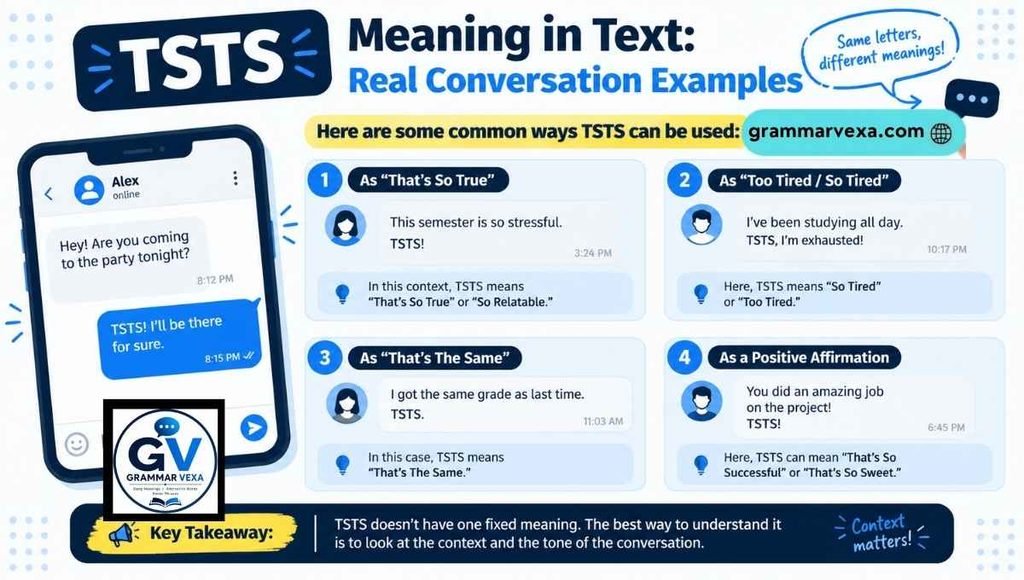
The following TSTS examples are illustrative conversations. They show how different contexts can produce different interpretations. They aren’t evidence that every speaker uses TSTS in exactly this way.
Example: Agreement
Alex: “That ending was wild.”
Sam: “TSTS 😂”
Here, the reply can function as an informal agreement or shared reaction.
Example: Playful Disapproval
Alex: “I ate the last slice without asking.”
Sam: “tsts 😭”
The lowercase reaction may imitate “tsk-tsk.” It suggests playful judgment.
Example: Mild Teasing
Alex: “I forgot my own password again.”
Sam: “tsts 😂”
The sender isn’t necessarily angry. They’re teasing the other person.
Example: Possible Shyness
Alex: “So, do you actually like them?”
Sam: “TSTS 🙈”
If both people use TSTS as “Too Shy To Say,” the interpretation fits.
Example: Avoiding a Direct Answer
Alex: “Who told you about the surprise?”
Sam: “TSTS.”
This could indicate that the sender doesn’t want to reveal the answer if their shared shorthand supports that meaning.
Example: A Shared Internet Slang Reaction
Alex: “This is exactly the kind of chaos I wanted.”
Sam: “TSTS.”
In some online communities, this may work as a compressed expression of shared attitude.
What These Examples Teach
The important lesson isn’t memorizing five expansions.
It’s learning to identify TSTS intended meaning from conversational evidence.
When an abbreviation is ambiguous, ask:
- What happened immediately before it?
- What tone does the conversation have?
- What does the sender normally say?
- Are there emojis or punctuation?
- Is this an inside joke?
- Does the expanded phrase make grammatical sense?
- Could it simply be a typo?
That process produces a much more reliable interpretation.
What Does TSTS Mean on Snapchat?
The TSTS meaning on Snapchat isn’t governed by a special official Snapchat definition.
Snapchat encourages short, fast exchanges. Users may rely on slang, abbreviations, emojis, stickers, and visual context. That environment can make ambiguous expressions especially difficult to interpret.
If someone sends:
“tsts 😂”
after you admit doing something silly, the expression may resemble playful “tsk-tsk” behavior.
If someone sends:
“TSTS”
after agreeing with a statement, a slang interpretation such as “type shit, type shit” may be more plausible.
The app itself doesn’t determine the answer.
TSTS in Snapchat Messages
When interpreting TSTS on Snapchat, check:
- The previous Snap or message
- The caption
- Any attached emoji
- Whether the conversation is romantic
- Whether you’re joking
- Whether the sender uses unusual abbreviations regularly
Snapchat’s disappearing-message format can make context harder to recover. That’s another reason not to interpret a short abbreviation in isolation.
What Does TSTS Mean on TikTok?
The TSTS meaning on TikTok can vary because TikTok has many overlapping language communities.
A comment may use slang differently from a direct message. A gaming creator’s audience may use TSTS differently from a relationship-focused community.
TikTok comments also depend heavily on the video itself.
For example, imagine a video about an outrageous fashion choice. Someone comments:
“TSTS 😂”
The surrounding comments may reveal whether TSTS means agreement, humor, or a particular community expression.
TSTS in TikTok Comments
Before interpreting TSTS in a comment section, examine:
- The original video
- The creator’s caption
- Replies to the comment
- Repeated slang in the thread
- Emojis
- Community-specific expressions
This approach is much safer than searching for one universal definition.
TSTS Meaning on Instagram, WhatsApp, and Other Platforms
The same principle applies across Instagram, WhatsApp, Discord, Messenger, iMessage, SMS, and other messaging environments.
There is generally no platform-level rule saying that TSTS must mean one particular phrase.
On Instagram, TSTS may appear in:
- DMs
- Comments
- Replies
- Captions
- Group conversations
A comment may use it as a reaction. A private DM may carry a more personal meaning.
WhatsApp conversations often involve close friends, family members, school groups, or work groups. The same abbreviation can therefore have very different meanings across chats.
A family group may interpret TSTS as a personal shorthand. A friend group might use it as internet slang.
Group Chats
Group chats create another layer of ambiguity.
If ten people are participating, one person’s shorthand may not be familiar to everyone.
That’s why clear communication matters when an abbreviation could reasonably confuse the audience.
TSTS Meaning From a Guy or Girl: Does Gender Change It?
Searches such as “TSTS meaning from a guy” or “TSTS meaning from a girl” often suggest that people expect a gender-specific definition.
There isn’t good evidence that TSTS has a universal male or female meaning.
A guy and a girl can use the same abbreviation with completely different intentions. The more useful clues are tone, relationship, topic, previous messages, and established slang habits.
If a Guy Sends TSTS
Don’t automatically assume he’s flirting, annoyed, or hiding a secret.
Look at what he was responding to.
If the message follows a joke, TSTS could be playful. weather it follows a strong opinion, it could indicate agreement. or it appears after a questionable decision, it could resemble “tsk-tsk.”
If a Girl Sends TSTS
The same principle applies.
A girl using TSTS doesn’t automatically mean she’s flirting or angry.
For example:
You: “I ate your fries.”
Her: “tsts 😂”
That’s more likely playful judgment than a declaration of romantic interest.
On the other hand:
You: “You know who I was thinking about.”
Her: “TSTS 😏”
The romantic context may influence the interpretation.
But even here, the abbreviation alone doesn’t prove romantic interest.
The Better Rule
Don’t decode the sender’s gender. Decode the conversation.
That simple rule prevents a lot of unnecessary misinterpretation.
How to Respond to TSTS
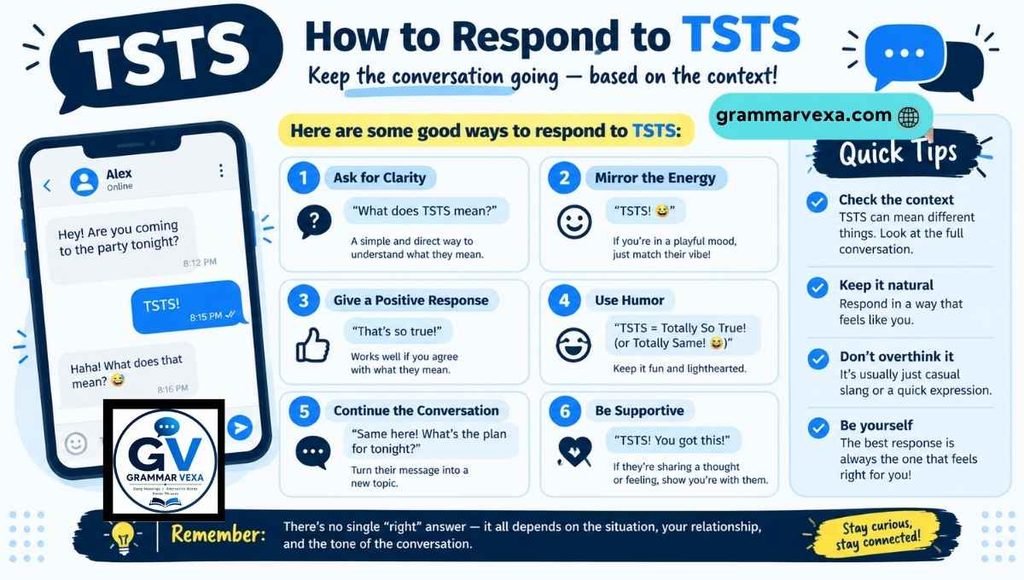
Knowing how to respond to TSTS depends on which interpretation fits the conversation.
When the meaning is obvious, match the tone. When it’s unclear, ask rather than guess.
If TSTS Shows Agreement
You can respond naturally:
- “Exactly 😂”
- “Right?”
- “You get it.”
- “Same!”
- “For real.”
If TSTS Sounds Like “Tsk-Tsk”
A playful response can keep the conversation light:
- “Don’t judge me 😂”
- “I know, I know.”
- “What did I do now?”
- “Guilty.”
- “Okay, okay!”
If You Think It’s Flirty
Don’t assume the abbreviation proves anything. Respond to the broader conversation instead.
For example:
Them: “tsts 😏”
You: “That look says you’re judging me.”
This keeps the conversation moving without making an unsupported assumption.
If You Have No Idea What It Means
A direct question is often the best TSTS response.
Try:
“Wait, what does TSTS mean here?”
Or:
“What do you mean by TSTS?”
That may feel less clever than guessing. It’s far more effective.
When Should You Use TSTS?
The best TSTS usage depends on your audience.
Use it when everyone involved understands the slang or when the context makes the meaning obvious.
Good Situations for TSTS
TSTS can fit:
- Casual conversations
- Friendly chats
- Group chats
- Social media replies
- Memes
- Informal DMs
- Gaming communities
- Jokes between close friends
Its strongest setting is informal communication where brevity and tone matter more than precision.
When Not to Use TSTS
Avoid unexplained TSTS in:
- Job applications
- Business emails
- Academic assignments
- Formal reports
- Customer service messages
- Legal communication
- Professional proposals
- Serious workplace discussions
The issue isn’t simply that slang is “bad.”
The bigger problem is ambiguity.
A professional reader shouldn’t have to guess what four letters mean.
Common Mistakes When Using or Interpreting TSTS
Several common misunderstandings about TSTS come from treating informal slang like standardized vocabulary.
Assuming TSTS Has One Fixed Meaning
This is the biggest mistake.
Online sources themselves show competing interpretations. Urban Dictionary contains several different user-submitted definitions.
Therefore, saying “TSTS always means X” is too strong.
Treating Every Search Result as Equally Reliable
A slang website can document a usage without proving that the usage is widespread.
User-generated dictionaries are particularly useful for discovering niche language. They shouldn’t automatically be treated as authoritative dictionaries.
Confusing TSTS With TSK-TSK
This is an important distinction.
Tsk-tsk is an established English expression. Dictionaries define it as a sound representing disapproval.
TSTS as “type shit, type shit” is a contemporary slang usage documented in online communities.
They can look similar when written quickly, but they don’t necessarily mean the same thing.
Assuming a Romantic Meaning
A message from a crush can make every abbreviation feel loaded.
Don’t overread it.
TSTS by itself isn’t proof of:
- Attraction
- Jealousy
- Anger
- Romantic interest
- Rejection
The surrounding conversation provides stronger evidence.
Ignoring Typos
Short strings of letters can also result from fast typing.
One slang reference specifically notes that tsts can appear as a typo of “tests.”
For example:
“I have three tsts tomorrow.”
The intended word is probably “tests.”
Context makes that interpretation obvious.
TSTS vs Similar Slang Terms
TSTS shouldn’t be treated as interchangeable with common texting abbreviations.
| Term | Common meaning | Main function |
|---|---|---|
| TSTS | Context-dependent slang | Reaction, agreement, attitude, or other community-specific use |
| IDK | I Don’t Know | Uncertainty |
| TBH | To Be Honest | Direct opinion |
| NVM | Never Mind | Withdrawal or dismissal |
| IMO | In My Opinion | Opinion marker |
| SMH | Shaking My Head | Disappointment or disbelief |
| LOL | Laugh Out Loud | Amusement |
| BRB | Be Right Back | Temporary absence |
| IDC | I Don’t Care | Indifference |
| ILY | I Love You | Affection |
| FOMO | Fear of Missing Out | Anxiety about missing an experience |
These abbreviations generally have more stable meanings than TSTS.
For example, IDK usually communicates uncertainty. TBH usually introduces honesty or an opinion. TSTS requires more contextual interpretation.
TSTS vs IDK
IDK directly communicates uncertainty.
“IDK who told him.”
TSTS doesn’t normally provide such a clear semantic signal.
TSTS vs TBH
TBH introduces an honest opinion.
“TBH, I don’t like it.”
TSTS can function more like a reaction.
TSTS vs SMH
SMH means “shaking my head” and commonly expresses disbelief, disappointment, or frustration.
A lowercase tsts can sometimes create a similar emotional effect. However, the two aren’t interchangeable.
TSTS vs LOL
LOL communicates amusement or lightness.
TSTS may communicate agreement, attitude, teasing, or disapproval depending on context.
TSTS vs ILY
ILY has a clear affectionate meaning: “I love you.”
TSTS doesn’t inherently communicate romantic affection.
Is TSTS a Common Texting Abbreviation?
TSTS is less standardized than major texting abbreviations such as LOL, BRB, IDK, or TBH.
That’s an important distinction.
A term can circulate online without becoming universally understood. Digital language often develops in small communities first. Users may create shorthand that makes perfect sense to their friends but leaves outsiders confused.
TSTS fits that broader pattern of informal online language.
Current online references show competing meanings rather than a single standardized definition.
Why Short Slang Spreads
Digital conversations reward speed.
A short reaction can replace a sentence. An emoji can replace an explanation. An abbreviation can compress an entire shared idea.
That doesn’t make every abbreviation universally recognizable.
In fact, the shorter an expression becomes, the more it may depend on shared context.
The Origin of TSTS
There isn’t a well-established authoritative record showing one single creator or official origin for the modern slang TSTS.
That uncertainty matters.
Some user-generated entries date particular interpretations to the early 2020s. Urban Dictionary, for example, contains entries for “type shii type shii” from 2022 and 2023.
Those entries show that the expression has appeared in online slang communities. They don’t establish a universal origin.
The Older “Tsk-Tsk” Connection
The story is clearer for tsk-tsk.
Oxford describes tsk tsk as an imitative expression dating to the 1940s. Merriam-Webster lists its first known use in 1930 for the sense of expressing disapproval.
That makes the sound-based interpretation much older than modern social media.
Digital users can reproduce spoken reactions through letters. This is common in online communication.
Words such as:
- “ugh”
- “hmm”
- “wow”
- “tsk”
- “psst”
can all represent sounds, reactions, or conversational signals.
So lowercase tsts may sometimes function less like an acronym and more like a written sound.
TSTS as an Acronym vs an Expressive Reaction
One subtle point helps explain the confusion.
Not every four-letter string is functioning as a traditional acronym.
An acronym normally represents words through their initial letters.
But online language also uses expressive spellings. These reproduce sounds, reactions, gestures, or conversational attitudes.
That’s why asking “what does TSTS stand for?” can sometimes be the wrong question.
The better question may be:
“What is the sender trying to express with TSTS here?”
That shift from letter expansion to communicative function makes interpretation much easier.
TSTS Usage Tips for Clear Communication
If you decide to use TSTS, keep the audience in mind.
Match the Group’s Language
If your friends already use TSTS, the expression may feel natural.
If nobody in the conversation uses it, suddenly introducing it can create confusion.
Let Context Do Some Work
A standalone:
“TSTS.”
is difficult to interpret.
A contextual message:
“You really ate the whole cake? tsts 😂”
gives the reader much more information.
Don’t Force Slang Into Every Message
Natural texting doesn’t require an abbreviation in every sentence.
Sometimes “Exactly 😂” communicates your meaning better than TSTS.
Avoid Ambiguous Slang in Serious Conversations
When emotions are high, clarity becomes more important.
If you’re discussing:
- A relationship problem
- An argument
- A workplace issue
- A financial matter
- A sensitive personal topic
use direct language.
A vague abbreviation can turn a small misunderstanding into a larger one.
A Simple Framework for Interpreting TSTS
When you need an accurate interpretation, use the C-T-T-C method:
Context → Tone → Topic → Conversation history
Context
What happened immediately before TSTS?
Tone
Does the message feel funny, serious, annoyed, affectionate, or sarcastic?
Topic
Are the people discussing a joke, relationship, gaming, work, school, or something else?
Conversation History
Have these people used TSTS before?
This four-step framework works because slang is fundamentally social. The meaning doesn’t live inside the letters alone.
A Practical Decision Guide
Use this quick guide when someone sends TSTS.
| What appears around TSTS | What to consider first |
|---|---|
| Laughing emoji | Playful or humorous interpretation |
| Eye-roll emoji | Possible teasing or disapproval |
| Romantic conversation | Consider relationship context, but don’t assume flirting |
| Strong agreement | A slang reaction such as “type shit, type shit” may fit |
| Someone did something silly | “Tsk-tsk” style reaction may fit |
| Secret or unanswered question | A context-specific “too shy/smart to say” interpretation could fit |
| Formal conversation | Ask for clarification rather than guessing |
| Strange grammar | Consider whether it is a typo |
| Unknown group slang | Ask the sender |
This is more reliable than relying on a single online definition.
Is TSTS Rude or Offensive?
TSTS isn’t automatically rude.
Its tone depends on the interpretation.
If it represents “type shit, type shit,” the expanded phrase contains profanity. That makes it unsuitable for many professional environments even when friends consider it harmless.
If lowercase tsts represents “tsk-tsk,” it can range from playful teasing to genuine disapproval.
For example:
“You ate my leftovers again? tsts 😂”
sounds playful.
Compare that with:
“You ignored the warning again. TSTS.”
The second could sound more critical.
Tone changes meaning.
When TSTS Can Cause Miscommunication
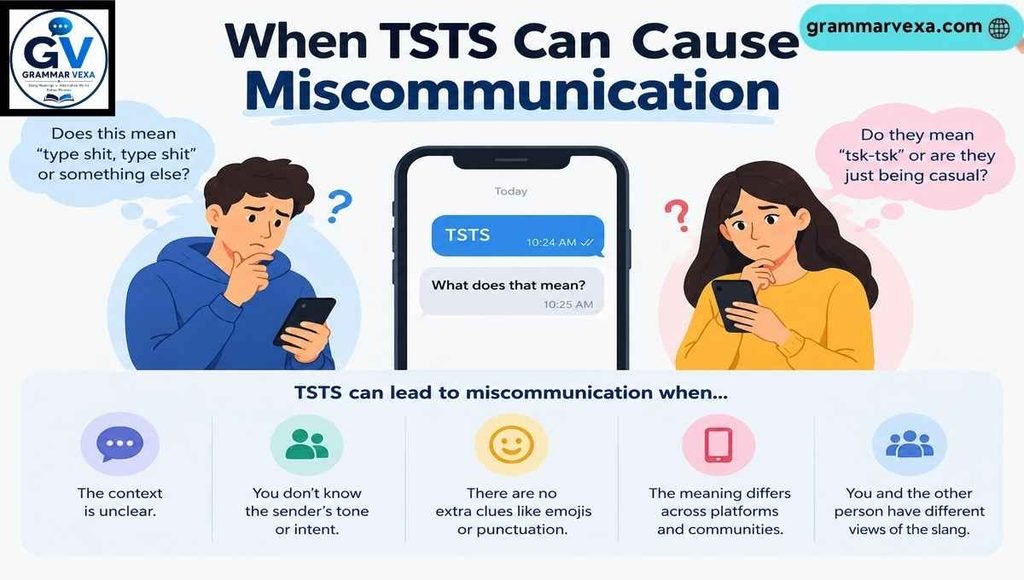
Short expressions remove information.
A complete sentence tells you who did what, why it happened, and how the sender feels.
A four-letter reaction doesn’t.
That’s why TSTS confusion can happen easily between people from different age groups, online communities, or language backgrounds.
Someone might interpret TSTS as:
- Agreement
- Disapproval
- Shyness
- Humor
- A typo
- A private abbreviation
- A slang phrase
Meanwhile, the sender may intend something completely different.
How to Avoid Misunderstandings
When precision matters:
- Explain unfamiliar slang.
- Use complete sentences.
- Avoid unexplained acronyms.
- Ask what unfamiliar terms mean.
- Consider your audience.
- Don’t assume online definitions are universal.
The goal of communication isn’t to use the shortest possible message. It’s to make the intended meaning clear.
Expert Tips for Understanding TSTS
Don’t Rank Meanings Without Evidence
If several communities use TSTS differently, don’t declare one interpretation universal.
Distinguish Documentation From Standardization
A slang website documenting a phrase doesn’t mean everyone uses it.
This distinction is especially important with user-generated sources.
Check the Message Function
Ask whether TSTS is acting as:
- A reaction
- An abbreviation
- An inside joke
- A sound
- A typo
- A community-specific phrase
That question can solve the mystery faster than searching the letters alone.
Pay Attention to Capitalization
Capitalization isn’t a strict rule, but it can provide clues.
TSTS may look more like an acronym.
tsts may look more like an expressive reaction.
Neither format guarantees a particular meaning.
TSTS in Different Types of Conversations
Friendly Conversations
TSTS can work as a quick reaction among friends who share the same slang.
Playful Chat
A lowercase “tsts” can imitate mild disapproval while keeping the mood light.
Romantic Conversations
TSTS doesn’t automatically mean affection.
The surrounding conversation determines whether the message sounds teasing, shy, playful, or something else.
Gaming Communities
Gaming communities often develop specialized slang. If TSTS appears in a gaming chat, community-specific meaning should be considered before applying a general definition.
Workplace Chats
Avoid it unless the workplace culture clearly supports informal slang and everyone understands the expression.
Even then, direct wording is safer for important information.
Academic Discussions
TSTS generally doesn’t belong in formal academic writing.
Use standard language instead.
Pros and Cons of Using TSTS
| Pros | Cons |
|---|---|
| Very short | Meaning can be unclear |
| Fits casual chats | Not universally recognized |
| Can add personality | May be interpreted incorrectly |
| Works as a quick reaction | Some meanings contain profanity |
| Can convey tone efficiently | Poor choice for formal communication |
| Fits internet culture | Different communities may use it differently |
The central trade-off is speed versus clarity.
TSTS saves typing. A complete sentence reduces ambiguity.
TSTS Meaning in One Quick Reference
| Question | Best answer |
|---|---|
| What does TSTS mean? | It has multiple context-dependent uses |
| What does TSTS mean in text? | One current slang use is “type shit, type shit” |
| Can tsts mean “tsk-tsk”? | Yes, especially as a sound-like reaction |
| Does TSTS have one fixed definition? | No |
| Can it mean “Too Smart To Say”? | Some online sources use it that way |
| Can it mean “Too Shy To Say”? | Some online sources report that use |
| Does gender change the meaning? | No universal gender-specific meaning exists |
| Is TSTS formal? | No; treat it as informal |
| Can it be used on Snapchat? | Yes, but context determines meaning |
| Can it appear on TikTok? | Yes, especially in informal comments or chats |
| Should you guess its meaning? | Only when the surrounding context is clear |
Conclusion
Understanding TSTS Meaning in Text Explained: Definition, Uses & Examples helps you read short online messages with better context. TSTS can have different meanings depending on the conversation, tone, platform, and surrounding words. Some uses are common in modern slang, while others come from specific online communities.
The key to TSTS Meaning in Text Explained: Definition, Uses & Examples is context. Check the full message before deciding what the abbreviation means. Pay attention to tone, emojis, and the relationship between the people chatting. When the meaning isn’t clear, asking for clarification is better than guessing. This simple approach helps you use texting slang naturally and avoid confusion.
FAQs
What does TSTS mean in text?
TSTS meaning in text depends on context. A documented modern slang use is “type shit, type shit,” while lowercase “tsts” can also represent “tsk-tsk.”
What does TSTS mean in texting?
TSTS meaning in texting can vary between conversations and online communities. Check the surrounding words, tone, and topic before choosing an interpretation.
What does TSTS mean on Snapchat?
On Snapchat, TSTS doesn’t have one universal meaning. Its interpretation depends on how the sender uses it in the conversation.
What does TSTS mean on TikTok?
On TikTok, TSTS may appear as casual internet slang or a community-specific expression. The video’s caption, comments, and context can help explain its intended meaning.
Is TSTS a common texting abbreviation?
TSTS is less standardized than abbreviations such as LOL, BRB, or IDK. Different communities may use it in different ways.
Can TSTS have more than one meaning?
Yes. TSTS has multiple meanings, so assuming one fixed definition can lead to confusion or miscommunication.
How should you respond to TSTS in a text?
First, use the conversation context to understand the intended meaning. If you’re unsure, ask the sender what they mean rather than guessing.
Should you use TSTS in formal communication?
It’s better to avoid TSTS in professional, academic, or formal messages because the abbreviation can be ambiguous. Use clear wording when the meaning needs to be understood immediately.

Jessica Morgan is an English language writer and researcher at Grammar Vexa. I enjoy exploring slang, vocabulary, word meanings, synonyms, and alternative phrases. Through my work, I aim to make English easier to understand by providing clear explanations, useful examples, and practical language tips.







1 thought on “TSTS Meaning in Text Explained: Definition, Uses & Examples”