When you want to praise someone, “keep up the good work” is a safe and familiar choice. It tells the person that their effort, progress, or performance is going well and encourages them to continue. Merriam-Webster defines the phrase simply as “to continue doing good work.”
Still, the same phrase can become repetitive. In a workplace, you might want something more professional. With a friend, a warmer expression may sound more natural. For a student, specific encouragement can be more useful than a generic compliment.
That’s why this guide brings together 150+ other ways to say keep up the good work, organized by tone and situation. You’ll find professional phrases, casual expressions, academic encouragement, workplace praise, email examples, and specific alternatives that make your feedback more meaningful.
The central idea is simple: good praise tells someone what went well and encourages them to build on it.
What Does “Keep Up the Good Work” Mean?
The keep up the good work meaning is “continue doing something well.” The phrase combines praise and encouragement. First, it recognizes that someone is performing successfully. Then it encourages that person to maintain the same level of effort or quality.
For example:
“Your presentation was clear and well organized. Keep up the good work.”
The speaker isn’t only saying that the presentation succeeded. The second sentence encourages the person to continue using the same strengths.
The phrase can apply to many situations, including:
- Workplace performance
- School assignments and grades
- Personal projects
- Athletic training
- Creative work
- Team projects
- Professional development
- Long-term goals
- Everyday accomplishments
Keep Up Meaning and Good Work Meaning
The words themselves explain the phrase.
“Keep up” means to maintain something at its current level or continue doing it. “Good work” refers to work that meets or exceeds expectations.
Together, the keep up the good work phrase communicates:
“You’re doing well, so continue with the same effort and quality.”
It’s therefore both a compliment and an encouraging expression.
Is “Keep Up the Good Work” a Compliment?
Yes. It’s generally a positive compliment and a form of positive reinforcement.
However, the strength of the compliment depends on context. Saying “Keep up the good work” after someone completes an ordinary task may feel routine. Mentioning exactly what impressed you usually creates stronger recognition.
For example:
- Generic: “Keep up the good work.”
- Specific: “Your research made the report much clearer. Keep building on that approach.”
The second version provides useful information as well as praise.
150+ Other Ways to Say “Keep Up the Good Work”
Below are other ways to say keep up the good work, grouped according to tone and purpose. Some phrases work almost anywhere. Others fit specific relationships or situations.
Short and Simple Alternatives
These options work well when you need quick words of encouragement.
- Great job!
- Well done!
- Nice work!
- Excellent work!
- Great work!
- Fantastic job!
- Outstanding!
- Excellent effort!
- Terrific work!
- Amazing job!
- Impressive work!
- Superb job!
- Brilliant work!
- Wonderful job!
- That’s excellent!
- Way to go!
- Job well done!
- That’s the way!
- You nailed it!
- That’s impressive!
These are especially useful for quick messages, conversations, classroom comments, and informal workplace communication.
Encouraging Alternatives
Sometimes you aren’t praising a finished achievement. You’re encouraging continued effort.
- Keep it up!
- Keep going!
- Don’t stop now!
- You’re on the right track.
- Keep pushing forward.
- Stay the course.
- Keep making progress.
- You’re doing really well.
- You’re headed in the right direction.
- Keep building on this success.
- Keep moving forward.
- Stay motivated.
- Keep up the momentum.
- Continue doing what you’re doing.
- Keep putting in the effort.
- You’re making great progress.
- Keep striving.
- Keep reaching higher.
- Keep working toward your goals.
- Don’t lose that momentum.
These expressions focus more on encouraging continued effort than simply celebrating a completed task.
Professional Alternatives
In a professional setting, praise usually works best when it sounds sincere and specific.
- Excellent work on this project.
- Your work continues to impress.
- You’ve done an excellent job.
- Your efforts are making a real difference.
- Your performance has been outstanding.
- You’ve made significant progress.
- Your contribution is greatly appreciated.
- Thank you for your continued excellent work.
- Your attention to detail is impressive.
- Your commitment is showing in the results.
- You’re delivering excellent results.
- Your work sets a strong example.
- Please continue this level of performance.
- Your efforts haven’t gone unnoticed.
- You’ve handled this exceptionally well.
- Your performance has been exemplary.
- Your results demonstrate strong attention to quality.
- Your contribution has strengthened the project.
- Your professionalism really stands out.
- You’ve maintained a consistently high standard.
A phrase such as “Your attention to detail is impressive” often carries more value than a generic “Good job” because it tells the recipient what behavior deserves repetition.
The Center for Creative Leadership similarly emphasizes feedback based on specific observed behavior rather than vague evaluations.
Workplace Alternatives for Employees and Colleagues
When praising employees, colleagues, or team members, you can make the compliment more relevant to their contribution.
- You’re doing a fantastic job.
- Great work on the project.
- Thanks for putting in the extra effort.
- Your hard work is paying off.
- You’ve made a strong contribution.
- You’re making a noticeable impact.
- I appreciate everything you’ve contributed.
- You’ve handled this really well.
- Your consistency is impressive.
- Thanks for keeping things moving.
- You’ve made this project stronger.
- Your effort has really helped the team.
- You’re setting a great example.
- Your work has been a valuable addition.
- You’ve delivered excellent results.
- Your dedication is making a difference.
- You’ve shown excellent judgment.
- Your work ethic is impressive.
- Your contribution has been valuable to the team.
- You’re maintaining an excellent standard.
Alternatives for Managers and Leaders
Leaders often need to recognize performance while encouraging future growth.
- I’m impressed with your progress.
- You’ve exceeded expectations.
- Your leadership is making a difference.
- You’re setting a strong standard for the team.
- Your results speak for themselves.
- You’ve handled the challenge exceptionally well.
- Your initiative deserves recognition.
- You’ve shown excellent judgment.
- Your dedication is paying off.
- Keep building on this success.
- You’ve demonstrated strong leadership.
- Your decision-making has been impressive.
- You’ve made a meaningful contribution.
- Your consistency has been excellent.
- You’re creating a positive impact across the team.
These phrases are especially appropriate during one-on-one meetings, project reviews, performance discussions, and team recognition.
Alternatives for Students and Teachers
In an academic setting, praise can reinforce learning progress without making the student feel that grades are the only thing that matters.
- You’re making excellent progress.
- Keep working hard.
- You’re improving every day.
- You’re showing real progress.
- Your effort is paying off.
- You’re doing a great job with this assignment.
- Keep challenging yourself.
- You’re developing strong skills.
- Your hard work is showing.
- You’re on the right path.
- Your understanding has improved significantly.
- You’ve made strong progress on this project.
- Your approach is becoming more effective.
- Your persistence is paying off.
- You’re building a strong foundation.
For students, specific feedback can be particularly useful because it connects effort, strategy, and progress rather than offering praise without direction.
Friendly and Casual Alternatives
With friends or close colleagues, a more energetic phrase may fit better.
- You’re killing it!
- You’re crushing it!
- You’ve got this!
- You’re doing awesome!
- You’re rocking it!
- Nice one!
- That’s awesome!
- You’re on fire!
- You’re doing great!
- Keep rolling!
- You’ve got a good thing going.
- Don’t slow down now.
- You’re absolutely nailing this.
- You’re doing amazing.
- Keep being awesome!
Be careful with slang in formal communication. “You’re crushing it!” can sound warm among friends but may feel too casual in a formal work email.
Warm and Personal Alternatives
When someone has worked hard toward a personal goal, warmth can matter more than formality.
- I’m really proud of your progress.
- You should be proud of what you’ve accomplished.
- It’s wonderful to see how far you’ve come.
- You’ve worked incredibly hard for this.
- Your dedication really shows.
- You’ve come a long way.
- I’m proud of the effort you’re putting in.
- You deserve to feel good about this.
- You’re doing better than you realize.
- Keep believing in yourself.
- Your determination is inspiring.
- You’ve earned this progress.
- Your persistence deserves recognition.
- Keep moving toward what matters to you.
- You’re building something worth being proud of.
Alternatives That Recognize Specific Effort
Generic praise tells someone that they did well. Specific praise tells them why.
- Your attention to detail really stands out.
- I appreciate the care you’ve put into this.
- Your persistence paid off.
- Your preparation made a real difference.
- Your creativity made this stand out.
- You’ve handled the details exceptionally well.
- Your problem-solving skills really showed here.
- Your consistency deserves recognition.
- The extra effort clearly paid off.
- Your thoughtful approach produced great results.
- Your preparation strengthened the final result.
- Your communication made the project easier to follow.
- Your organization saved the team valuable time.
- Your careful planning prevented several problems.
- Your persistence helped move this forward.
These are among the strongest keep up the good work alternatives because they identify a behavior that the person can repeat.
Best Alternatives to “Keep Up the Good Work” by Tone
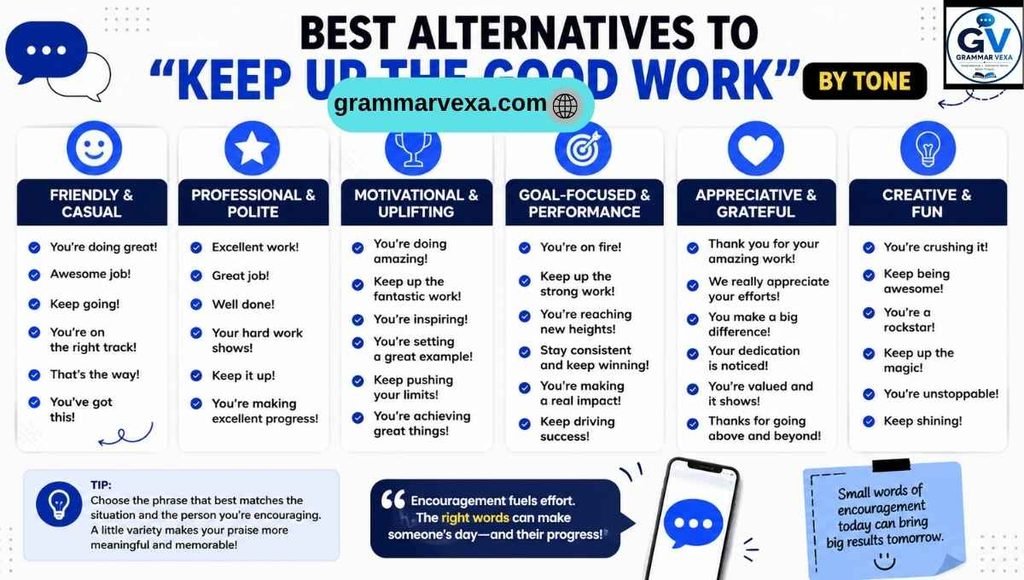
Choosing the right phrase isn’t only about finding a synonym. Tone matters just as much.
| Tone | Best Alternative | Where It Fits |
|---|---|---|
| Professional | “Excellent work on this project.” | Workplace |
| Formal | “Your performance has been exemplary.” | Official feedback |
| Friendly | “You’re doing great!” | Friends and coworkers |
| Casual | “You’re crushing it!” | Close friends |
| Encouraging | “Keep it up!” | Ongoing effort |
| Warm | “I’m proud of your progress.” | Personal relationships |
| Academic | “You’re making excellent progress.” | Students |
| Specific | “Your attention to detail really stands out.” | Performance feedback |
| Energetic | “You’re on fire!” | Informal settings |
| Appreciative | “Your contribution is greatly appreciated.” | Professional teams |
Which Phrase Should You Choose?
A useful rule is:
Match the phrase to the relationship, situation, and behavior you’re praising.
For example, a manager might say:
“Your analysis was thorough and easy to follow. Excellent work on the report.”
A friend might say:
“You’re crushing it! Keep going.”
A teacher might write:
“Your argument is much clearer in this draft. Keep building on that progress.”
Each sentence communicates praise. The wording simply matches the situation.
How to Choose the Right “Keep Up the Good Work” Alternative
The best ways to say keep up the good work depend on four factors.
Consider Your Relationship
Ask who will receive the message.
- Manager → employee: Use specific, professional praise.
- Coworker → coworker: Friendly professional language usually works.
- Teacher → student: Focus on progress and learning.
- Friend → friend: A warmer or more casual expression may fit.
- Parent → child: Encouragement can emphasize effort and growth.
- Client → professional: Appreciation should remain polished and respectful.
Consider the Situation
A completed task calls for a different phrase than an unfinished project.
For a completed presentation:
“Excellent presentation. Your explanation was clear and concise.”
For ongoing work:
“You’re making strong progress. Keep building on this momentum.”
someone facing difficulty:
“You’ve made real progress despite the challenges. Keep going.”
Consider Your Tone
Your positive tone should fit the setting.
Professional language often favors words such as:
- Excellent
- Impressive
- Consistent
- Valuable
- Exemplary
- Effective
- Outstanding
Casual language may favor:
- Awesome
- Amazing
- Crushing it
- Rocking it
- Nailed it
Neither style is automatically better. Context determines the right choice.
Make the Praise Specific
This is perhaps the most useful improvement.
Instead of:
“Good job. Keep it up.”
Try:
“The report was much easier to follow because you organized the findings by priority. Keep using that structure.”
The second version provides specific feedback. It recognizes the achievement and explains which behavior created the result.
“Keep Up the Good Work” vs. Similar Expressions
These phrases overlap, but they aren’t interchangeable in every situation.
| Expression | Main Meaning | Tone | Best Use |
|---|---|---|---|
| Keep up the good work | Continue doing well | Encouraging | Ongoing performance |
| Keep it up | Continue the current effort | Casual | Informal encouragement |
| Great job | You performed well | General | Completed task |
| Well done | You succeeded | Polite | Achievement |
| Excellent work | Your work was high quality | Professional | Workplace |
| Keep going | Continue despite difficulty | Motivational | Challenges |
| You nailed it | You did something extremely well | Casual | Friends or peers |
| Outstanding performance | Performance exceeded expectations | Formal | Reviews |
| Nice work | Your work was good | Friendly | Everyday praise |
“Keep Up the Good Work” vs. “Keep It Up”
“Keep it up” is shorter and generally more casual.
For example:
“Your training is going really well. Keep it up!”
“lets Keep up the good work” explicitly identifies the current work as good. “Keep it up” relies more heavily on context.
“Keep Up the Good Work” vs. “Great Job”
“Great job” usually celebrates something already completed.
“You finished the presentation ahead of schedule. Great job!”
“Keep up the good work” points toward the future.
“You’ve handled the project well so far. Keep up the good work.”
“Keep Up the Good Work” vs. “Well Done”
“Well done” often sounds more final. It recognizes a successful result.
“Keep up the good work” adds an expectation of continued performance.
That distinction makes the phrases useful in different situations.
How to Say “Keep Up the Good Work” Professionally
A professional compliment should ideally do more than sound positive. It should communicate recognition, appreciation, and useful information.
Good professional praise often identifies:
- What the person did.
- Why it mattered.
- What result it produced.
- Which strength should continue.
Professional Email Examples
After a successful report:
“Excellent work on the quarterly report. Your organization and attention to detail made the findings easy to understand. Please continue using this approach.”
After a successful presentation:
“Your presentation was clear, focused, and well prepared. The way you explained the key findings made the discussion much more productive.”
For ongoing performance:
“You’ve maintained a consistently high standard throughout the project. Your reliability has helped the team stay on schedule.”
For an employee who improved:
“Your recent progress has been impressive. The additional preparation is clearly improving the quality of your work.”
These examples demonstrate why professional encouragement phrases work best when they connect praise to observable performance.
How to Say “Keep Up the Good Work” Without Sounding Generic
The phrase isn’t inherently weak. It becomes weak when you use it without meaningful context.
A useful formula is:
Specific behavior + positive impact + future encouragement
For example:
“Your careful review caught several errors before submission. That attention to detail protected the quality of the report. Keep building on that strength.”
This approach works because it gives the recipient something concrete to remember.
The Center for Creative Leadership recommends feedback that describes specific behavior and its impact because that information helps people understand what they can repeat or change.
Generic vs. Specific Praise
| Generic | More Meaningful |
|---|---|
| Keep up the good work. | Your careful research strengthened the report. |
| Great job. | Your explanation made the difficult concept easy to understand. |
| Keep it up. | Your consistency has helped the project stay on schedule. |
| Excellent work. | Your presentation answered the team’s key questions clearly. |
| Good effort. | Your persistence helped you solve a difficult problem. |
The right-hand column creates meaningful recognition because it provides specific details.
Examples of “Keep Up the Good Work” in Real Conversations
At Work
“You’ve handled the client requests really well. Keep building on that communication style.”
In an Email
“Excellent work on the updated proposal. The revised structure makes the recommendations much clearer.”
In a Text Message
“You’re doing great! Keep it up.”
At School
“Your writing has improved a lot this semester. Keep working on those strong explanations.”
During a Team Project
“Everyone has contributed well so far. Let’s keep this momentum going.”
After a Difficult Achievement
“That wasn’t an easy challenge, but you stayed focused and got through it. Keep moving forward.”
When Someone Is Improving
“Your latest version is much stronger. The changes you made clearly improved the final result.”
These keep up the good work examples show how a small adjustment can make praise feel more personal.
Is “Keep Up the Good Work” Ever Rude or Patronizing?
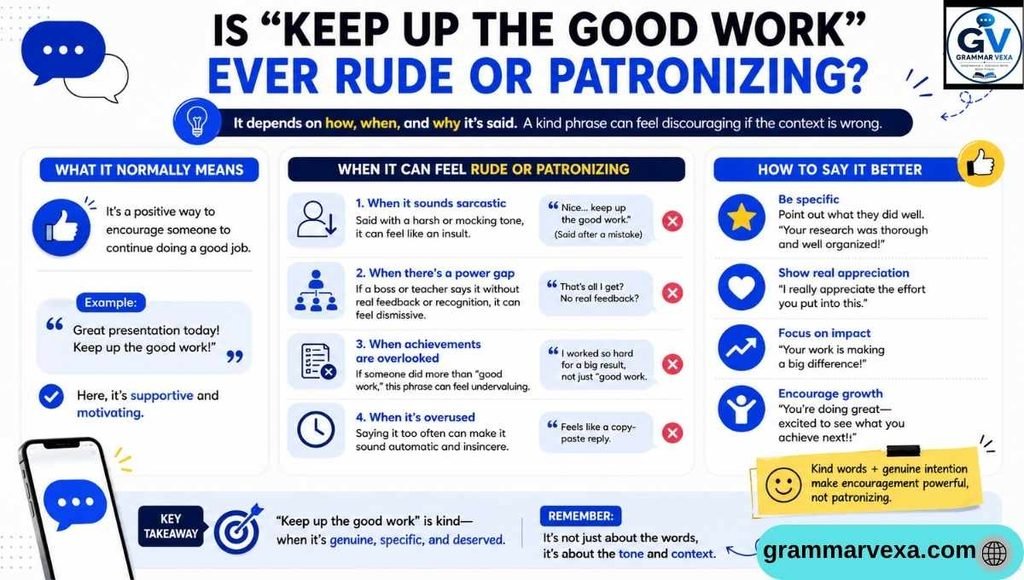
Usually, no. The phrase is generally positive and polite.
Still, context can change how it sounds.
A manager who says “Keep up the good work” after a detailed performance discussion may sound supportive. The same phrase delivered sarcastically could sound dismissive.
It can also feel overly generic when someone has achieved something significant.
Imagine an employee spends six months completing a difficult project and receives only:
“Keep up the good work.”
That praise isn’t wrong. It simply doesn’t match the significance of the achievement.
A stronger response might be:
“You handled a complicated project with excellent judgment. The final result exceeded the original target, and your persistence made a major difference.”
When to Use a Different Phrase
Consider another expression when:
- The achievement is unusually significant.
- The person needs specific feedback.
- You’re discussing a sensitive performance issue.
- The praise needs to explain its impact.
- The relationship requires a more formal tone.
- The phrase has become repetitive.
Pros and Cons of Saying “Keep Up the Good Work”
Pros
- Encourages continued effort
- Shows appreciation
- Boosts confidence
- Can strengthen relationships
- Works in many settings
- Has a naturally supportive tone
- Is easy to understand
- Fits both spoken and written communication
Research supports the broader value of well-delivered positive feedback. A 2026 systematic review in the Journal of Organizational Behavior concluded that current evidence generally shows positive feedback can enhance performance, although the effects of negative feedback depend more heavily on context and relationship quality.
Cons
- It can sound generic.
- It may become overused.
- It doesn’t identify what the person did well.
- It isn’t very actionable.
- It may feel routine if used automatically.
- It can sound too casual in some formal contexts.
- It may fail to recognize an important achievement adequately.
Gallup and Workhuman’s research also emphasizes that valuable feedback should be timely, authentic, and useful. Recognition works best when it clarifies the behaviors and contributions that matter.
Why Specific Praise Is More Useful Than Generic Praise
A simple compliment can make someone feel good. Specific feedback can also help them understand what to repeat.
Consider two comments:
“Great job!”
and:
“Your summary clearly separated the main findings from the supporting details. That made the report much easier to scan.”
The second comment does more work.
It recognizes quality. is It identifies the behavior. It explains the impact. Most importantly, it gives the recipient a practical clue for future performance.
A 2024 study examining positive and negative feedback found that positive feedback had a favorable effect on subsequent professional performance. The effect appeared across different backgrounds and was especially pronounced for highly relevant tasks.
Workplace recognition also matters beyond the immediate compliment. Gallup reports that well-recognized employees are 45% less likely to have turned over two years later.
That doesn’t mean every “good job” prevents turnover. It does show why organizations should treat recognition as more than empty politeness.
Best Practices for Meaningful Encouragement
Use these principles when you praise someone.
Be Specific
Name the behavior or result that impressed you.
Be Timely
Give recognition while the achievement is still fresh.
Connect Effort to Results
Explain how the person’s contribution helped.
Match the Tone
A formal review requires different language from a text to a friend.
Recognize Improvement
Don’t focus only on perfect outcomes. Progress matters too.
Keep It Sincere
Avoid exaggerated compliments that don’t match reality.
Encourage Without Creating Pressure
“Keep building on this progress” often sounds healthier than implying that someone must perform perfectly forever.
Ask What Recognition Feels Meaningful
People don’t all prefer praise in the same way. Gallup recommends asking employees how they prefer recognition and learning which forms of praise feel meaningful to them.
Common Mistakes When Giving Praise
Being Too Generic
“Good job” tells someone very little.
Better: “Your careful proofreading eliminated several errors before publication.”
Repeating the Same Phrase
If every achievement receives “keep up the good work,” the expression can become background noise.
Rotate between great job, excellent work, specific recognition, and meaningful appreciation.
Praising Effort Without Recognizing Results
Effort matters. Results matter too.
Instead of saying only:
“You worked really hard.”
Try:
“Your persistence helped you finish the project ahead of schedule.”
Using Casual Slang in Formal Settings
“You’re crushing it” may work with a close colleague. It may not belong in a formal performance review.
Giving Praise That Sounds Condescending
A phrase can become patronizing when the speaker talks down to the recipient.
Compare:
“Good job, kid. Keep it up.”
with:
“You’ve made excellent progress. Your preparation really shows.”
The second version treats the recipient with greater respect.
Praising Everyone in Exactly the Same Way
Recognition becomes more meaningful when it reflects the individual’s contribution.
Instead of:
“Great work, everyone.”
Try:
“Maria kept the timeline on track, while James strengthened the technical analysis. Both contributions made the final result stronger.”
A Simple Framework for Giving Better Praise
A useful framework is B-A-I-F:
| Step | Meaning | Example |
|---|---|---|
| B | Behavior | “You reorganized the report by priority.” |
| A | Achievement | “The final version was much easier to follow.” |
| I | Impact | “That helped the client understand the recommendations.” |
| F | Future | “Keep using that structure in future reports.” |
This turns a vague compliment into actionable feedback.
For example:
“You reorganized the report by priority. The final version was much easier to follow, which helped the client understand the recommendations. Keep using that structure in future reports.”
That’s more informative than:
“Keep up the good work.”
The difference isn’t length alone. It’s specificity.
25 Ready-to-Use Sentences Instead of “Keep Up the Good Work”
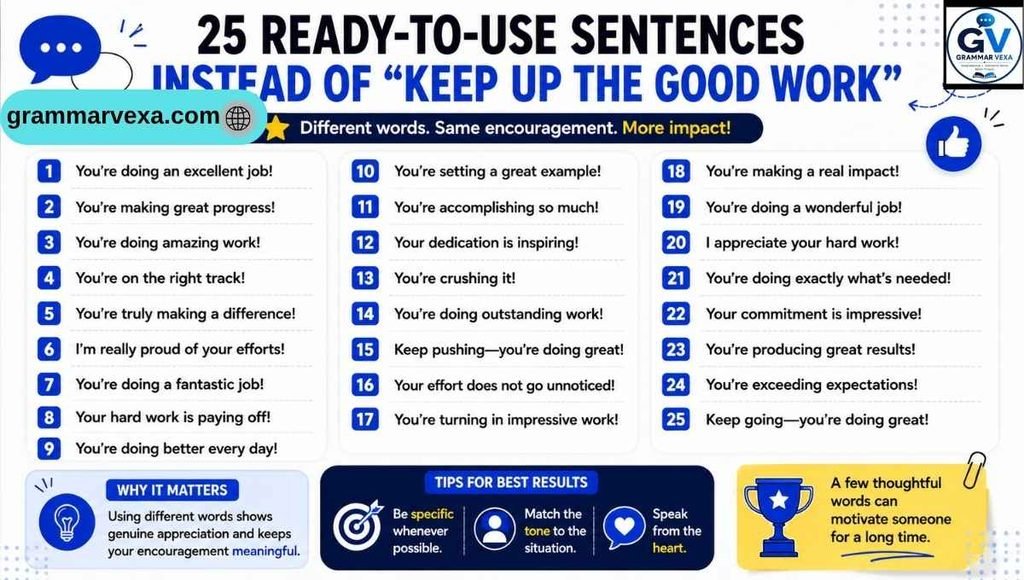
Here are practical keep up the good work expressions that can be copied into everyday communication:
- “Your hard work is clearly paying off.”
- “You’ve made excellent progress on this.”
- “Your attention to detail really stands out.”
- “You’ve handled this challenge exceptionally well.”
- “Your consistency has been impressive.”
- “You’re making a meaningful contribution to the team.”
- “Your preparation made a noticeable difference.”
- “You’ve maintained a high standard throughout the project.”
- “Your persistence deserves recognition.”
- “The quality of your work has been excellent.”
- “You’re building strong momentum.”
- “Your recent improvement has been impressive.”
- “Your dedication is showing in the results.”
- “You’ve made this project stronger.”
- “Your work has had a positive impact.”
- “You’re developing excellent skills.”
- “Your thoughtful approach really paid off.”
- “You’ve exceeded expectations on this task.”
- “Your contribution has been valuable.”
- “You’re making steady progress toward your goal.”
- “Your effort has produced excellent results.”
- “Your professionalism really stands out.”
- “You’ve shown impressive problem-solving skills.”
- “Your commitment to quality is clear.”
- “Keep building on this success.”
What Should a Manager Say Instead of “Keep Up the Good Work”?
Managers can make praise more useful by connecting it to performance, impact, and future behavior.
For example:
“Your handling of the client presentation was excellent. You answered difficult questions calmly and kept the discussion focused. Keep using that approach in future meetings.”
This kind of professional praise is stronger than a generic compliment because the employee knows exactly what worked.
Research also supports frequent, meaningful feedback. Gallup reports that employees who say they receive valuable feedback from coworkers are substantially more likely to report positive workplace outcomes.
What Should a Teacher Say Instead of “Keep Up the Good Work”?
Teachers can make academic encouragement more useful by identifying progress.
Instead of:
“Keep up the good work.”
Try:
“Your argument is much clearer than in your previous draft. The evidence now supports each major point more effectively.”
Other useful options include:
- “Your writing has become more precise.”
- “You’ve made strong progress with this skill.”
- “Your reasoning is becoming more detailed.”
- “Your preparation is showing in your results.”
- “Keep applying this strategy.”
- “You’ve made a significant improvement.”
- “Your persistence is paying off.”
The student receives encouragement and a clearer picture of their learning progress.
How to Praise Someone’s Effort Without Sounding Repetitive
Use different dimensions of praise instead of endlessly changing synonyms.
You can recognize:
- Effort: “You put serious effort into this.”
- Persistence: “You stayed with the problem until you solved it.”
- Quality: “The final work is exceptionally polished.”
- Improvement: “You’ve made noticeable progress.”
- Creativity: “Your approach brought a fresh perspective.”
- Accuracy: “Your careful checking improved the final result.”
- Teamwork: “Your communication helped the team stay aligned.”
- Leadership: “You gave the group clear direction.”
- Impact: “Your contribution made the project more efficient.”
- Achievement: “You exceeded the original target.”
This approach keeps professional feedback, personal encouragement, and workplace recognition from becoming repetitive.
Final Takeaway
The best other ways to say keep up the good work aren’t necessarily the fanciest ones. They are the phrases that fit the person, situation, relationship, and achievement.
For quick encouragement, “Great job,” “Well done,” and “Keep it up” work beautifully. In professional communication, phrases such as “Your contribution has made a real difference” or “Your attention to detail is impressive” provide more substance.
When the situation matters, go one step further. Identify what the person did well, explain why it mattered, and encourage them to continue that behavior.
FAQs
What are the best other ways to say “keep up the good work”?
Popular alternatives include “great job,” “well done,” “excellent work,” “keep it up,” and “keep up the momentum.” For meaningful praise, mention the specific achievement or behavior.
Is “keep up the good work” professional?
Yes. “Keep up the good work” is polite and acceptable in many workplace situations, although specific praise often sounds more professional and genuine.
What is the difference between “keep up the good work” and “keep it up”?
“Keep up the good work” directly praises someone’s work while encouraging them to continue. “Keep it up” has the same basic idea but sounds shorter and more casual.
What can I say instead of “keep up the good work” in an email?
Try “Excellent work on this project,” “Your contribution is greatly appreciated,” or “You’ve maintained a consistently high standard.” These professional encouragement phrases work well in emails.
How can I say “keep up the good work” without sounding generic?
Give specific feedback about what the person did well. For example, say, “Your attention to detail improved the final report” instead of simply saying, “Keep up the good work.”
What are good alternatives to “keep up the good work” for students?
Teachers can say “You’re making excellent progress,” “Your effort is paying off,” or “Your understanding has improved significantly.” These phrases connect praise with student progress.
Is “keep up the good work” a compliment?
Yes. The phrase combines praise and encouragement by recognizing someone’s current performance and encouraging continued effort.
What is a more meaningful alternative to “great job”?
Use a specific compliment that explains the achievement, such as “Your clear explanation made the presentation much easier to understand.” Specific recognition provides more useful feedback than a general phrase.
Can “keep up the good work” sound rude or patronizing?
It can in certain contexts, especially when the speaker uses a sarcastic or condescending tone. Adding specific, sincere recognition usually makes the supportive phrase feel more genuine.
That small shift turns ordinary praise into meaningful recognition.
In other words, don’t just say:
“Keep up the good work.”
When possible, say what made the work good. That’s where genuine praise becomes useful feedback, stronger encouragement, and a better way to recognize someone’s effort.

Jessica Morgan is an English language writer and researcher at Grammar Vexa. I enjoy exploring slang, vocabulary, word meanings, synonyms, and alternative phrases. Through my work, I aim to make English easier to understand by providing clear explanations, useful examples, and practical language tips.







3 thoughts on “150+ Other Ways to Say “Keep Up the Good Work””