
Science has a surprisingly rich collection of terms beginning with the letter Z. These science words that start with Z stretch across biology, chemistry, physics, astronomy, Earth science, and environmental science. Some describe living organisms, while others explain chemical behavior, quantum phenomena, groundwater, or advanced materials.
If you’re building science vocabulary, studying for a class, writing an academic assignment, or simply curious about unusual terminology, this guide brings the most useful Z terms together in one place. You’ll learn what each word means, why it matters, and where scientists use it.
The letter Z may appear near the end of the alphabet, but its scientific vocabulary is anything but ordinary. From a zygote beginning embryonic development to zooplankton supporting aquatic food webs, these terms reveal how closely different scientific fields connect.
Science Words That Start With Z: Quick Reference
Here’s a quick overview of important Z science words and their meanings.
| Science word | Field | Simple meaning |
|---|---|---|
| Zoology | Biology | The study of animals |
| Zymology | Biology/Food science | The study of fermentation |
| Zoogeography | Biogeography | The study of animal distribution |
| Zygote | Biology | The cell formed after fertilization |
| Zinc | Chemistry/Biology | An essential chemical element and nutrient |
| Zymase | Biochemistry | A group of enzymes involved in fermentation |
| Zero-point energy | Physics | The minimum energy of a quantum system |
| Zeolite | Chemistry/Materials science | A porous mineral or synthetic material |
| Zymogen | Biochemistry | An inactive enzyme precursor |
| Zooplankton | Marine biology | Drifting aquatic animals |
| Zeta potential | Chemistry | An electrokinetic measure related to particle surface charge |
| Zoonosis | Medicine/Biology | An infection that can spread between animals and people |
| Zirconium | Chemistry/Materials science | A corrosion-resistant metallic element |
| Zeeman effect | Physics | Splitting of spectral lines in a magnetic field |
| Zwitterion | Chemistry | A molecule with positive and negative formal charges |
| Zygospore | Biology | A resistant reproductive structure formed by certain organisms |
| Zone of saturation | Earth science | Ground beneath which pores are substantially water-filled |
| Zeta function | Mathematics/Physics | A family of functions important in number theory and physics |
This list shows why science words beginning with Z aren’t limited to one branch of science. They describe everything from organisms and enzymes to minerals, particles, and mathematical functions.
Zoology: The Scientific Study of Animals
Zoology is the branch of biology devoted to the scientific study of animals. It covers animal structure, behavior, physiology, classification, evolution, reproduction, development, and relationships with their environments.
In simple terms, zoology asks how animals work and how they fit into the natural world.
Major Areas of Zoology
Zoology includes several specialized areas, such as:
- Animal anatomy: Studies animal structures and body systems.
- Animal physiology: Examines how animal organs and systems function.
- Animal behavior: Investigates how animals interact with one another and their surroundings.
- Evolutionary zoology: Examines animal evolution and adaptation.
- Taxonomy: Classifies animals according to their biological relationships.
- Wildlife biology: Focuses on wild animal populations and habitats.
- Conservation biology: Applies biological knowledge to species survival and biodiversity protection.
Modern zoology also overlaps with genetics, ecology, neuroscience, developmental biology, and environmental science.
For example, researchers studying an endangered bird might examine its genetics, feeding behavior, reproductive success, habitat requirements, and response to climate change. That single project can involve several scientific fields at once.
Zygote: The First Cell After Fertilization
A zygote is the cell produced when two gametes combine during sexual reproduction. In humans, this occurs when a sperm fertilizes an egg.
The zygote contains genetic material from both parents. It then begins a sequence of cell divisions that eventually produces the embryo.
How a Zygote Forms
The basic sequence is:
Sperm + egg → fertilization → zygote → cell division → embryo
The zygote’s chromosomes carry genetic information inherited from both parents. As development continues, cells divide and specialize into tissues and organs.
This makes the zygote an important concept in genetics, reproductive biology, embryonic development, and developmental biology.
Zygote vs Embryo
These terms aren’t interchangeable.
| Term | Meaning |
|---|---|
| Zygote | The single cell formed immediately after fertilization |
| Embryo | The developing organism after the zygote begins dividing and developing |
The distinction matters in reproductive science and fertility research. Scientists may also study early embryonic development to understand genetic disorders, fertility, and cellular differentiation.
Zooplankton: Tiny Animals With a Huge Ecological Role
Zooplankton are drifting aquatic animals and animal-like organisms found in oceans, lakes, estuaries, and other water bodies. They include organisms such as copepods, krill, jellyfish larvae, fish larvae, and other small animals.
Despite their size, zooplankton have an enormous ecological role.
Zooplankton in Aquatic Food Webs
Many zooplankton feed on phytoplankton, microscopic photosynthetic organisms that form the base of many aquatic food webs. Zooplankton then become food for fish, seabirds, marine mammals, and other predators.
A simplified pathway looks like this:
Sunlight → phytoplankton → zooplankton → fish → larger predators
NOAA explains that zooplankton help transfer energy through marine food webs. Copepods, for example, are important food for many fish and other marine organisms.
Why Zooplankton Matter
Scientists monitor zooplankton because their abundance and composition can reflect changes in marine ecosystems. Temperature, salinity, oxygen, pH, nutrients, and phytoplankton availability can all influence zooplankton communities.
Their importance extends beyond ecology. Changes in plankton communities can affect fisheries because young fish often depend on small organisms for food.
Expert insight: A tiny change at the bottom of an aquatic food web can create much larger effects farther up the chain. Zooplankton are one of the key biological links that make this connection possible.
Zoogeography: Understanding Animal Distribution
Zoogeography examines the geographic distribution of animals across Earth. It asks why particular species live in certain places and why they are absent from others.
Animal distribution isn’t random. Geography, climate, food availability, evolutionary history, barriers, competition, and habitat conditions all influence where species survive.
Factors That Shape Zoogeography
Important factors include:
- Climate
- Temperature
- Rainfall
- Elevation
- Ocean currents
- Mountain ranges
- Deserts
- Rivers and other geographic barriers
- Food availability
- Competition
- Predation
- Human land use
- Historical geological changes
For example, an island may contain species found nowhere else because geographic isolation allowed them to evolve independently.
Zoogeography and Conservation
Zoogeographic information helps scientists identify biodiversity hotspots, vulnerable species ranges, habitat corridors, and areas requiring conservation efforts.
As climate change alters temperature and precipitation patterns, species may shift their geographic ranges. Habitat fragmentation can make such movement harder.
That makes zoogeography valuable for conservation planning, wildlife management, and understanding biodiversity loss.
Zoonosis: When Infections Cross Between Animals and People
A zoonosis, or zoonotic disease, is an infection that can spread between animals and humans. The CDC notes that zoonotic diseases can be caused by viruses, bacteria, parasites, and fungi.
Examples include diseases caused by pathogens such as rabies virus, Salmonella bacteria, and certain parasites.
How Zoonotic Diseases Spread
Transmission can occur through different routes, including:
- Direct animal contact
- Bites or scratches
- Contaminated food
- Contaminated water
- Insect vectors
- Contact with animal waste
- Environmental exposure
Not every disease associated with animals spreads in the same way. The transmission route depends on the pathogen and host.
Why Zoonosis Matters
Zoonotic disease research brings together veterinary medicine, public health, ecology, microbiology, and epidemiology.
This is a major reason scientists use a One Health approach. Human health, animal health, and environmental conditions can influence one another.
Zymology: The Science of Fermentation
Zymology is the scientific study of fermentation. It connects microbiology, biochemistry, food science, and biotechnology.
Fermentation involves metabolic processes in which microorganisms such as yeast or bacteria transform organic compounds.
Why Fermentation Matters
Fermentation has been important for thousands of years, especially in producing foods and beverages. Modern science has expanded its role considerably.
Applications include:
- Bread production
- Fermented foods
- Industrial enzymes
- Biofuel production
- Biotechnology
- Pharmaceutical manufacturing
- Food preservation
- Production of organic acids
Yeast, for instance, can convert sugars into ethanol and carbon dioxide under suitable conditions. The carbon dioxide produced during bread fermentation helps dough rise.
Zymology and Modern Biotechnology
Today, scientists can use engineered microorganisms to produce valuable compounds. This makes fermentation science relevant to industrial biotechnology and sustainable manufacturing.
The basic idea remains simple: microorganisms can act as biological factories.
Zymase: Enzymes Behind Fermentation
Zymase refers to an enzyme complex associated with alcoholic fermentation in yeast. The term has historical importance in biochemistry because early fermentation research helped establish that enzymes could drive chemical transformations outside living cells.
Fermentation depends on a network of biochemical reactions rather than one simple reaction.
Zymase and Enzyme Activity
Enzymes act as biological catalysts. They help reactions occur efficiently without being consumed in the overall process.
In yeast fermentation, enzymes participate in pathways that break down sugars and ultimately produce compounds such as ethanol and carbon dioxide.
This makes zymase relevant to:
- Biochemical reactions
- Fermentation efficiency
- Food science
- Microbiology
- Industrial biotechnology
The term is less commonly used in modern laboratory language than the names of individual enzymes and pathways, but it remains useful when discussing the history and chemistry of fermentation.
Zymogen: An Inactive Enzyme Precursor
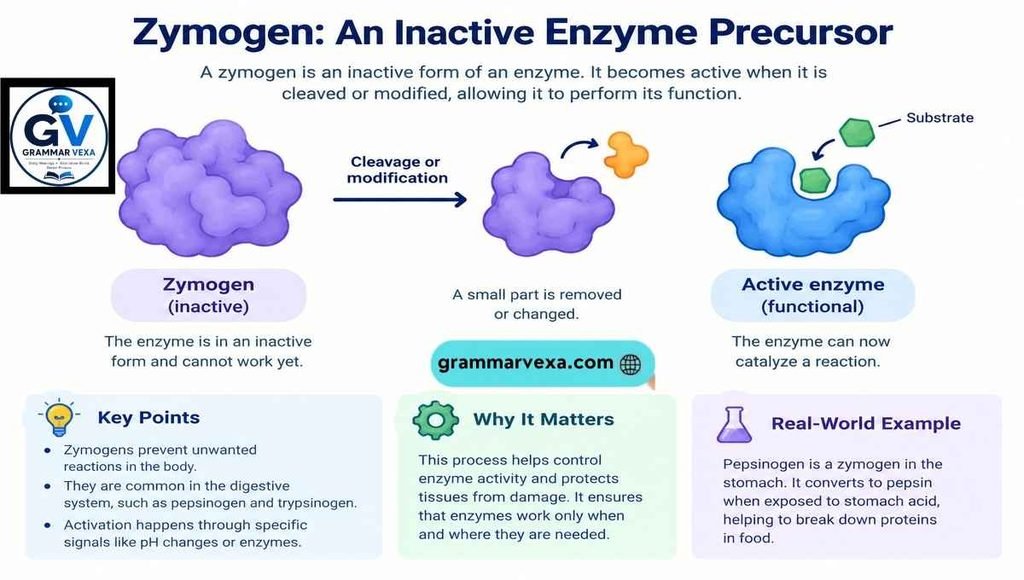
A zymogen is an inactive enzyme precursor that becomes active after a specific biochemical change.
This strategy protects cells and tissues from unwanted enzyme activity.
Why Zymogens Are Important
Digestive enzymes provide an excellent example.
The stomach produces pepsinogen, which is the inactive precursor of pepsin. Stomach acid creates conditions that activate pepsinogen into pepsin, the enzyme that helps digest proteins.
The pancreas also produces several digestive enzymes as inactive precursors. Trypsinogen, for example, is activated in the small intestine and then helps activate other digestive enzyme precursors.
Zymogen Activation
The principle can be summarized as:
Inactive precursor → controlled activation → active enzyme → biochemical function
This is a clever example of enzyme regulation. Instead of keeping powerful enzymes active inside cells, biological systems can store them safely until they are needed.
Zinc: An Essential Chemical Element
Zinc is the chemical element with the symbol Zn and atomic number 30. It’s both an important industrial material and an essential nutrient for humans.
The body uses zinc in numerous biological processes. According to the NIH Office of Dietary Supplements, zinc supports immune function, DNA and protein synthesis, wound healing, cell signaling, and cell division.
Zinc in Human Health
Zinc is required for the activity of hundreds of enzymes. It’s also important for normal growth and development.
For adults, the U.S. recommended dietary allowance is generally 11 mg per day for men and 8 mg per day for women, although needs vary by life stage.
Too little zinc can cause health problems. However, more isn’t automatically better. Excessive zinc intake can cause nausea and other problems and can interfere with copper absorption. The adult tolerable upper intake level is 40 mg per day.
Industrial Uses of Zinc
Zinc also has major technological applications.
It is widely used for:
- Galvanizing steel
- Corrosion protection
- Alloys such as brass
- Batteries
- Chemical manufacturing
- Some pigments and compounds
Galvanizing works because zinc helps protect iron or steel from corrosion.
Zirconium: A Corrosion-Resistant Metal
Zirconium is a metallic element with the symbol Zr and atomic number 40. It is valued for its corrosion resistance and ability to perform under demanding conditions.
The U.S. Geological Survey identifies uses for zirconium in nuclear fuel cladding, chemical piping, heat exchangers, and specialty alloys.
Zirconium in Nuclear Technology
The Zirconium alloys are especially important in nuclear technology because zirconium has useful corrosion resistance and relatively low neutron absorption compared with many structural metals.
The Zirconium is also associated with zircon, a naturally occurring zirconium silicate mineral.
Zirconium vs Zinc
These names sound similar, but the elements are very different.
| Feature | Zinc | Zirconium |
|---|---|---|
| Symbol | Zn | Zr |
| Atomic number | 30 | 40 |
| Main identity | Essential trace element and industrial metal | Corrosion-resistant industrial metal |
| Biological role | Essential nutrient | Not an essential human nutrient |
| Major applications | Galvanizing, alloys, batteries | Nuclear, chemical, ceramic, specialty applications |
Zeolite: Porous Minerals With Powerful Chemical Properties
Zeolites are hydrated aluminosilicate minerals with open structures. Both natural and synthetic zeolites are important because their structures allow adsorption, ion exchange, molecular sieving, and catalytic behavior.
Their tiny pores and channels make them useful as selective molecular filters.
How Zeolites Work
A zeolite can be thought of as a microscopic framework containing channels and cavities.
These structures can:
- Hold water
- Exchange certain ions
- Adsorb molecules
- Separate substances by size
- Support catalytic reactions
USGS describes zeolites as materials whose open crystal structures permit dehydration and ion exchange.
Uses of Zeolites
Zeolites have applications in:
- Water treatment
- Wastewater treatment
- Detergents
- Catalysis
- Molecular sieving
- Agriculture
- Animal feed
- Environmental cleanup
Some zeolites can exchange ions such as ammonium, which makes them useful in certain water-treatment applications.
Real-world example: In water treatment, ion-exchange materials can remove selected dissolved ions by replacing them with ions held within the material.
Zwitterion: A Molecule With Two Opposite Charges
A zwitterion is a molecule that carries formal positive and negative charges while having an overall neutral charge.
IUPAC defines zwitterionic compounds as neutral compounds containing formal charges of opposite signs. Glycine provides a familiar example.
Amino Acids as Zwitterions
Amino acids commonly contain an amino group and a carboxyl group. Depending on the surrounding pH, these groups can carry different protonation states.
In a typical zwitterionic form:
NH₃⁺ — CH₂ — COO⁻
The molecule has both positive and negative charges, yet its net charge is zero.
Why Zwitterions Matter
Zwitterions are important in:
- Biochemistry
- Protein chemistry
- Molecular biology
- Pharmaceutical science
- Acid-base chemistry
Their charge behavior affects how molecules interact with water, membranes, proteins, and other substances.
Zeta Potential: Measuring Behavior at Particle Surfaces
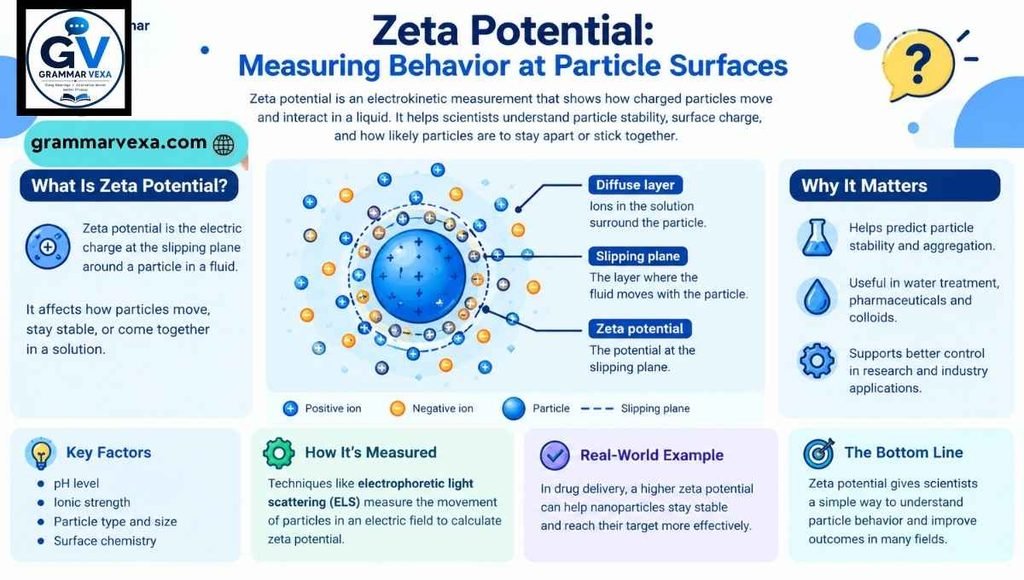
The Zeta potential is an electrokinetic measurement associated with charged particles or surfaces in a fluid.
The concept is especially important in colloidal systems, where tiny particles remain dispersed in a liquid.
The American Chemical Society describes zeta potential as a commonly reported measure related to the charge state of solid surfaces and colloidal particles in contact with solvents.
Why Zeta Potential Matters
Particles in suspension can attract or repel one another. Their surface properties strongly influence whether they remain dispersed or begin to aggregate.
This matters in:
- Water treatment
- Pharmaceuticals
- Drug delivery systems
- Nanotechnology
- Paints and coatings
- Food products
- Mineral processing
A large electrostatic repulsion can help keep particles apart. Changes in pH or ionic strength can alter surface behavior and therefore change particle stability.
Zeta Potential Is Not Simply “Surface Charge”
This distinction matters.
Zeta potential is an electrokinetic potential measured near the slipping plane of a particle in a fluid. It isn’t simply a direct measurement of the chemical charge sitting on the particle’s surface.
That difference becomes important when interpreting laboratory measurements.
Zero-Point Energy: Energy at the Quantum Level
Zero-point energy is the minimum energy that a quantum system can possess.
In classical physics, one might imagine an oscillator eventually becoming completely motionless. Quantum mechanics changes that picture.
For a quantum harmonic oscillator, the ground-state energy is:
E₀ = ½ℏω
This nonzero ground-state energy is a direct consequence of quantum theory.
Zero-Point Energy and Quantum Fluctuations
A quantum system cannot simply behave like a classical object sitting perfectly still at zero energy.
This connects zero-point energy with broader ideas involving:
- Quantum mechanics
- Quantum fluctuations
- Vacuum states
- Quantum fields
- Casimir-related phenomena
However, zero-point energy shouldn’t be confused automatically with dark energy.
NASA notes that vacuum energy has been discussed as one possible connection to the cosmological constant and accelerated expansion, but the relationship remains an active area of theoretical physics.
A Common Misunderstanding
Zero-point energy doesn’t mean scientists have discovered a simple source of limitless usable energy.
The term describes the ground-state energy of quantum systems. Turning that concept into a practical energy source is a completely different question.
Zeeman Effect: When Magnetic Fields Split Spectral Lines
The Zeeman effect describes the splitting of atomic spectral lines when atoms interact with a magnetic field.
It provides a direct connection between quantum physics, atomic structure, magnetism, and spectroscopy.
How the Zeeman Effect Works
Atomic energy levels can split into magnetic sublevels when a magnetic field is applied.
When electrons transition between these energy levels, they emit or absorb light at specific frequencies. The magnetic field changes those energy levels, producing measurable shifts or splitting in spectral lines.
NIST provides detailed equations describing the energy shifts and magnetic sublevels associated with the Zeeman effect.
Why Scientists Use the Zeeman Effect
The effect can help researchers determine properties such as magnetic splitting factors and study atomic spectra.
It’s also useful in spectroscopy and research involving magnetized plasmas.
This makes the Zeeman effect an excellent example of how an abstract quantum phenomenon can become a practical measurement tool.
Zeta Function: A Mathematical Concept With Scientific Connections
The Riemann zeta function is primarily a mathematical concept, but it has important connections to physics and scientific modeling.
For real values greater than 1, it can be represented by the series:
ζ(s) = 1 + 1/2ˢ + 1/3ˢ + 1/4ˢ + …
The function is deeply connected to prime numbers and the prime number theorem. Its nontrivial zeros are central to the famous Riemann hypothesis, which remains unproved.
Why the Zeta Function Matters
The zeta function appears in areas involving:
- Number theory
- Mathematical physics
- Statistical mechanics
- Quantum theory
- Complex analysis
This term shows that scientific vocabulary isn’t restricted to biology or chemistry. Mathematics often provides the language needed to describe physical systems.
Zygospore: A Resistant Reproductive Structure
A zygospore is a specialized reproductive structure formed by certain organisms, particularly some fungi and algae.
It develops through the fusion of compatible reproductive cells or structures and can provide a resistant stage during unfavorable conditions.
Zygospore vs Zygote
These terms are related but shouldn’t be treated as synonyms.
A zygote is a fertilized cell.
A zygospore is a specialized reproductive structure that can develop from sexual fusion and often serves as a resistant stage.
The distinction becomes especially useful when studying fungal reproduction, life cycles, and developmental biology.
Zone of Saturation: Water Beneath the Ground
The zone of saturation is an important concept in Earth science and hydrology.
It refers to the subsurface region where pore spaces are substantially filled with water. The water table is commonly described as the upper surface of this water-filled region in basic groundwater models.
Groundwater and Aquifers
An aquifer is a water-bearing geological formation capable of transmitting enough groundwater to wells or springs.
The relationship can be simplified as:
Rainfall → infiltration → groundwater recharge → saturated zone → aquifer → wells/springs
Groundwater doesn’t sit inside giant underground lakes in most settings. Instead, it occupies pores, fractures, and spaces within geological materials.
Why the Zone of Saturation Matters
This concept is essential for understanding:
- Groundwater storage
- Drinking water supplies
- Aquifer systems
- Well construction
- Water movement
- Drought
- Groundwater contamination
- Sustainable water use
USGS notes that porosity and permeability influence how water is stored and transmitted underground.
A useful caution is that the water table is more complicated than the simple phrase “top of the saturated zone” suggests. USGS research has highlighted important hydrogeological nuances in how the water table is defined.
How These Z Science Words Connect Across Fields
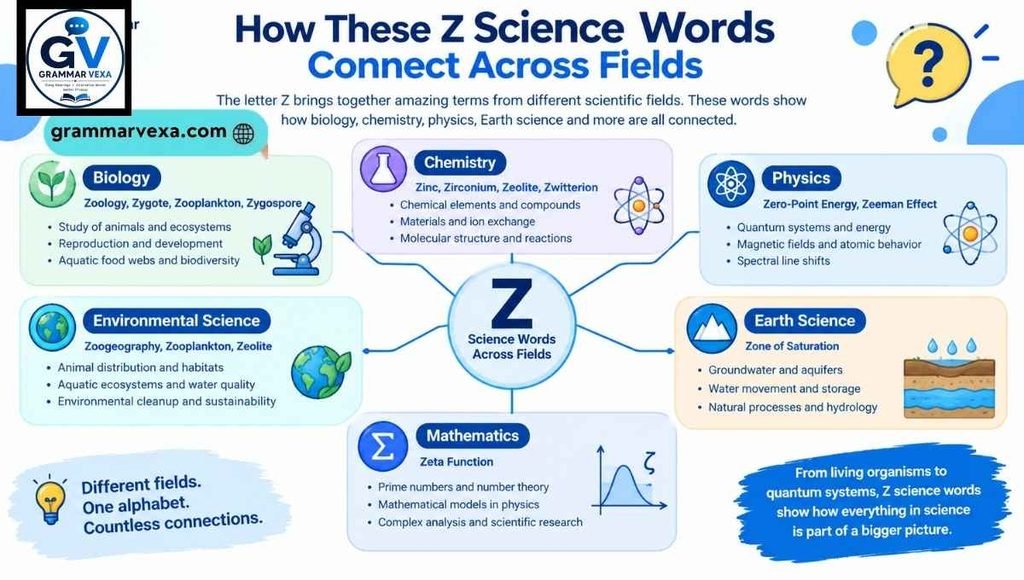
The most interesting feature of science words that start with Z is how they connect different disciplines.
| Field | Z terms | What they help explain |
|---|---|---|
| Biology | Zoology, zygote, zymogen, zygospore | Animals, reproduction, enzymes |
| Marine biology | Zooplankton, zoogeography | Aquatic ecosystems and animal distribution |
| Medicine | Zoonosis, zinc, zymogen | Disease, nutrition, biochemical regulation |
| Chemistry | Zinc, zirconium, zeolite, zwitterion | Elements, materials, molecules |
| Physics | Zero-point energy, Zeeman effect | Quantum systems and atomic behavior |
| Mathematics | Zeta function | Prime numbers and mathematical physics |
| Earth science | Zone of saturation | Groundwater and aquifer systems |
| Environmental science | Zooplankton, zeolite, zoonosis | Ecosystem health and environmental management |
These connections demonstrate an important principle: scientific fields overlap constantly.
A marine biologist may use chemistry to understand ocean nutrients. A medical researcher may use biochemistry to understand enzyme activation. An environmental scientist may use hydrology and mineralogy to study groundwater contamination.
Z Science Terms in Real-World Applications
Medicine and Biotechnology
Several Z terms have direct medical relevance.
Zinc supports cellular metabolism and immune function. Zymogens help regulate digestive enzymes. Zoonoses are central to infectious disease surveillance.
These examples show how molecular processes can affect whole-body health and public health.
Environmental Science
Zooplankton can provide information about aquatic ecosystem conditions. Zeolites can participate in water-treatment processes. The zone of saturation helps scientists understand groundwater resources.
Together, these concepts support environmental monitoring and resource management.
Materials and Industrial Chemistry
Zinc and zirconium have important industrial roles. Zeolites provide porous materials with useful ion-exchange, adsorption, and catalytic properties.
These materials demonstrate how microscopic structure can determine macroscopic performance.
Physics and Astronomy
The Zeeman effect helps scientists analyze atomic spectra and magnetic interactions. Zero-point energy provides an essential quantum concept.
The underlying lesson is simple: at very small scales, nature doesn’t always behave like everyday objects.
Commonly Confused Z Science Terms
Zygote vs Zygospore
A zygote is a fertilized cell. A zygospore is a specialized reproductive structure formed in certain organisms.
Zoology vs Zoogeography
Zoology studies animals broadly.
Zoogeography focuses specifically on where animals live and why their distributions differ.
Zymology vs Zymase
Zymology is the study of fermentation.
Zymase refers to an enzyme complex historically associated with alcoholic fermentation in yeast.
Zymogen vs Active Enzyme
A zymogen is inactive until activated.
An active enzyme can immediately perform its catalytic function under suitable conditions.
Zinc vs Zirconium
Zinc is an essential nutrient and industrial metal. Zirconium is a corrosion-resistant metal used in specialized industrial and nuclear applications.
Zero-Point Energy vs Vacuum Energy
Zero-point energy describes minimum energy associated with quantum systems.
Vacuum energy is a broader concept in quantum field theory and cosmology. The two concepts are related in some theoretical frameworks, but they shouldn’t be treated as identical in every context.
Best Ways to Learn Science Words That Start With Z
Learning unusual scientific terms becomes easier when you connect each word to an actual concept.
Group Terms by Field
Don’t memorize a giant alphabetical list without context.
Instead, group terms:
- Biology: zygote, zoology, zymogen
- Marine science: zooplankton, zoogeography
- Chemistry: zinc, zirconium, zeolite, zwitterion
- Physics: zero-point energy, Zeeman effect
- Earth science: zone of saturation
- Mathematics: zeta function
Connect Each Word to an Example
For example:
- Zygote: fertilization
- Zooplankton: ocean food web
- Zymogen: pepsinogen
- Zinc: enzyme activity
- Zeolite: ion exchange
- Zeta potential: particle stability
- Zeeman effect: magnetic spectral splitting
- Zone of saturation: groundwater
Concrete examples are easier to remember than isolated definitions.
Don’t Confuse Similar-Sounding Terms
Several Z terms look or sound similar. That’s where mistakes happen.
Before using a term in academic writing, check whether it describes an organism, process, material, measurement, or theoretical concept.
For example, zeta potential has nothing to do with the Riemann zeta function, despite their shared name.
Key Takeaways About Z Science Vocabulary
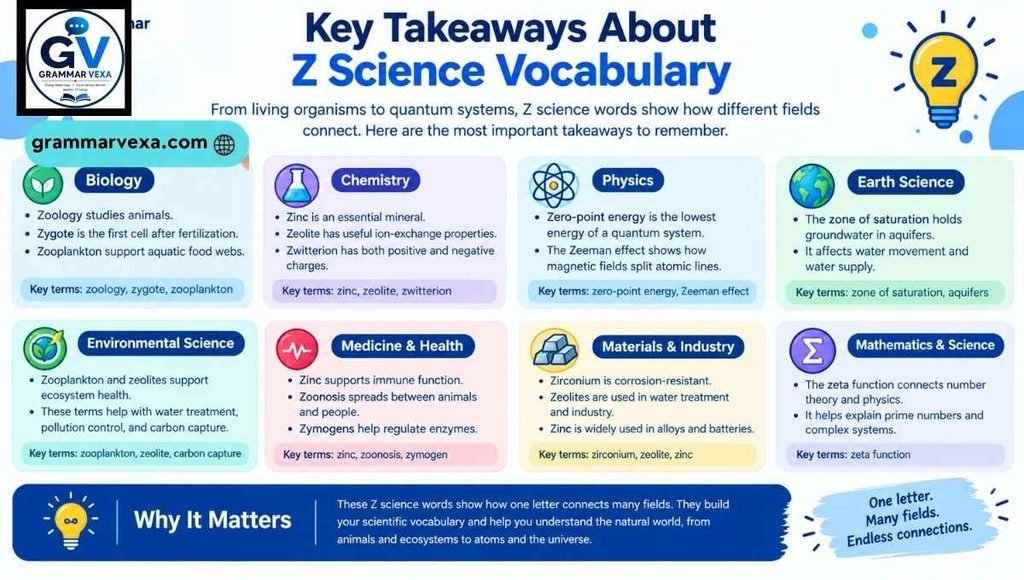
- Zoology is the scientific study of animals.
- A zygote forms when reproductive cells fuse during fertilization.
- Zooplankton connect microscopic primary producers with larger aquatic organisms.
- Zoogeography explains patterns in animal distribution.
- Zymology studies fermentation and its biological chemistry.
- Zymogens are inactive enzyme precursors that become active under controlled conditions.
- Zinc is an essential nutrient and useful industrial metal.
- Zirconium is important in nuclear and chemical applications.
- Zeolites have valuable porous, ion-exchange, adsorption, and catalytic properties.
- Zwitterions contain positive and negative formal charges while remaining electrically neutral overall.
- Zeta potential helps scientists understand particle behavior in colloidal systems.
- Zero-point energy describes the minimum energy of a quantum system.
- The Zeeman effect reveals how magnetic fields influence atomic energy levels.
- The zeta function connects mathematics with number theory and physics.
- The zone of saturation is fundamental to groundwater science.
The real value of these science words beginning with Z lies in what they reveal. A single letter can lead from animal biology to quantum mechanics, from fermentation to groundwater, and from molecular chemistry to marine ecosystems.
Conclusion
Zooming Into Science: Fascinating Science Words That Start With Z shows how much scientific vocabulary can fit around one letter. Terms like zoology, zygote, zooplankton, zinc, zeolite, and zeta potential cover biology, chemistry, and environmental science. Other terms, such as zero-point energy and the Zeeman effect, introduce fascinating ideas from physics. Each word connects to a real scientific concept or process.
Zooming Into Science: Fascinating Science Words That Start With Z also makes complex terms easier to understand. Learning these words can strengthen your science vocabulary and improve your understanding of different fields. From animal life and fermentation to quantum systems and groundwater, these terms show how broad science can be. They also give you useful language for studying, writing, and discussing scientific concepts with greater confidence.
FAQs
What are some science words that start with Z?
Common examples include zoology, zygote, zooplankton, zinc, zeolite, zymogen, and zeta potential. These terms come from biology, chemistry, physics, and environmental science.
What is zoology in science?
Zoology is the scientific study of animals. It covers animal behavior, anatomy, physiology, evolution, and classification.
What is the difference between a zygote and a zygospore?
A zygote forms when two reproductive cells fuse during fertilization. A zygospore is a specialized reproductive structure formed by some fungi and algae.
Why is zinc important in the human body?
Zinc supports immune function, DNA and protein production, cell division, and wound healing. The body needs it in small amounts but cannot produce it naturally.
What is zeta potential used for?
Zeta potential helps scientists understand the surface charge and stability of particles suspended in liquids. It has practical uses in water treatment, pharmaceuticals, and colloid science.
What are zeolites used for?
Zeolites are porous materials valued for ion exchange, adsorption, and molecular sieving. They’re used in areas such as water treatment, detergents, agriculture, and industrial processing.
Are there physics words that start with Z?
Yes. Zero-point energy and the Zeeman effect are important physics terms. Zero-point energy relates to quantum ground states while the Zeeman effect describes changes in atomic energy levels caused by magnetic fields.
Why are zooplankton important to aquatic ecosystems?
Zooplankton connect microscopic producers such as phytoplankton with larger aquatic animals. They play an important role in aquatic food webs and nutrient cycling.
How can students learn science words that start with Z?
Group terms by field and connect each word with a simple definition and real example. Reviewing related concepts regularly makes scientific vocabulary easier to remember.

Jessica Morgan is an English language writer and researcher at Grammar Vexa. I enjoy exploring slang, vocabulary, word meanings, synonyms, and alternative phrases. Through my work, I aim to make English easier to understand by providing clear explanations, useful examples, and practical language tips.








2 thoughts on “Zooming Into Science: Fascinating Science Words That Start With Z”