Pre and Post Meaning: Understanding Their Usage and Importance explains how the terms pre and post describe timing and sequence. In general, pre- means before a specific event, time, or process, while post- means after it. These prefixes appear in everyday English and specialized fields, including education, medicine, business, technology, and social media. Understanding their meaning makes unfamiliar words easier to interpret and helps you communicate more precisely.
A small prefix can completely change where an action belongs on a timeline. Pretest refers to an assessment before instruction, while post-test refers to one conducted afterward. The same pattern appears in pre-launch and post-launch, preoperative and postoperative, and pre-treatment and post-treatment. Once you recognize this sequence, many professional terms become easier to understand at a glance.
Learning Pre and Post Meaning: Understanding Their Usage and Importance also helps you avoid common language misunderstandings. You’ll see how these terms work as prefixes, how context affects the meaning of “post,” and how they’re used across different industries. Clear examples and practical comparisons make the distinction simple to remember and apply correctly.
What Do Pre and Post Mean?
The simplest pre and post definition is based on time and sequence:
- Pre- = before something
- Post- = after something
Think of an event as the center point on a timeline:
Pre → Specific event → Post
For example:
Pre-game → Game → Post-game
The pre-game stage occurs first. The game itself is the reference event. The post-game stage follows it.
Cambridge Dictionary defines pre- as a prefix meaning “before” a time or event. It gives examples such as pre-flight, pre-lunch, and pre-industrial. Cambridge similarly defines post- as a prefix meaning “after or later than,” with examples such as postgraduate and postoperative.
This basic relationship appears across thousands of words.
| Term | Meaning | Example |
|---|---|---|
| Pre- | Before | Pretest |
| Post- | After | Post-test |
| Pre-event | Before an event | Pre-event planning |
| Post-event | After an event | Post-event review |
| Pre-treatment | Before treatment | Pre-treatment assessment |
| Post-treatment | After treatment | Post-treatment monitoring |
| Pre-launch | Before launch | Pre-launch marketing |
| Post-launch | After launch | Post-launch analysis |
The key is identifying the reference point. Without that reference point, the words can seem vague.
For example, “preparation” doesn’t simply mean “before” in isolation. It describes actions taken beforehand for a particular task, event, or process.
Key Takeaway
When you see pre- attached to a word, ask:
What happens before what?
When you see post-, ask:
What happens after what?
Those two questions solve most cases involving the difference between pre and post.
Pre Meaning: What Does Pre Mean in English?
The meaning of pre is generally connected with something occurring before, earlier than, or in advance of another event or condition.
The form pre- is a prefix. A prefix is a letter or group of letters added to the beginning of a word to create a new word or change its meaning. Cambridge Dictionary describes prefixes as elements added to the beginning of words and identifies pre- as a prefix expressing the time relationship “before.”
So when you see pre-, look for the event or action that comes later.
Pre- as a Prefix
The pre prefix meaning becomes clearer through examples:
- Preheat = heat something before using it.
- Prepay = pay before receiving or completing something.
- Preview = view something before the main presentation or release.
- Pretest = test before instruction or another assessment stage.
- Preorder = order before an item becomes generally available.
- Prelaunch = occurring before a formal launch.
- Preoperative = relating to the period before an operation.
- Prenatal = relating to the period before birth.
- Pre-existing = existing beforehand.
The prefix doesn’t always describe a literal clock time. It can describe a stage in a process.
For example, a pre-approval may occur before a final transaction. A pre-screening step may occur before a more detailed evaluation. A pre-install process may happen before software or equipment is fully installed.
The central idea remains the same: the action or condition comes first.
Pre Means More Than Simply “Before”
The word pre often carries the idea of preparation.
Consider pre-meeting preparations. These might include reviewing documents, setting an agenda, checking data, and identifying questions.
The word doesn’t merely tell you that these actions happen earlier in time. It tells you where those actions sit within a larger process.
That distinction matters.
Compare:
- “I read the report.”
- “I completed the pre-reading before the workshop.”
The second sentence provides information about sequence and purpose.
Common Words With Pre-
Here are some familiar pre and post words involving the pre- prefix:
| Pre-word | Meaning |
|---|---|
| Preheat | Heat beforehand |
| Prepay | Pay beforehand |
| Preview | View beforehand |
| Preplan | Plan beforehand |
| Prewash | Wash before another washing stage |
| Pre-book | Book in advance |
| Pretest | Test before another stage |
| Pre-cut | Cut beforehand |
| Prepack | Pack beforehand |
| Preprogram | Program in advance |
| Pre-order | Order before general availability |
| Pre-exercise | Occurring before exercise |
| Pre-read | Read beforehand |
| Pre-screen | Screen before a later evaluation |
| Pre-schedule | Schedule ahead of time |
| Pre-install | Install beforehand |
| Pre-fill | Fill beforehand |
| Pre-clean | Clean before another process |
| Pre-chill | Chill beforehand |
| Pre-record | Record before the later use |
Some of these words are common in everyday language. Others appear mainly in technical, professional, or specialized contexts.
Post Meaning: What Does Post Mean in English?
The post meaning becomes slightly more complicated because post has several meanings in English.
As a prefix, post- generally means after or later than a particular event or time. Cambridge gives examples including postgraduate, postoperative, and post-lunch.
For example:
- Post-test = a test conducted after instruction or another reference stage.
- Post-event = occurring after an event.
- Post-surgery = occurring after surgery.
- Post-launch = occurring after a product launch.
- Post-treatment = occurring after treatment.
- Post-graduation = occurring after graduation.
Post- as a Prefix
The post prefix meaning becomes easiest to understand when you connect it with a reference event.
- Post + event = after the event
- Post + surgery = after surgery
- Post + launch = after launch
- Post + treatment = after treatment
This is why postoperative recovery refers to recovery after an operation. Similarly, postnatal care concerns care after birth.
The exact professional meaning can be more specific than the simple “after” definition. In medicine, for example, terms can describe defined stages of patient care. Still, the underlying time relationship remains useful for understanding the terminology.
Common Words With Post-
| Post-word | Meaning |
|---|---|
| Postpone | Delay something until a later time |
| Post-workout | Occurring after exercise |
| Post-event | Occurring after an event |
| Post-call | Occurring after a call |
| Post-graduation | Occurring after graduation |
| Post-release | Occurring after a release |
| Post-payment | Payment made afterward |
| Post-surgery | After surgery |
| Post-reading | Occurring after reading |
| Post-vacation | Following a vacation |
| Post-test | Assessment after another stage |
| Post-launch | Following a launch |
| Post-tax | After taxes |
| Post-implementation review | Review after implementation |
| Postoperative | After an operation |
| Postnatal | After birth |
| Post-treatment | After treatment |
| Post-processing | Processing performed after an earlier processing stage |
Notice something interesting about postpone. It doesn’t simply mean “after” in the same way as post-event. It means to delay something until a later time. This is an example of why vocabulary shouldn’t be reduced to one-word translations.
Pre vs. Post: The Key Difference
The simplest pre vs post meaning comparison is chronological:
Pre = before. Post = after.
Suppose a company launches a new application on Monday.
- Work done Sunday is pre-launch.
- The launch occurs Monday.
- Analysis performed Tuesday is post-launch.
The terms establish a relationship between actions and a specific event.
| Feature | Pre- | Post- |
|---|---|---|
| Basic meaning | Before | After |
| Time position | Earlier in time | Later in time |
| Related idea | Preparation | Follow-up |
| Common use | Planning | Evaluation |
| Example | Pre-test | Post-test |
| Business | Pre-launch | Post-launch |
| Medicine | Preoperative | Postoperative |
| Education | Pre-reading | Post-reading |
| Technology | Pre-processing | Post-processing |
| Social media | Pre-scheduled content | Post-campaign analysis |
A Simple Way to Remember Pre and Post
Use this memory trick:
PRE = PRIOR
Both begin with the same pr sound and connect with something that happens earlier.
POST = FOLLOWING
A post-stage follows the reference event.
Another useful method is to picture a timeline:
Before → Event → After
Pre → Event → Post
Once you identify the central event, the terminology becomes much easier.
How Pre and Post Work as Prefixes
A prefix appears at the beginning of a word. It can modify the meaning of the base word or create a new word. Cambridge explains that prefixes are added to the beginning of words and can express relationships such as time, place, manner, and negation.
For pre- and post-, the important relationship is usually time.
Consider the base word test:
- Pretest → before the relevant learning or assessment stage
- Post-test → after the relevant learning or assessment stage
Now consider launch:
- Pre-launch → before launch
- Post-launch → after launch
The base word tells you what the event or process is. The prefix tells you where the action falls in the sequence.
Pre and Post as Process Markers
This is especially useful in professional language.
Imagine a software deployment process:
Pre-deployment testing → Deployment → Post-deployment monitoring
Each label identifies a different stage.
Similarly, a research project might use:
Pre-intervention assessment → Intervention → Post-intervention assessment
The terms create a clear structure without requiring long explanations.
That’s one reason pre and post terminology appears so frequently in technical fields.
Pre and Post Meaning in Daily Life
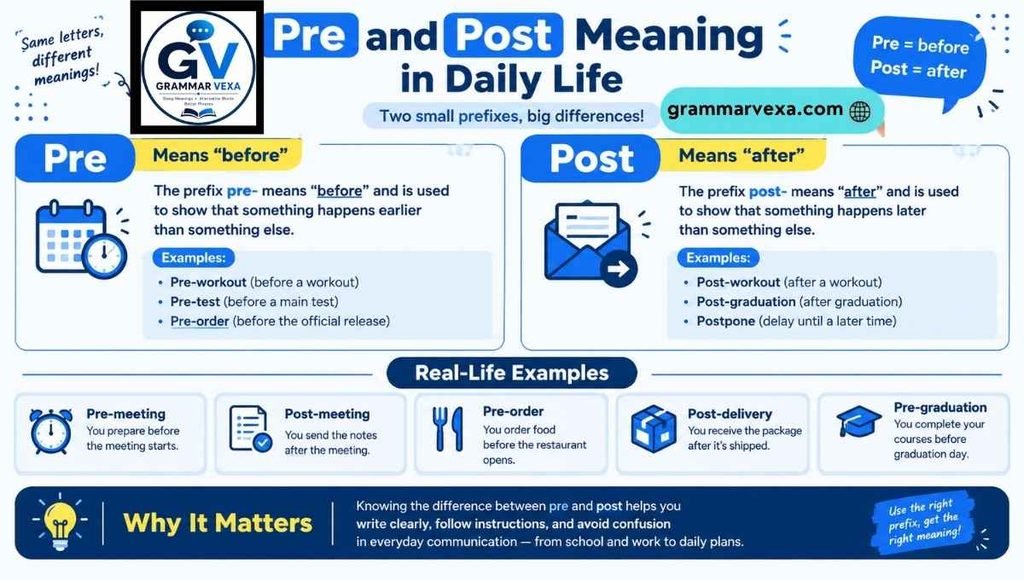
Everyday life is full of activities that happen before and after other activities.
You might preheat an oven before cooking. You might prepay a bill before a service is provided. After an event, you might write a post-event summary.
These terms make sequences easier to describe.
Examples of Pre in Daily Life
Consider these ordinary examples:
- Preheat the oven before baking.
- Prewash clothes when the fabric requires an initial rinse.
- Pre-book a hotel before traveling.
- Pre-order a product before its release date.
- Pre-pack supplies before a trip.
- Complete a pre-read before a meeting.
- Make pre-meeting preparations before a discussion.
- Use pre-chilled ingredients before serving.
Each example involves something happening in advance.
Examples of Post in Daily Life
Afterward, the language changes:
- Review a post-event report.
- Complete a post-workout routine.
- Discuss results during a post-call follow-up.
- Handle post-vacation tasks after returning home.
- Review post-reading activities after finishing a text.
- Complete post-payment records after a transaction.
The distinction helps with planning, organization, productivity, and communication.
For example, a meeting checklist could contain:
Pre-meeting: Review agenda → Prepare questions → Check documents
Meeting: Discuss issues → Make decisions → Assign tasks
Post-meeting: Send notes → Confirm responsibilities → Track follow-up
That’s a practical example of how pre and post usage supports clear sequencing.
Pre and Post Meaning in Education
Education provides one of the clearest examples of the pre and post meaning in education.
Teachers often divide learning into stages. Students begin with existing knowledge, receive instruction, and then demonstrate what they’ve learned.
A common structure is:
Pre-test → Teaching → Post-test
Pre-Test and Post-Test
A pre-test measures what students know before instruction or a learning intervention.
A post-test measures performance after the relevant instruction or intervention.
The comparison can help teachers understand whether learning occurred.
For example:
| Stage | Activity | Purpose |
|---|---|---|
| Pre | Pre-test | Establish starting knowledge |
| During | Teaching | Deliver instruction |
| Post | Post-test | Measure later performance |
However, a higher post-test score doesn’t automatically prove that teaching caused every improvement. Researchers and educators must consider factors such as test familiarity, outside learning, and assessment design.
That’s an important point when interpreting measurable learning.
Pre-Reading and Post-Reading
Reading instruction also uses these stages.
Pre-reading activities might include:
- Reviewing the title.
- Looking at headings.
- Predicting the topic.
- Activating prior knowledge.
- Introducing important vocabulary.
After reading, post-reading activities might include:
- Answering comprehension questions.
- Summarizing the text.
- Discussing key ideas.
- Comparing claims.
- Applying information to a new problem.
The two stages support different parts of the learning process.
Pre-reading prepares the mind for incoming information. Post-reading helps students process, evaluate, and apply what they encountered.
Why Pre and Post Matter in Education
The terminology helps teachers and curriculum designers distinguish stages of learning.
For example:
Pre-reading activates prior knowledge. Post-reading checks comprehension and encourages deeper application.
That distinction can make a lesson easier to organize and assess.
It also helps students understand why an activity exists. Instead of seeing every classroom task as unrelated, they can see a sequence.
Pre and Post Meaning in Business
Business operations depend heavily on timing. Planning occurs before execution. Evaluation usually occurs afterward.
That’s why the pre and post meaning in business appears in areas such as finance, marketing, project management, sales, and product development.
Pre-Launch and Post-Launch
A product launch provides a straightforward example.
Before release, a company may conduct:
- Market research
- Product testing
- Pre-launch marketing
- Customer research
- Pricing analysis
- Pre-approval
- Staff training
- Technical checks
After release, the company may conduct:
- Customer feedback collection
- Sales analysis
- Bug monitoring
- Post-launch reviews
- Campaign performance analysis
- Product improvements
The difference is not merely grammatical. It represents two distinct phases of business planning and execution.
Pre-Tax and Post-Tax Income
Finance provides another useful example.
Pre-tax income refers to income before applicable taxes are deducted.
Post-tax income refers to the amount remaining after taxes are accounted for.
For example, if a company’s accounting report presents a profit figure before income taxes and another figure after taxes, the labels help readers understand exactly where each figure sits in the financial sequence.
The terms are useful because financial results can change significantly depending on whether a figure is measured before or after a particular deduction.
Pre-Approval and Post-Implementation Review
In business processes, pre-approval occurs before a transaction, purchase, or action receives final authorization.
A post-implementation review, by contrast, occurs after a project or system has been implemented.
The review may examine:
- Whether objectives were achieved.
- Whether the project stayed within budget.
- What problems appeared.
- How users responded.
- What should change next time.
This is a practical example of how pre and post terminology separates preparation from evaluation.
Pre and Post Meaning in Medicine
Medical terminology uses pre- and post- extensively because patient care often follows carefully defined sequences.
The pre and post meaning in medicine usually helps identify whether something relates to a stage before or after a medical event, procedure, treatment, or birth.
Preoperative and Postoperative
The terms preoperative and postoperative are common examples.
Preoperative care concerns preparation and assessment before surgery.
Postoperative recovery concerns care and monitoring after surgery.
The exact care provided depends on the procedure and the patient’s circumstances. Medical teams may consider factors such as medications, medical history, vital signs, pain, mobility, wound care, and potential complications.
The terminology provides a useful temporal marker.
Before surgery → Surgery → After surgery
Preoperative → Procedure → Postoperative
Prenatal and Postnatal
The same principle appears around birth.
Prenatal refers to the period before birth.
Postnatal refers to the period after birth.
Healthcare professionals use these terms to distinguish different periods of care and assessment.
For example:
- Prenatal checkups occur during pregnancy before birth.
- Postnatal care occurs after birth.
- A pre-existing condition existed before a particular medical event or diagnosis.
- Post-treatment monitoring occurs after treatment.
Pre-Treatment and Post-Treatment
Treatment can also create a clear reference point.
A clinical process might involve:
Pre-treatment assessment → Treatment → Post-treatment monitoring
The initial assessment can establish a baseline. Later measurements may show how the patient’s condition changed.
However, medical terminology can be highly specific. A reader shouldn’t assume that every term beginning with pre- or post- has the same clinical implications across all specialties.
For health decisions, terminology should be interpreted in the context of the actual medical record and professional guidance.
Why Medical Prefixes Matter
Medical language contains many prefixes and roots that help professionals describe relationships efficiently.
Knowing that pre- often indicates something before an event and post- often indicates something afterward can make unfamiliar terminology easier to decode.
Still, recognizing a prefix isn’t enough to diagnose a condition or interpret a treatment plan. Medical words often contain several components, and their full meanings can be specialized.
Pre and Post Meaning in Technology
Technology processes frequently occur in stages. Data enters a system, processing occurs, and additional actions follow.
That’s why pre and post meaning in technology appears in software engineering, web development, image processing, video production, and system administration.
Pre-Installed Software
Pre-installed software is software already installed on a device when it reaches the user.
The word tells you the software installation occurred before the user’s normal setup process.
Pre-Processing and Post-Processing
Data workflows often separate processing into stages.
Pre-processing occurs before the main processing operation.
Post-processing occurs after the main operation.
For example:
Raw image → Pre-processing → Main image operation → Post-processing → Final image
Pre-processing might involve preparing or cleaning input data.
Post-processing might involve refining or transforming the output.
The exact steps vary by application.
Pre-Fetching
Pre-fetching describes obtaining data before it is expected to be needed.
A system may anticipate future demand and retrieve information ahead of time.
The purpose is often related to performance.
The core relationship remains:
Expected future need → Fetch beforehand → Use later
The word “pre” communicates that the retrieval occurs before the main use.
Postback and Server Actions
In web development, a postback can refer to a request sent back to a server, especially in particular web frameworks and architectures.
Here, “postback” should not be interpreted simply as “after.” It illustrates an important rule:
Not every word beginning with “post” uses the prefix post- in the simple chronological sense.
Technical vocabulary can develop specialized meanings. Context always matters.
Pre vs. Post Meaning in Social Media
Social media creates an especially interesting case because post has both a time-related prefix meaning and a completely different everyday meaning.
The post meaning in social media usually refers to a piece of content published online.
You can:
- Create a post.
- Write a post.
- Publish a post.
- Share a post.
- Edit a post.
- Delete a post.
In this usage, post isn’t functioning as the opposite of “pre.”
Cambridge defines post as a verb that can mean putting information on the Internet for others to see.
Pre-Scheduled Posts
Suppose a company creates ten social media posts on Monday and schedules them for publication throughout the following week.
The content preparation happens before publication.
Those are pre-scheduled posts.
The word “pre” communicates advance preparation.
Pre-Event Teasers
Before a conference, brand launch, or public event, a company might publish:
- Sneak peeks
- Countdown graphics
- Speaker announcements
- Short promotional videos
- Registration reminders
These can function as pre-event teasers.
After the event, the same organization might publish:
- Photos
- Video clips
- Results
- Quotes
- Recaps
- Post-event highlights
The content strategy therefore has two distinct phases.
Post-Campaign Analysis
After a social media campaign ends, marketers may conduct post-campaign analysis.
They might examine:
- Reach
- Engagement
- Click-through activity
- Conversions
- Audience response
- Content performance
- Campaign objectives
This is different from content preparation.
The broader sequence looks like this:
Content preparation → Publication → Campaign → Post-campaign analysis
Understanding the timing makes the terminology much easier to follow.
Pre and Post in English Writing
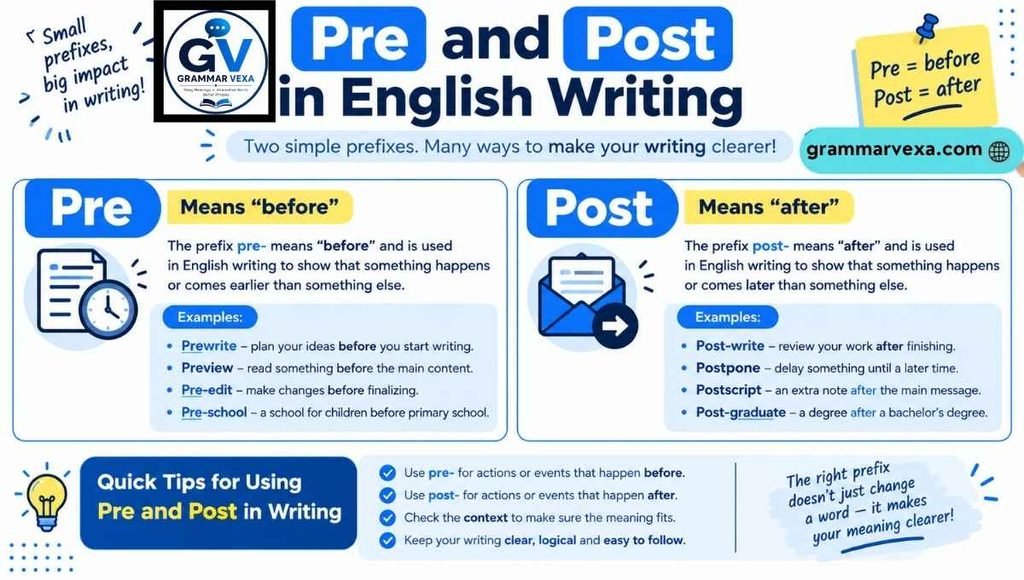
The pre and post in English grammar question often comes down to understanding prefixes and compounds.
A prefix attaches to the beginning of a word. But spelling conventions aren’t identical for every word.
Cambridge notes that there are no absolute rules governing whether a prefixed word should always use a hyphen or appear as one word. A dictionary can provide the appropriate spelling for a particular word.
When to Use Pre- and Post-
Common established forms include:
- Preheat
- Prepay
- Preview
- Postgraduate
- Postoperative
- Postwar
Other constructions may commonly appear with a hyphen, especially when clarity benefits from one.
Examples include:
- Pre-event
- Pre-launch
- Post-event
- Post-launch
- Post-treatment
- Pre-existing
The correct form can depend on the word, context, publication style, and dictionary convention.
Don’t Assume Every Pre- or Post- Word Uses the Same Spelling
One of the most common common mistakes with pre and post is treating the prefixes like a universal spelling formula.
For example, you shouldn’t decide that every word must be written as:
pre-word
or:
post-word
English compounds develop through usage and editorial convention.
When accuracy matters, check a current dictionary or the style guide used by your publication.
Common Pre and Post Examples
Examples are often the fastest way to understand the pre and post meaning examples.
Everyday Examples
- Preheat the oven before baking.
- Prepay the bill before the service begins.
- Preview the presentation before the meeting.
- Complete the post-event survey afterward.
- Follow the post-workout routine after exercise.
- Review the post-call notes after speaking with the client.
Education Examples
- Students completed a pre-test before the lesson.
- The teacher assigned pre-reading for homework.
- Students completed a post-test after instruction.
- The class discussed post-reading activities afterward.
Business Examples
- The company began pre-launch marketing.
- The finance team calculated pre-tax income.
- Management conducted a post-launch review.
- The team performed a post-campaign analysis.
Medical Examples
- The patient received preoperative care.
- The doctor reviewed the patient’s pre-existing condition.
- The patient received postoperative monitoring.
- The healthcare team provided post-treatment guidance.
Technology Examples
- The device includes pre-installed software.
- The system performs pre-processing on incoming data.
- The application uses pre-fetching to obtain data early.
- The system performs post-processing after the main operation.
A Practical Framework for Using Pre and Post Correctly
When you’re unsure about how to use pre and post, don’t guess. Use a simple four-step process.
Step 1: Identify the Reference Event
First, identify the event or process you’re talking about.
It could be:
- A test
- A meeting
- A launch
- Surgery
- Graduation
- Treatment
- Publication
- Installation
- Campaign
- Exercise session
Step 2: Identify the Timing
Ask whether the action happens before or after that event.
If it happens earlier, pre- may be appropriate.
If it happens later, post- may be appropriate.
Step 3: Check the Full Word
Don’t interpret the prefix alone.
For example, post as a social media noun doesn’t mean “after.” It refers to published content.
Likewise, technical terms can develop specialized meanings.
Step 4: Check Spelling and Context
If you’re writing professionally, verify whether the term should be:
- One word
- Hyphenated
- Two words
A reliable dictionary or relevant style guide can settle the question.
Common Misunderstandings About Pre and Post
Several misunderstandings appear repeatedly when people learn these terms.
Does Post Mean Before or After?
Post generally means after when it functions as the prefix post-.
For example:
- Post-test = after the relevant test or learning stage
- Postoperative = after an operation
- Post-event = after an event
- Post-launch = after launch
Cambridge defines post- as “after or later than” in its English dictionary.
Is Pre Before or After?
Pre generally means before.
Examples include:
- Pretest
- Prelaunch
- Preoperative
- Prenatal
- Prepayment
Cambridge defines pre- as meaning “before” a time or event.
Are Pre and Post Opposites?
In terms of chronological prefixes, they often represent opposite positions.
Pre = earlier
Post = later
However, they aren’t universal grammatical opposites because both words can have other meanings.
For example, a post can be an online message or a job position. In those uses, it isn’t the chronological opposite of “pre.”
Does Post Always Mean After?
No.
This is one of the most important distinctions in the entire topic.
Compare:
Postoperative care
Here, post- means after.
Now compare:
I wrote a post on the website.
Here, post means online content.
Cambridge lists several standalone meanings for post, including a job, a physical pole, mail, and publishing information online.
Does Pre Always Mean Before?
As a prefix, pre- generally carries the meaning “before.”
But not every word containing the letters pre necessarily uses pre- as a meaningful prefix.
That’s an important language-learning principle.
You shouldn’t split every word into pieces simply because those letters appear inside it.
Pre and Post: Pros and Cons of the Terms
The terms are useful, but context still matters.
Advantages
- They communicate timing efficiently.
- They make complex processes easier to organize.
- They appear across many professional fields.
- They help readers understand sequences.
- They support concise technical communication.
- They make related stages easy to compare.
Potential Problems
- Some words have specialized meanings.
- Post has several unrelated standalone meanings.
- Hyphenation can vary between words.
- Readers may misunderstand a term without its context.
- Prefix recognition doesn’t always reveal the full meaning of a technical word.
The solution isn’t to avoid these terms. It’s to use them accurately.
Expert Tips for Understanding Pre and Post
A few habits can make these words much easier to interpret.
Look for the Event in the Background
Words such as pre-event and post-event are meaningless without an event to anchor them.
Always identify that reference point.
Think in Sequences
Instead of memorizing dozens of isolated words, think in stages:
Preparation → Main event → Follow-up
Then map the terms:
Pre → Event → Post
This approach works across education, business, medicine, and technology.
Don’t Treat Every “Post” as a Prefix
If someone says:
“I published a post.”
They aren’t saying they published something “after.”
They’re using post as a noun referring to online content.
Context determines meaning.
Learn Word Families
Learning related pairs is more effective than memorizing isolated terms.
For example:
- Pre-launch / Post-launch
- Pre-test / Post-test
- Pre-treatment / Post-treatment
- Pre-event / Post-event
- Pre-reading / Post-reading
- Pre-processing / Post-processing
These pairs reinforce the underlying relationship.
Real-World Example: A Product Launch
Imagine a technology company preparing to release a new application.
Before launch, the company conducts:
- Market research
- Product testing
- Security checks
- Pre-launch promotion
- Customer onboarding preparation
The application launches.
Afterward, the company conducts:
- User feedback collection
- Performance monitoring
- Bug fixes
- Post-launch analysis
- Product improvements
The language itself reflects the workflow.
Pre-launch describes preparation.
Post-launch describes evaluation and follow-up.
This makes the pre vs post meaning useful beyond vocabulary. The terms can help organize real business operations.
Real-World Example: Education
Consider a teacher introducing a new science unit.
Before instruction:
Pre-reading → Pre-test → Lesson preparation
During instruction:
Teaching → Demonstration → Practice
After instruction:
Post-test → Discussion → Post-reading activity
The terms make the learning stages visible.
A pre-test establishes a starting point. A post-test provides a later measurement.
The same structure can appear in educational research, although researchers need appropriate study designs and controls before drawing strong causal conclusions.
Real-World Example: Medical Care
A surgical process provides another clear timeline:
Preoperative assessment → Surgery → Postoperative recovery
Before surgery, healthcare professionals may conduct assessments and prepare the patient according to the procedure.
After surgery, the care team monitors recovery and provides appropriate follow-up.
The words don’t replace detailed medical terminology. Instead, they provide useful time markers within the larger patient-care process.
Real-World Example: Social Media Campaign
A company might structure a campaign like this:
Pre-event teasers → Event coverage → Post-event highlights → Post-campaign analysis
Before the event, content builds awareness.
During the event, the company shares timely information.
Afterward, it publishes highlights and evaluates campaign performance.
Here, pre and post describe different stages of content planning and communication.
Pre and Post Meaning: Quick Reference Guide
| Question | Answer |
|---|---|
| What does pre mean? | Usually before or earlier than something |
| What does post mean? | As a prefix, usually after or later than something |
| What is the pre prefix meaning? | Before a particular event, time, or process |
| What is the post prefix meaning? | After a particular event, time, or process |
| Is pre before or after? | Before |
| Is post before or after? | After, when used as the prefix post- |
| Are pre and post opposites? | They often represent opposite chronological stages |
| What is a pretest? | A test given before a relevant learning or assessment stage |
| What is a post-test? | A test given afterward |
| What is pre-launch? | Before a product or project launch |
| What is post-launch? | After a product or project launch |
| What does post mean on social media? | Usually a piece of content published online |
| Does every pre/post word use the same spelling? | No; spelling and hyphenation vary by word |
How to Remember Pre and Post
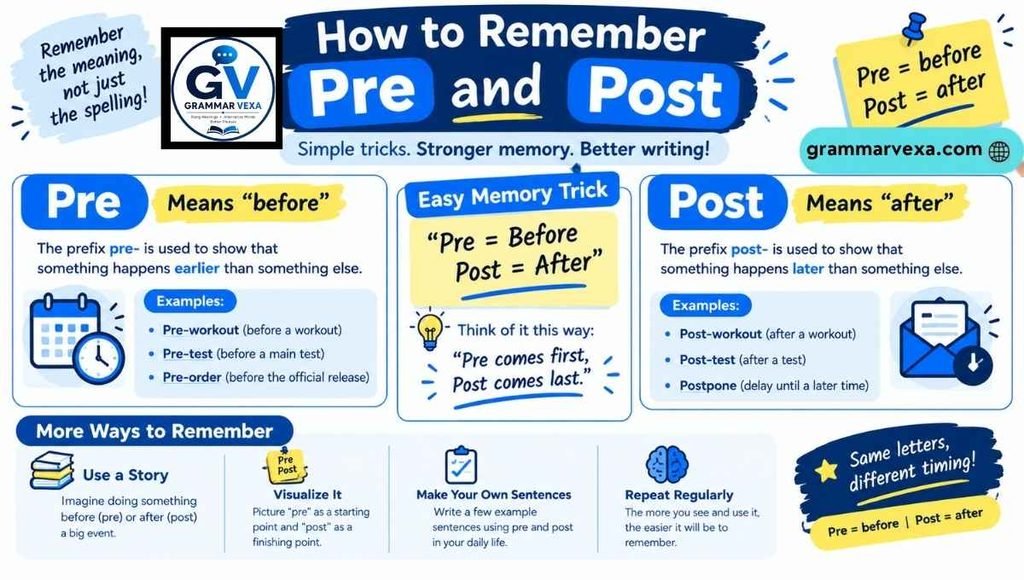
If you remember only one thing, remember this:
Pre comes before. Post comes after.
For a stronger memory connection:
PRE = PRIOR
POST = FOLLOWING
Then picture a simple timeline:
PRE → EVENT → POST
For example:
Pre-test → Instruction → Post-test
Or:
Pre-launch → Product release → Post-launch
Or:
Preoperative → Surgery → Postoperative
This approach works because it connects vocabulary with chronology and sequence rather than requiring pure memorization.
Common Mistakes With Pre and Post
Mistake 1: Assuming Post Always Means After
This ignores the other meanings of post.
A social media post isn’t necessarily something that comes after another event.
Mistake 2: Ignoring the Reference Event
“Post-treatment” only makes sense when treatment is the reference point.
Always identify what happened first.
Mistake 3: Treating Every Word Containing “Pre” as a Pre-Word
The letters pre can occur inside words without functioning as the prefix pre-.
Don’t infer meaning from spelling alone.
Mistake 4: Assuming Every Prefix Requires a Hyphen
English spelling doesn’t work that mechanically.
Some prefixed words are written as one word, while others use a hyphen. Cambridge specifically notes that there are no absolute rules for all prefixed forms.
Mistake 5: Using Technical Terms Without Understanding Them
Recognizing pre- as “before” and post- as “after” can help you decode a term. It doesn’t guarantee that you understand the complete technical meaning.
This matters especially in medicine, law, finance, and computing.
Best Practices for Correct Pre and Post Usage
For clear communication, follow these principles:
- Identify the reference event.
- Use pre- for an earlier stage when appropriate.
- Use post- for a later stage when appropriate.
- Consider the complete word rather than only its prefix.
- Check dictionary definitions for unfamiliar terms.
- Verify spelling and hyphenation when writing professionally.
- Don’t assume that standalone “post” means after.
- Use paired terms when comparing two stages.
The goal isn’t to force every situation into a pre/post pattern. The goal is to make timing and sequence clear.
Conclusion
Pre and Post Meaning: Understanding Their Usage and Importance helps you understand how words describe timing and sequence. Pre- generally means before an event, process, or specific time, while post- generally means after it. This simple distinction appears in everyday language and in fields such as education, medicine, business, technology, and social media. Knowing these meanings makes unfamiliar terms easier to understand and use correctly.
Understanding Pre and Post Meaning: Understanding Their Usage and Importance also improves clear communication. Recognizing the difference between before and after helps you follow instructions, understand timelines, and interpret specialized terms with confidence. Once you learn the basic pattern, examples such as pretest and post-test or pre-launch and post-launch become much easier to understand. Keep the timeline in mind, and these useful terms become simple to remember.
FAQs
What is the meaning of pre and post?
Pre generally means before or earlier than a particular event, time, or process. Post generally means after or later than that reference point when used as the prefix post-.
Does pre mean before?
Yes. The prefix pre- generally means before a particular time or event. Examples include pretest, prelaunch, preoperative, and prenatal.
Does post mean after?
Yes, when post- functions as a prefix. Examples include post-test, postoperative, post-launch, and post-treatment.
Is post before or after?
Post- means after or later than a particular event or time. However, standalone post can have other meanings, including an online message, a job position, or mail in British English.
What does pre mean in English?
In English, pre- is a prefix that generally indicates something occurring before a particular event or time. Cambridge gives examples such as pre-flight and pre-lunch.
What does post mean in English?
Post has several meanings. As a prefix, post- means after or later than something. As a standalone word, it can refer to online content, a job or position, a physical pole, or mail depending on context.
Are pre and post opposite words?
They often express opposite chronological relationships. Pre- indicates an earlier stage, while post- indicates a later stage.
What are some pre and post examples?
Common pairs include pre-test/post-test, pre-launch/post-launch, pre-event/post-event, pre-treatment/post-treatment, and pre-reading/post-reading.
What is pre and post in education?
In education, pre often describes activities or assessments that occur before instruction, such as a pre-test or pre-reading. Post describes activities or assessments that occur afterward, such as a post-test or post-reading activity.
What is pre and post in medicine?
In medicine, the terms often identify stages around a medical event or procedure. Examples include preoperative/postoperative, prenatal/postnatal, and pre-treatment/post-treatment.
What is pre and post in business?
Businesses use pre and post to distinguish stages around launches, projects, transactions, and evaluations. Examples include pre-launch planning, pre-tax income, post-launch analysis, and post-implementation review.
What is the post meaning in social media?
On social media, a post usually means content published online for other people to view. In that context, “post” isn’t being used as the chronological prefix meaning “after.”

Jessica Morgan is an English language writer and researcher at Grammar Vexa. I enjoy exploring slang, vocabulary, word meanings, synonyms, and alternative phrases. Through my work, I aim to make English easier to understand by providing clear explanations, useful examples, and practical language tips.








2 thoughts on “Pre and Post Meaning: Understanding Their Usage and Importance”