
Science has its own language. A single term can describe a measurement, biological process, chemical substance, physical law, or object in space. If you’re looking for science words that start with K, you’ll find useful terms across biology, physics, chemistry, earth science, astronomy, and medicine.
Some K terms are familiar, such as Kelvin, kilogram, and kinetic energy. Others, including karyokinesis, karyoplasm, kymography, and karyotype, appear more often in specialized scientific writing.
This guide explains science words beginning with K in simple language. You’ll learn what each term means, where scientists use it, why it matters, and how related concepts connect. The article also includes student-friendly vocabulary, comparison tables, examples, and answers to common questions about scientific terms that start with K.
Science Words That Start With K: Quick List
The following table gives you a fast overview of important K science words and their scientific fields.
| Science Word | Simple Meaning | Main Field |
|---|---|---|
| Kelvin | SI unit of thermodynamic temperature | Physics |
| Kilogram | SI base unit of mass | Physics |
| Kinetic Energy | Energy associated with motion | Physics |
| Karyotype | An organized representation of chromosomes | Genetics |
| Karyokinesis | Division of a cell nucleus | Cell Biology |
| Karyoplasm | Material inside the cell nucleus | Cell Biology |
| Kymograph | Instrument or system used to record changes over time | Physiology |
| Kymography | Technique for producing or analyzing movement records | Physiology |
| Krebs Cycle | Metabolic pathway involved in cellular respiration | Biology |
| Keratin | Family of structural proteins | Biology |
| Kinematics | Study of motion without focusing on its causes | Physics |
| Kinetic Friction | Friction acting between sliding surfaces | Physics |
| Kinetochore | Protein structure involved in chromosome movement | Cell Biology |
| Kinase | Enzyme that transfers phosphate groups | Biochemistry |
| Ketone | Organic compound containing a carbonyl group | Chemistry |
| Krypton | Chemical element with atomic number 36 | Chemistry |
| Karst | Landscape shaped by dissolution of soluble rock | Geology |
| Kuiper Belt | Region of icy bodies beyond Neptune | Astronomy |
This list shows why scientific vocabulary can be surprisingly broad. The letter K connects measurements, molecules, cells, energy, landscapes, and distant objects in space.
Common Science Words That Start With K
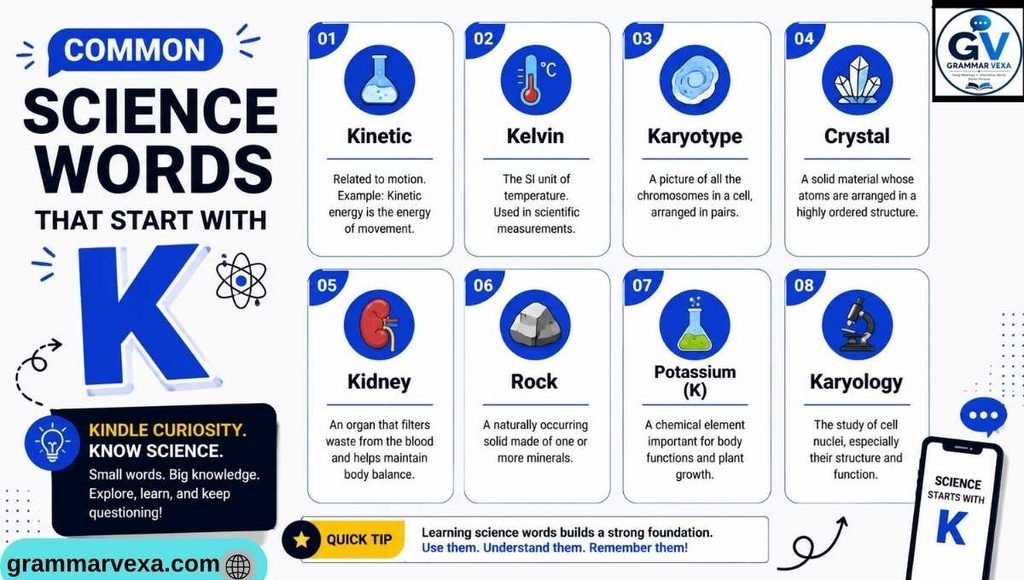
Several K terms appear repeatedly in textbooks, laboratories, research papers, and classrooms. These are worth learning first because they connect to major science concepts.
Kelvin
Kelvin is the SI unit of thermodynamic temperature. Its symbol is K. Unlike degrees Celsius or degrees Fahrenheit, the kelvin is written without a degree symbol.
The Kelvin scale is an absolute temperature scale. Its zero point corresponds to absolute zero, the theoretical lower limit of thermodynamic temperature.
The SI defines the kelvin by fixing the exact numerical value of the Boltzmann constant at 1.380649 × 10⁻²³ joules per kelvin.
For everyday temperatures, Celsius may feel more intuitive. Scientists often use kelvin because it works naturally with equations involving thermodynamics, gas laws, radiation, and molecular energy.
For example:
- 0°C = 273.15 K
- 25°C = 298.15 K
- −273.15°C = 0 K
The conversion from Celsius is simple:
K = °C + 273.15
The Kelvin scale becomes especially useful when studying very cold systems, gases, stars, blackbody radiation, and laboratory experiments.
Kilogram
The kilogram is the SI base unit of mass. Its symbol is kg.
Mass tells you how much matter an object contains. Weight, by contrast, is a force caused by gravity. That distinction matters in physics because the same object has essentially the same mass on Earth and the Moon while its weight changes with gravitational strength.
Modern SI measurement doesn’t define the kilogram using a physical metal object. Instead, it defines the kilogram using the exact value of the Planck constant, h. The fixed value is 6.62607015 × 10⁻³⁴ joule seconds.
This change became effective in 2019. It connected the kilogram to fundamental constants rather than a particular artifact.
Scientists use kilograms in:
- Physics experiments
- Chemistry calculations
- Engineering
- Laboratory measurements
- Pharmaceutical research
- Material science
- Industrial manufacturing
The kilogram is therefore much more than a classroom unit. It forms part of the measurement foundation used throughout modern science.
Kinetic Energy
Kinetic energy is the energy an object has because it is moving.
For an object with mass m moving at velocity v, its classical kinetic energy is:
KE = ½mv²
That equation reveals something important. Speed has a squared relationship with kinetic energy. If velocity doubles while mass remains constant, kinetic energy becomes four times greater.
Consider a moving bicycle. When it travels slowly, it has relatively little kinetic energy. Increase its speed and the energy rises quickly.
Kinetic energy appears in many areas of physics and engineering, including:
- Moving vehicles
- Collisions
- Rotating machinery
- Mechanical systems
- Wind turbines
- Hydroelectric systems
- Molecular motion
- Energy transfer
At the microscopic level, particle motion also connects to temperature and thermal behavior. At larger scales, engineers calculate kinetic energy when designing brakes, safety systems, machines, and transportation equipment.
Krebs Cycle
The Krebs cycle, also called the citric acid cycle or tricarboxylic acid cycle, is a central metabolic pathway.
In aerobic cellular respiration, acetyl-CoA enters this cycle and undergoes a sequence of reactions. The pathway produces reduced electron carriers, including NADH and FADH₂, along with ATP or an equivalent energy-bearing molecule. These electron carriers then contribute to ATP production through the electron transport chain.
In eukaryotic cells, the Krebs cycle takes place in the mitochondrial matrix.
One turn of the cycle produces:
- 3 NADH
- 1 FADH₂
- 1 ATP or GTP equivalent
- 2 CO₂
Because one glucose molecule produces two acetyl-CoA molecules, the cycle turns twice per glucose molecule.
The pathway isn’t simply an energy factory. Its intermediate compounds also contribute to the production of molecules used to build amino acids, fatty acids, nucleotides, and other cellular components.
Karyotype
A karyotype refers to an organism’s complete set of chromosomes. It can also mean the laboratory image in which chromosomes from a cell are arranged in an organized pattern.
Scientists examine chromosomes according to characteristics such as size, shape, banding patterns, and centromere position.
A typical human somatic cell contains 46 chromosomes arranged as 23 pairs. A karyotype helps scientists identify changes in chromosome number or large structural abnormalities.
For example:
- Down syndrome commonly involves three copies of chromosome 21.
- Turner syndrome involves a missing X chromosome in the typical chromosome complement.
- Certain cancers can involve acquired chromosome changes.
Medical laboratories use karyotyping to investigate chromosome-related conditions, some fertility problems, certain cancers, and prenatal chromosome abnormalities.
Karyokinesis
Karyokinesis means nuclear division.
During mitosis, duplicated chromosomes become organized and separated so that the genetic material can enter two daughter nuclei. OpenStax describes karyokinesis as the nuclear division portion of the mitotic phase.
The major stages of mitotic karyokinesis are:
- Prophase
- Prometaphase
- Metaphase
- Anaphase
- Telophase
Karyokinesis shouldn’t be confused with cytokinesis. Karyokinesis divides the nucleus and its chromosomes. Cytokinesis divides the cytoplasm.
Together, these processes allow cells to reproduce, grow, repair tissues, and maintain genetic continuity.
Karyoplasm
Karyoplasm is the material contained within a cell nucleus. The term is closely associated with nucleoplasm, which describes the semifluid material surrounding the chromosomes and nucleolus inside the nucleus.
The nucleus is a highly organized environment. It contains:
- DNA
- Chromosomes
- Nucleolus
- Nuclear proteins
- Enzymes
- RNA-related machinery
- Other dissolved molecules
Within this environment, important processes such as DNA replication, transcription, and RNA synthesis occur.
Think of the nucleus as a secure research room. DNA stores the instructions while the surrounding nuclear environment provides the conditions and molecular machinery needed to use those instructions.
Kymograph
A kymograph is a scientific instrument or recording system designed to show changes over time.
Historically, kymographs commonly used a rotating drum and stylus to create a visual trace. Scientists could then study changes in pressure, movement, muscle activity, or other physiological signals.
Kymographs became particularly useful in physiology because biological systems often produce patterns rather than single measurements.
Researchers could study:
- Muscle contractions
- Pressure changes
- Respiratory patterns
- Blood pressure
- Organ function
- Mechanical movement
Modern laboratories frequently use electronic sensors and digital data acquisition instead of mechanical drums. However, the underlying idea remains useful: convert a changing biological or physical signal into a record that scientists can analyze.
Research literature also uses kymograph-based computational systems for muscle physiology and measurement.
Kymography
Kymography refers to the process or technique of recording and analyzing movement or changing signals using a kymograph or related system.
The distinction is straightforward:
- Kymograph = the instrument or recording system
- Kymography = the recording or analysis technique
In modern biomedical research, digital imaging and sensors can produce similar time-based visual records. These methods help researchers identify patterns, rhythms, movement, and changes that may be difficult to understand from isolated measurements.
Keratin
Keratin is a family of structural proteins found throughout the bodies of humans and other animals.
It’s strongly associated with:
- Hair
- Nails
- Skin
- Hooves
- Horns
- Feathers
- Other protective structures
Keratin proteins form durable structural networks. Their molecular structure helps tissues tolerate mechanical stress and environmental exposure. Research also distinguishes different keratin types and their roles in epithelial tissues.
Keratin isn’t merely a cosmetic ingredient. Scientists study it in cell biology, tissue engineering, biomaterials, wound research, and biotechnology.
Because keratin can be processed into different biomaterial forms, researchers have investigated its potential for applications such as drug delivery and tissue-related materials.
Biology Words That Start With K
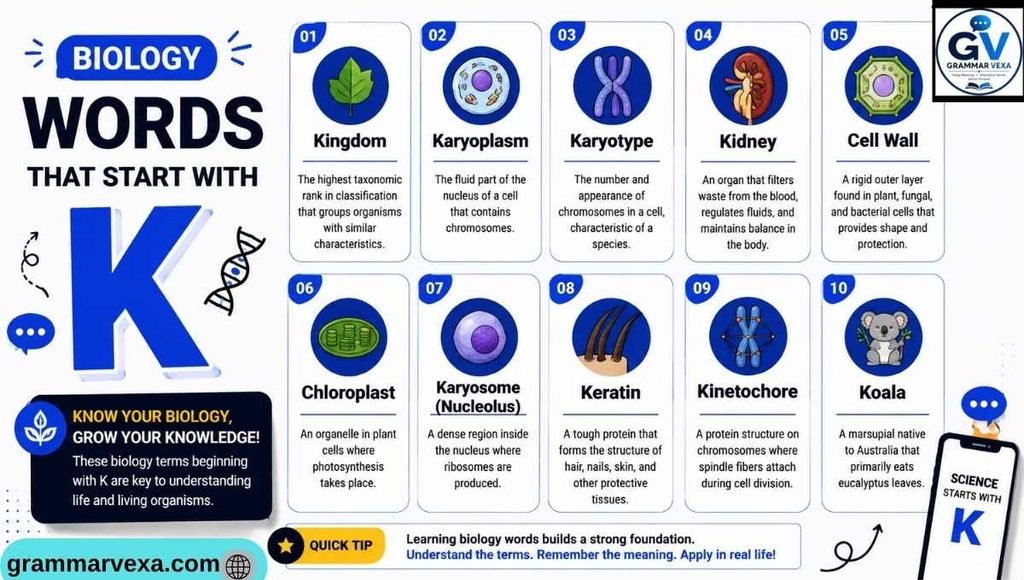
Biology contains some of the most specialized scientific words that start with K. Many relate to cells, genetics, metabolism, proteins, and molecular processes.
Karyotype
In genetics, a karyotype provides a broad view of chromosome number and structure.
A karyotype doesn’t read every DNA letter. Instead, it gives researchers a chromosome-level picture.
This makes it useful when a suspected genetic problem involves:
- Extra chromosomes
- Missing chromosomes
- Large chromosome rearrangements
- Large deletions
- Large duplications
For example, chromosome analysis can identify the extra chromosome associated with Down syndrome.
Karyokinesis
In cell biology, karyokinesis is nuclear division.
During mitosis, chromosomes move through an ordered sequence of stages. The cell carefully organizes duplicated genetic material before separating it into daughter nuclei.
This process matters because errors in chromosome separation can produce cells with abnormal chromosome numbers.
Cell-cycle regulation is therefore closely connected to growth, development, tissue maintenance, and disease biology.
Karyoplasm
Karyoplasm describes the nuclear material surrounding chromosomes and the nucleolus.
Its importance comes from the fact that the nucleus isn’t an empty container. Nuclear processes require a complex molecular environment containing enzymes, proteins, RNA, nucleotides, and other molecules.
Keratin
Biologists classify keratins as structural proteins. They contribute to the mechanical properties of epithelial cells and protective tissues.
Keratin’s strength comes partly from interactions between protein chains and their structural organization. Hard keratin-rich tissues such as hair and nails can withstand substantial mechanical stress.
Krebs Cycle
The Krebs cycle connects biology, chemistry, and energy metabolism.
It doesn’t operate as an isolated pathway. Instead, it interacts with carbohydrate, fat, and protein metabolism. Several cycle intermediates can become starting materials for biosynthetic pathways.
Kinase
A kinase is an enzyme that transfers a phosphate group, often from ATP, to another molecule.
Kinases are central to cell signaling and metabolism. By adding phosphate groups to proteins or other molecules, they can change molecular activity, location, or interactions.
This makes kinases important subjects in:
- Molecular biology
- Cell signaling
- Cancer research
- Pharmacology
- Biotechnology
Kinetochore
The kinetochore is a protein structure associated with the centromere of a chromosome.
During cell division, spindle microtubules interact with kinetochores to help move chromosomes. This makes kinetochores essential to accurate chromosome segregation.
Karyogamy
Karyogamy means the fusion of two nuclei, usually during sexual reproduction.
It differs from karyokinesis:
- Karyogamy = fusion of nuclei
- Karyokinesis = division of a nucleus
The similar-looking words can cause confusion, so learning their roots helps.
Chemistry Words That Start With K
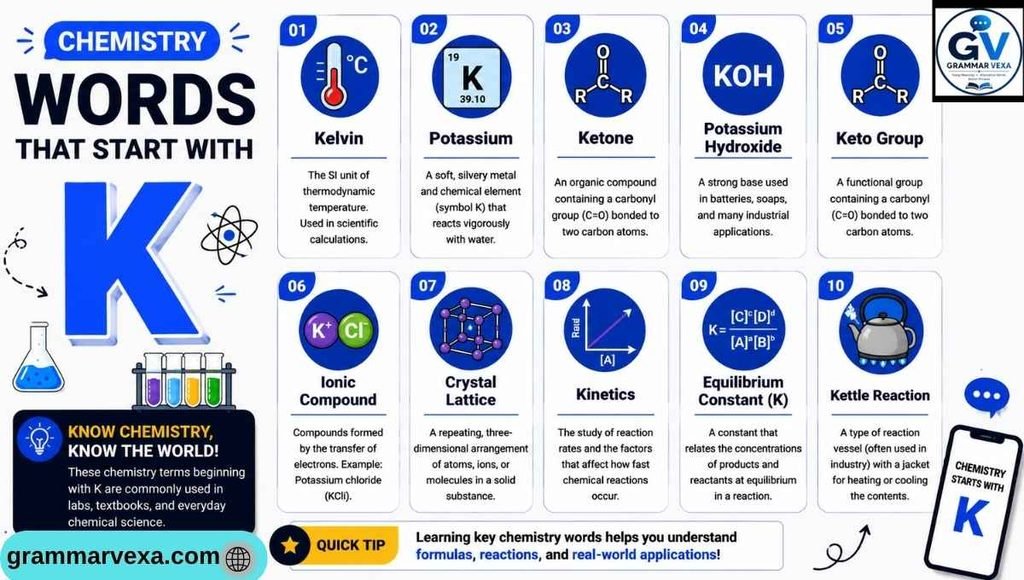
The Chemistry offers several useful scientific terms beginning with K. Some describe compounds while others identify elements or theories.
Ketone
A ketone is an organic compound containing a carbonyl group bonded to two carbon-containing groups.
A simple example is acetone, commonly used as a solvent.
Ketones appear in organic chemistry, biochemistry, metabolism, and industrial chemistry.
The word also appears in medical and biological discussions because the body can produce ketone bodies under certain metabolic conditions.
Ketosis
Ketosis describes a metabolic state in which the body produces elevated amounts of ketone bodies.
The chemistry behind ketosis involves the breakdown and processing of fatty acids and related metabolic pathways.
It’s important to distinguish the scientific term from the medical condition ketoacidosis, which is a potentially dangerous metabolic disturbance and isn’t simply another word for ordinary nutritional ketosis.
Kinetic Molecular Theory
The kinetic molecular theory explains macroscopic properties of gases by considering the motion of microscopic particles.
The theory connects:
- Temperature
- Particle motion
- Pressure
- Volume
- Collisions
- Energy
In simple terms, hotter gas generally means greater average molecular kinetic energy.
This theory helps explain why heating a gas can increase pressure when its volume remains fixed.
Krypton
Krypton is a chemical element with atomic number 36.
It’s a noble gas, which means it has relatively low chemical reactivity under ordinary conditions.
Krypton has applications involving lighting and specialized technologies. Its chemical identity makes it useful in discussions of atomic structure, periodic trends, and noble-gas chemistry.
Potassium
Potassium is one of the most interesting examples of a scientific K connection.
Its chemical symbol is K, which comes from the Latin name kalium. Its atomic number is 19.
Potassium is important in chemistry and biology because it exists as an ion that contributes to electrical and chemical processes in living cells.
So when you see K⁺ in a biology or chemistry text, it usually refers to the potassium ion rather than Kelvin.
Potassium Permanganate
Potassium permanganate, KMnO₄, is a strong oxidizing compound used in chemistry and some water-treatment applications.
It provides a useful example of how chemical formulas communicate composition. The formula tells you that the compound contains potassium, manganese, and oxygen.
Physics Words That Start With K
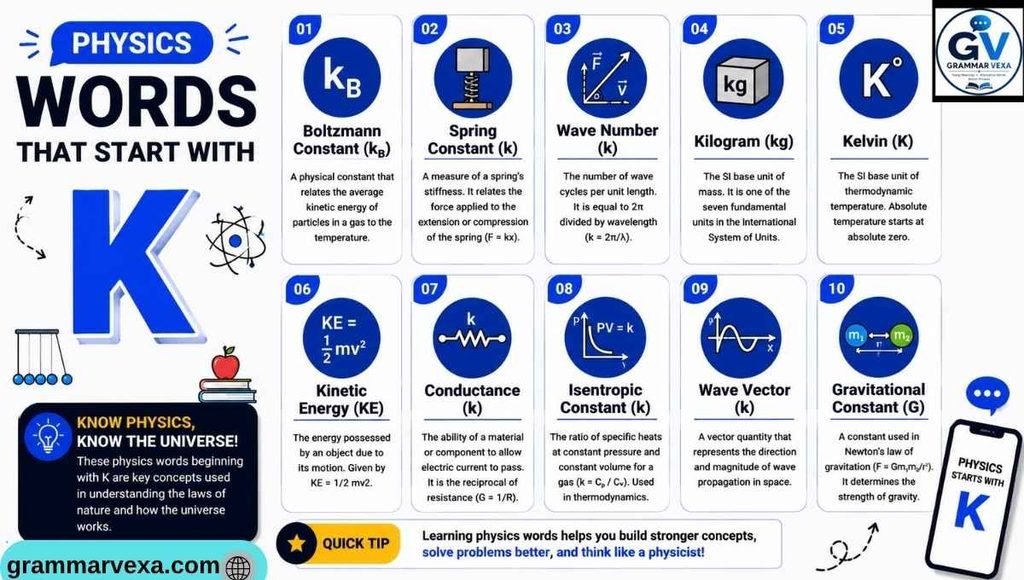
The Physics contains many high-value science words that start with K, particularly around motion, temperature, electricity, and mathematical descriptions.
Kinematics
Kinematics describes motion without focusing on the forces causing that motion.
It commonly deals with:
- Position
- Displacement
- Velocity
- Acceleration
- Time
For example, if you describe how quickly a car moves and how its velocity changes, you’re doing kinematics.
Kinetic Friction
Kinetic friction acts when two surfaces slide against each other.
For example, when a box slides across a floor, friction opposes the relative motion between the surfaces.
It’s different from static friction, which acts before sliding begins.
Kinetic Theory
Kinetic theory connects microscopic particle motion with observable properties of matter.
The basic idea is powerful: matter may look still at the macroscopic level while its particles remain in constant motion.
That microscopic motion helps explain temperature, pressure, diffusion, and gas behavior.
Kepler’s Laws
Kepler’s laws of planetary motion describe how planets orbit the Sun.
They state that:
- Planets move in elliptical orbits with the Sun at one focus.
- A line joining a planet and the Sun sweeps out equal areas in equal times.
- The square of a planet’s orbital period is proportional to the cube of the semimajor axis of its orbit.
These laws played a major role in the development of modern astronomy and celestial mechanics.
Kirchhoff’s Laws
The Kirchhoff’s circuit laws help engineers and physicists analyze electrical circuits.
Kirchhoff’s current law concerns conservation of electric charge at a junction.
The Kirchhoff’s voltage law concerns the algebraic sum of voltage changes around a closed circuit.
These principles are widely used in electrical engineering and circuit analysis.
Earth and Environmental Science Words That Start With K
The natural world contains several useful K terms that aren’t always included in basic school glossaries.
Karst
A Karst describes a landscape formed when soluble rocks such as limestone dissolve through chemical weathering.
Karst environments can contain:
- Caves
- Sinkholes
- Underground drainage
- Springs
- Disappearing streams
Groundwater movement is particularly important in karst landscapes because water can travel through fractures and underground channels.
Katabatic Wind
A katabatic wind is a downslope wind caused by relatively dense cold air moving under gravity.
These winds are especially important in cold mountainous and polar environments.
The term connects atmospheric science with geography because local terrain strongly influences the movement of cold air.
Kettle Lake
A kettle lake forms when a block of glacial ice becomes buried in sediment and later melts.
The melting ice leaves a depression that can fill with water.
Kettle lakes therefore provide a visible example of how glaciers can reshape landscapes long after the ice itself has disappeared.
Kame
A kame is a mound or ridge of sediment deposited by glacial meltwater.
Kames and kettle lakes can occur in the same glacial landscapes, making them useful terms when studying glacial geology.
Köppen Climate Classification
The Köppen climate classification organizes climates using patterns involving temperature and precipitation.
It provides a systematic way to compare climate regions around the world.
Because climate depends on multiple interacting environmental factors, classification systems help scientists organize large amounts of geographic information.
Astronomy and Space Science Words That Start With K
Some of the most fascinating scientific words beginning with K belong to astronomy.
Kuiper Belt
The Kuiper Belt is a broad region of icy bodies beyond Neptune.
NASA describes it as a large, doughnut-shaped region containing numerous icy objects. Pluto is one of its best-known members.
The region matters because its objects preserve clues about the early solar system.
Scientists believe many Kuiper Belt objects are remnants left over from the formation of the planets. Some contain rock, water ice, methane, ammonia, and other frozen materials.
NASA’s New Horizons spacecraft famously visited Pluto and later flew past Arrokoth, giving researchers close-up information about objects in the outer solar system.
K-Type Star
A K-type star belongs to a category in the stellar spectral classification system.
K-type stars are cooler and more orange in appearance than Sun-like G-type stars. Their characteristics make them important when astronomers compare stellar temperatures, colors, and lifetimes.
The classification system helps astronomers describe stars consistently instead of relying only on visual appearance.
Kelvin–Helmholtz Mechanism
The Kelvin–Helmholtz mechanism describes a process in which gravitational contraction can release energy.
The concept has been important in astrophysics, particularly in discussions about how gravitational energy can contribute to the luminosity of stars and other astronomical objects.
It illustrates a recurring scientific theme: gravity can be converted into other forms of energy.
Science Words That Start With K for Students
Not every scientific term is equally suitable for every grade level. A fifth grader may need a short definition of kinetic energy, while an advanced student may need equations or molecular details.
The following groupings are practical learning guides rather than universal curriculum standards.
K Science Words for 5th Grade
Start with concrete ideas that students can observe.
- Kilogram — a unit used to measure mass.
- Kinetic energy — energy of moving objects.
- Kelvin — a scientific temperature unit.
- Kidney — an organ that filters waste from blood.
- Keratin — a protein found in hair, nails, and skin.
A useful classroom example is a rolling ball. Students can observe motion and then connect that observation to kinetic energy.
K Science Words for 6th Grade
At this level, students can begin connecting terms to broader scientific systems.
- Kinetic energy
- Kelvin
- Kilogram
- Karst
- Krebs cycle
- Karyotype
The focus should remain on meaning rather than memorizing complicated definitions.
K Science Words for 7th Grade
Seventh-grade science vocabulary can introduce more biological and physical detail.
- Karyotype
- Karyokinesis
- Kinetic energy
- Kinetic friction
- Krebs cycle
- Kinematics
For example, students can learn that karyokinesis refers to nuclear division while cytokinesis refers to division of the cytoplasm.
K Science Words for 8th Grade
Older students can handle more abstract concepts.
- Kinematics
- Kirchhoff’s laws
- Kepler’s laws
- Kinetic molecular theory
- Kinetochore
- Karyokinesis
- Krebs cycle
At this stage, connecting terms to equations, diagrams, experiments, and real scientific problems makes vocabulary more meaningful.
Science Words That Start With K and Their Meanings
Here is a broader glossary of useful scientific terms that start with K.
| Term | Meaning | Field |
|---|---|---|
| Kame | Glacial sediment mound or ridge | Geology |
| Karst | Landscape formed largely through dissolution of soluble rock | Geology |
| Karyogamy | Fusion of nuclei | Biology |
| Karyokinesis | Division of a cell nucleus | Cell Biology |
| Karyoplasm | Material within the nucleus | Cell Biology |
| Karyotype | Complete chromosome set or arranged chromosome image | Genetics |
| Kelvin | SI unit of thermodynamic temperature | Physics |
| Keratin | Family of structural proteins | Biology |
| Ketone | Organic compound containing a carbonyl group bonded to two carbon groups | Chemistry |
| Kinematics | Study of motion without its causes | Physics |
| Kinetic Energy | Energy associated with motion | Physics |
| Kinetic Friction | Friction during sliding motion | Physics |
| Kinase | Enzyme that transfers phosphate groups | Biochemistry |
| Kinetochore | Protein structure involved in chromosome movement | Cell Biology |
| Krebs Cycle | Metabolic pathway that processes acetyl-CoA | Biology |
| Krypton | Noble gas with atomic number 36 | Chemistry |
| Kuiper Belt | Region of icy bodies beyond Neptune | Astronomy |
| Kilogram | SI base unit of mass | Physics |
| Köppen Classification | System for classifying climates | Earth Science |
This list also shows why learning K science words by subject can be more effective than memorizing them alphabetically.
Important Differences Between Similar K Science Terms
Some K terms look or sound similar. Understanding the differences prevents common science vocabulary mistakes.
Kinetic Energy vs. Potential Energy
| Kinetic Energy | Potential Energy |
|---|---|
| Energy associated with motion | Stored energy associated with position, configuration, or condition |
| Depends on mass and velocity in classical mechanics | Depends on the physical system and its configuration |
| A moving car has kinetic energy | A raised object can have gravitational potential energy |
| Increases with the square of velocity | Depends on the relevant potential |
A roller coaster provides an easy example. At the top of a hill, it has substantial gravitational potential energy. As it moves downhill, that energy can be converted into kinetic energy.
Kelvin vs. Celsius
Kelvin and Celsius have the same size temperature increment, but their zero points differ.
| Kelvin | Celsius |
|---|---|
| SI base unit for thermodynamic temperature | Common temperature unit |
| Symbol K | Symbol °C |
| Absolute scale | Relative scale based on the Celsius temperature interval |
| 0 K corresponds to absolute zero | 0°C is the freezing point of water under standard reference conditions |
A difference of 1 K has the same magnitude as a difference of 1°C.
Kinematics vs. Kinetics
Kinematics describes motion.
Kinetics examines the forces or interactions responsible for motion.
For example, describing how quickly a car accelerates is kinematics. Studying how engine force, friction, and resistance produce that acceleration moves into kinetics.
Karyotype vs. Karyokinesis
These terms belong to genetics and cell biology but describe completely different things.
- Karyotype = chromosome set or organized chromosome image.
- Karyokinesis = nuclear division.
A karyotype can help identify chromosome abnormalities. Karyokinesis describes what happens to chromosomes during nuclear division.
Kymograph vs. Kymography
The distinction is similar to instrument versus technique.
- Kymograph = recording instrument or system.
- Kymography = process of recording or analyzing changing signals.
Keeping that distinction in mind makes both terms easier to remember.
How K Science Terms Are Used in Real Life
Scientific vocabulary becomes easier to understand when you see where it appears outside a glossary.
In Medicine and Biology
Doctors and laboratory scientists may encounter karyotypes when investigating chromosome abnormalities.
Researchers also study kinases because cellular signaling depends heavily on phosphorylation reactions.
Keratin matters in dermatology, pathology, tissue biology, and biomaterials research.
Meanwhile, the Krebs cycle remains central to understanding cellular metabolism and energy production.
In Engineering and Physics
Engineers use kilograms when measuring mass and calculating forces.
They use kinematics to model motion and kinetic energy to understand moving systems.
Electrical engineers use Kirchhoff’s laws when analyzing circuits.
Temperature-sensitive systems may use Kelvin because thermodynamic equations often require an absolute temperature scale.
In Chemistry and Industry
Chemists work with compounds such as ketones, elements such as krypton, and potassium-containing compounds.
The kinetic molecular theory helps explain how gases behave at the molecular level.
Laboratory measurements also depend on standardized SI units such as the kilogram and kelvin.
In Earth and Space Science
Geologists may use karst, kame, and kettle lake when describing landscapes shaped by water or glaciers.
Climate scientists use classification systems such as the Köppen scheme to organize climate patterns.
Astronomers study the Kuiper Belt to understand the structure and history of the outer solar system. NASA notes that the region contains millions of small icy objects and includes Pluto and other dwarf-planet-scale bodies.
Why Learning Science Words That Start With K Matters
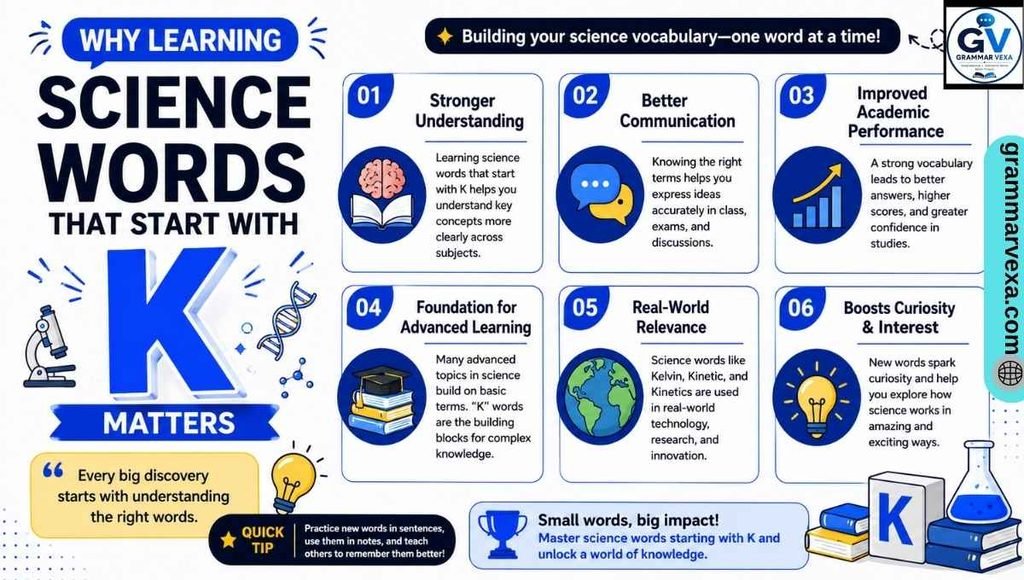
Learning scientific vocabulary isn’t just about memorizing definitions.
The right terms give you a shortcut to complex ideas.
When you understand kinetic energy, for example, you can immediately connect the word to motion, mass, velocity, collisions, and energy transfer.
When you understand karyotype, you can connect it to chromosomes, genetics, heredity, and chromosome abnormalities.
At the time When you understand Kelvin, you can connect temperature to thermodynamics, molecular motion, gas behavior, and radiation.
This creates a useful vocabulary network:
Term → Concept → Example → Scientific application
That approach works better than memorizing isolated words because science itself is interconnected.
Common Mistakes When Learning K Science Terms
Confusing Kelvin With Celsius
Kelvin isn’t written as “degrees Kelvin.”
Correct:
300 K
Not:
300° K
The unit name is kelvin and its symbol is K.
Treating Potassium and Kelvin as the Same K
The letter K has different meanings depending on context.
- K as a unit symbol = kelvin.
- K as a chemical symbol = potassium.
- K⁺ = potassium ion.
Context determines the meaning.
Confusing Karyotype With Karyokinesis
The words share a root related to the nucleus, but their meanings differ.
A karyotype describes chromosomes.
Karyokinesis describes nuclear division.
Mixing Up Kinematics and Kinetics
Kinematics focuses on describing motion. Kinetics focuses on causes such as forces and interactions.
Remember:
Kinematics = what the motion does.
Kinetics = why the motion happens.
Assuming Every K Term Belongs to Physics
Physics has famous K terms such as Kelvin and kinetic energy. However, K vocabulary appears just as strongly in biology, chemistry, geology, and astronomy.
A good science glossary should therefore cross subject boundaries.
How to Remember Science Words That Start With K
Scientific vocabulary becomes easier when you connect words to mental pictures.
Group Terms by Subject
Create separate groups:
Physics: Kelvin, kilogram, kinetic energy, kinematics
Biology: keratin, karyotype, karyokinesis, Krebs cycle
Chemistry: ketone, krypton, potassium
Geology: karst, kame, kettle lake
Astronomy: Kuiper Belt, K-type star
Connect Each Term to an Image
Picture a thermometer for Kelvin.
The Picture a moving car for kinetic energy.
Picture paired chromosomes for a karyotype.
The Picture hair for keratin.
Picture Pluto beyond Neptune for the Kuiper Belt.
A Picture a circular metabolic pathway for the Krebs cycle.
These associations make abstract vocabulary easier to recall.
Use Short Scientific Sentences
Instead of memorizing only:
“Karyotype means chromosome arrangement.”
Use:
“Scientists use a karyotype to examine chromosome number and structure.”
The second version gives your brain context.
Compare Similar Words
Pair terms that students commonly confuse:
- Kelvin vs. Celsius
- Kinematics vs. kinetics
- Karyotype vs. karyokinesis
- Kymograph vs. kymography
- Kinetic vs. potential energy
Comparison creates stronger memory links.
Real-World Examples of K Science Terms
Example 1: Measuring Temperature in a Laboratory
Suppose a chemistry experiment requires a temperature of 298.15 K.
That temperature corresponds to 25°C.
Using kelvin allows scientists to place temperature directly into thermodynamic equations without introducing a shifted Celsius zero point.
Example 2: Studying a Chromosome Condition
A medical laboratory may perform karyotyping when a clinician suspects a chromosome abnormality.
The laboratory examines chromosomes from a cell sample and organizes them into a karyotype. The result can reveal changes in chromosome number or large structural changes.
Example 3: Understanding Cellular Energy
When cells metabolize nutrients, the Krebs cycle produces NADH and FADH₂.
Those molecules carry high-energy electrons toward the electron transport system. Their oxidation contributes to the production of ATP during oxidative phosphorylation.
Example 4: Understanding Motion
Imagine a 1,000 kg car traveling at 20 m/s.
Using:
KE = ½mv²
the car’s kinetic energy is:
½ × 1,000 × 20² = 200,000 J
That is 200 kilojoules of kinetic energy.
The example shows why speed matters so much. Doubling velocity produces four times the classical kinetic energy when mass stays constant.
Example 5: Studying the Outer Solar System
Astronomers study Kuiper Belt objects because they contain clues about the solar system’s early history.
NASA describes the Kuiper Belt as a region beyond Neptune containing numerous icy remnants from planetary formation.
This makes the Kuiper Belt a natural laboratory for studying ancient solar-system material.
Key Takeaways About Science Words That Start With K
The most useful science words that start with K span several scientific disciplines.
Remember these core terms:
- Kelvin — SI unit of thermodynamic temperature.
- Kilogram — SI base unit of mass.
- Kinetic energy — energy associated with motion.
- Karyotype — complete chromosome set or organized chromosome image.
- Karyokinesis — nuclear division.
- Karyoplasm — material inside the nucleus.
- Kymograph — instrument or system for recording changing signals.
- Kymography — technique for recording or analyzing changes over time.
- Krebs cycle — metabolic pathway involved in cellular respiration.
- Keratin — family of structural proteins.
- Kinematics — description of motion.
- Kinase — enzyme that transfers phosphate groups.
- Kinetochore — chromosome-associated structure involved in chromosome movement.
- Ketone — type of organic compound.
- Krypton — noble-gas element.
- Karst — dissolution-shaped landscape.
- Kuiper Belt — icy region beyond Neptune.
The deeper lesson is that scientific vocabulary works as a map. Each term points toward a larger system of ideas involving matter, energy, cells, genetic material, chemical reactions, motion, or the natural world.
Conclusion
The Science Words That Start With K: Terms, Meanings & Examples guide makes scientific vocabulary easier to understand and remember. Terms like Kelvin, kilogram, and kinetic energy connect to physics. Words such as karyotype, keratin, and the Krebs cycle belong to biology. Other terms, including ketone, karst, and Kuiper Belt, show how widely K appears across science. Learning each word with its meaning and field helps you build a stronger science vocabulary.
The Science Words That Start With K: Terms, Meanings & Examples also shows why context matters when learning scientific terms. Comparing similar words can prevent confusion and improve understanding. Whether you’re a student, teacher, or curious learner, focus on the concept behind each term. Connecting scientific vocabulary with real examples makes these words easier to recall and use correctly.
FAQs
What are some science words that start with K?
Common science words that start with K include Kelvin, kilogram, kinetic energy, karyotype, keratin, kinematics, and the Krebs cycle.
What does K mean in science?
The meaning of K depends on context. It represents kelvin in temperature measurement and potassium in chemistry.
What are some biology words that start with K?
Examples include karyotype, karyokinesis, karyoplasm, keratin, kinase, kinetochore, and Krebs cycle.
What are some physics words that start with K?
Common examples include Kelvin, kilogram, kinetic energy, kinematics, kinetic friction, and kinetic theory.
What is the difference between Kelvin and Celsius?
Kelvin is an absolute temperature scale, while Celsius uses a different zero point. A change of 1 K equals a change of 1°C.
What is the difference between kinematics and kinetics?
Kinematics describes motion, while kinetics examines the forces and interactions that cause motion.
What is the difference between a karyotype and karyokinesis?
A karyotype shows an organism’s chromosomes in an organized form. Karyokinesis refers to the division of a cell nucleus.
Why is learning science words that start with K useful?
Learning these terms strengthens scientific vocabulary and helps students understand concepts in biology, chemistry, physics, and other fields more easily.

Jessica Morgan is an English language writer and researcher at Grammar Vexa. I enjoy exploring slang, vocabulary, word meanings, synonyms, and alternative phrases. Through my work, I aim to make English easier to understand by providing clear explanations, useful examples, and practical language tips.








1 thought on “Science Words That Start With K: Terms, Meanings & Examples”