“Well Deserve or Well Deserved: Which One Is Grammatically Correct?” refers to the common confusion between the base verb deserve and the adjective form well deserved. When you mean that something was fully earned, justified, or merited, well deserved is the correct phrase. Before a noun, use the hyphenated form well-deserved, as in “a well-deserved promotion.”
A small verb-form difference can completely change how natural a sentence sounds. Deserve works when someone merits something: “You deserve the award.” Well deserved describes the result: “The award was well deserved.” Once this pattern clicks, many common English grammar mistakes become much easier to spot and avoid.
The distinction also goes beyond choosing the right words. You’ll see how well deserved works in everyday English, professional writing, congratulations, and common expressions such as “well-deserved praise” and “well-deserved break.” Understanding when to use deserve, deserved, and well-deserved will help your sentences sound clearer, more polished, and more natural.
Well Deserve or Well Deserved: Which Is Correct?
The short answer is well deserved.
Use well deserved when you mean that something is completely justified or that someone has earned it because of their actions, qualities, effort, or achievement. Cambridge Dictionary defines “well deserved” as something a person completely deserves because of how they behaved or because of their qualities.
Consider these examples:
- “Your success is well deserved.”
- “That award was well deserved.”
- “She earned a well-deserved promotion.”
- “After months of hard work, he deserves a well-deserved break.”
- “Their victory was well deserved.”
By contrast, well deserve isn’t the standard form for this meaning.
You might see the individual words well and deserve together in unusual grammatical constructions, but that doesn’t make well deserve a normal substitute for well deserved.
The key distinction is simple:
| Form | Grammatical role | Example |
|---|---|---|
| deserve | Base-form verb | “You deserve the award.” |
| deserves | Present-tense verb | “She deserves recognition.” |
| deserved | Past form or adjective | “The award was well deserved.” |
| well-deserved | Compound adjective before a noun | “She received a well-deserved award.” |
| well deserve | Not the normal phrase for this meaning | Avoid using it instead of “well deserved.” |
So, if someone asks, “Which is correct, well deserve or well deserved?”, the answer is well deserved for the intended expression.
What Does “Well Deserved” Mean?
The well deserved meaning is straightforward: something is fully earned, justified, or appropriate because of someone’s actions, qualities, effort, or achievements.
The word deserved itself refers to something that a person earns or receives because of their behavior or qualities.
Adding well strengthens that idea.
In simple terms:
well deserved = fully deserved or thoroughly justified
For example:
- “She received a well-deserved award.”
- “He took a well-deserved vacation.”
- “The team celebrated a well-deserved victory.”
- “Her colleagues gave her well-deserved praise.”
- “After finishing the project, they enjoyed a well-deserved rest.”
The phrase can describe both positive and negative outcomes in broader English because something can be deserved even when it isn’t pleasant. However, well deserved most often appears with positive outcomes such as praise, recognition, rewards, rest, success, and congratulations.
The Basic Idea Behind “Well Deserved”
Think of deserved as answering this question:
“Did this person have good reason to receive it?”
If the answer is yes, something may be described as deserved.
If the evidence strongly supports that judgment, well deserved adds emphasis.
For example:
“Maya worked late every night to finish the project. Her promotion was well deserved.”
The promotion wasn’t merely something she received. Her effort and performance provide the reason it was deserved.
That connection between an action and its result gives the phrase much of its meaning.
Why “Well Deserve” Is Usually Incorrect
The central well deserved grammar issue involves the form of the verb.
Deserve is a verb. It means to have earned or to be worthy of receiving something because of your actions or qualities. Cambridge Dictionary lists deserve as a verb and gives patterns such as “deserve praise” and “deserve to win.”
For example:
- “You deserve praise.”
- “They deserve recognition.”
- “She deserves a promotion.”
- “He deserves to win.”
- “We deserve a break.”
But when you describe the result itself, English commonly uses deserved:
“The praise was well deserved.”
The grammatical structure has changed.
Compare:
“She deserves the award.”
with:
“The award is well deserved.”
In the first sentence, deserves tells us what the person merits.
In the second sentence, deserved describes the award.
That’s the heart of the well deserved vs well deserve distinction.
When to Use “Deserve”
Use deserve when the subject is the person or thing that merits something.
Common structures include:
Subject + deserve + noun
- “You deserve respect.”
- “She deserves recognition.”
- “They deserve credit.”
- “He deserves the award.”
Another common pattern is:
Subject + deserve + to + verb
- “She deserves to win.”
- “They deserve to succeed.”
- “He deserves to be recognized.”
Cambridge also gives examples of deserve + to-infinitive, such as “They certainly deserved to win that game.”
So deserve is absolutely a correct English word. It simply isn’t the correct replacement for deserved in the expression “well deserved.”
“Well Deserved” vs. “Well-Deserved”
Here’s another point that often trips people up.
You may see both:
- well deserved
- well-deserved
Both forms can be correct. Their placement in the sentence usually determines which form you should use.
Use “Well-Deserved” Before a Noun
When well-deserved directly modifies a noun, the hyphen helps show that the two words work together as a compound modifier.
Examples:
- “She received a well-deserved promotion.”
- “He earned a well-deserved reward.”
- “They enjoyed a well-deserved break.”
- “The athlete received well-deserved recognition.”
- “She earned a well-deserved reputation.”
- “The students received well-deserved praise.”
Cambridge specifically lists well-deserved as an adjective used before a noun, giving “a well-deserved break” as an example.
Use “Well Deserved” After a Linking Verb
When the phrase comes after a linking verb such as is, was, seems, or looks, you generally write it without the hyphen.
Examples:
- “Her promotion was well deserved.”
- “The victory was well deserved.”
- “His success is well deserved.”
- “The praise was well deserved.”
- “Their recognition was well deserved.”
Here, well deserved functions as a complement rather than as a compound modifier directly placed before a noun.
A Simple Comparison
| Before a noun | After a linking verb |
|---|---|
| a well-deserved award | the award was well deserved |
| a well-deserved promotion | the promotion was well deserved |
| a well-deserved break | the break was well deserved |
| a well-deserved victory | the victory was well deserved |
| well-deserved praise | the praise was well deserved |
This distinction follows a broader English punctuation pattern. Compound modifiers are often hyphenated before the noun they modify to make their relationship clear. Purdue OWL notes that hyphens can clarify when multiple words function together as a modifier before a noun.
Is “Well Deserved” Always Hyphenated?
No.
This is one of the most common misconceptions.
You don’t automatically hyphenate well deserved every time you write it.
Use well-deserved when it functions as a compound adjective before a noun:
“It was a well-deserved reward.”
Don’t normally use the hyphen when the phrase follows the noun and a linking verb:
“The reward was well deserved.”
The easiest test is to look at what comes next.
If a noun follows immediately
Use:
well-deserved + noun
“a well-deserved promotion”
If the phrase follows a linking verb
Use:
be + well deserved
“The promotion was well deserved.”
This rule isn’t unique to this expression. English frequently uses hyphens to clarify compound modifiers before nouns while leaving the same words open when they function differently in a sentence.
How to Use “Well Deserved” in a Sentence
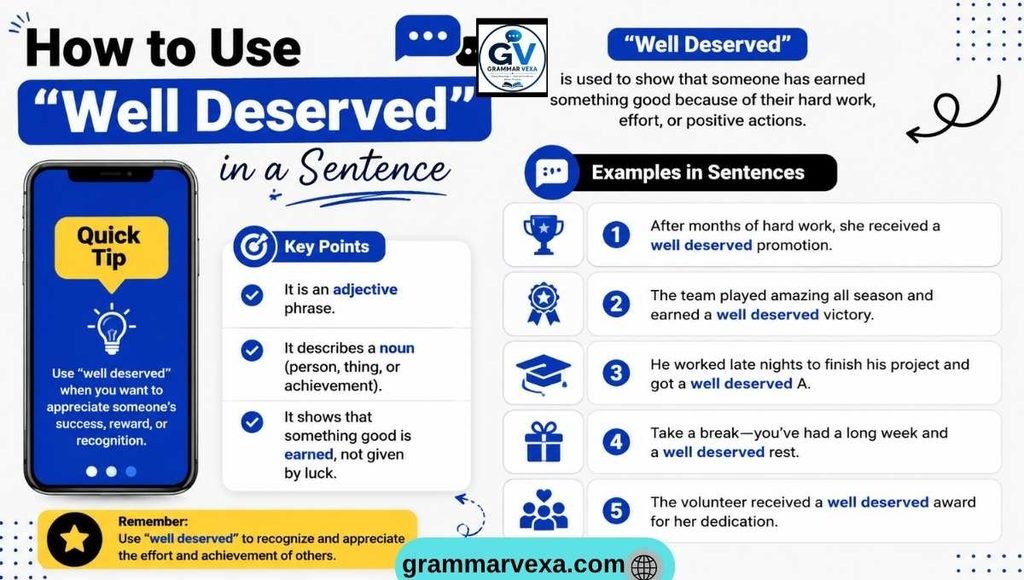
The well deserved usage becomes easy when you recognize a few common sentence patterns.
After “Is” or “Was”
This is probably the clearest pattern.
- “Her award was well deserved.”
- “His promotion was well deserved.”
- “Their victory was well deserved.”
- “The recognition was well deserved.”
- “Your success is well deserved.”
The subject is the thing receiving the judgment.
Before a Noun
Use the hyphenated form when the expression directly describes a noun.
- “She received a well-deserved promotion.”
- “He took a well-deserved vacation.”
- “The winner earned a well-deserved medal.”
- “They received well-deserved recognition.”
- “The team celebrated a well-deserved victory.”
As a Short Comment
In casual English, people often use:
“Well deserved!”
This is an abbreviated expression. The complete thought might be:
“That award was well deserved.”
The shorter version works because the context makes the missing words obvious.
You’ll often see this in:
- social media comments
- text messages
- congratulations
- workplace chats
- sports discussions
- award announcements
For example:
“You finally finished the marathon! Well deserved!”
The phrase doesn’t need a full sentence in this conversational context.
Common Situations Where “Well Deserved” Fits Naturally
The phrase appears in many contexts because people frequently talk about outcomes that follow effort, achievement, or merit.
Well-Deserved Congratulations
A common expression is:
“Congratulations! Well deserved.”
This means the speaker believes the recipient earned the praise or achievement.
You can also write:
- “Congratulations on your well-deserved promotion!”
- “Well deserved! You worked incredibly hard.”
- “That recognition is well deserved.”
- “Many congratulations on a well-deserved achievement.”
Notice the difference between the two structures:
“Congratulations! Well deserved.”
and:
“Congratulations on your well-deserved promotion.”
The first uses well deserved as a standalone complement. The second uses well-deserved directly before the noun.
A Well-Deserved Win or Victory
Sports and competitions frequently use the phrase.
Examples include:
- “That was a well-deserved victory.”
- “The championship was well deserved.”
- “The team earned a well-deserved win.”
- “Their victory was well deserved after such a strong performance.”
The phrase doesn’t necessarily mean the winner dominated every moment. It expresses the speaker’s judgment that the result was justified by the performance.
A Well-Deserved Promotion
Workplace English provides another common use.
“After years of strong performance, she earned a well-deserved promotion.”
Or:
“Her promotion was well deserved.”
The phrase works particularly well when discussing earned recognition, professional growth, or sustained performance.
A Well-Deserved Break or Rest
This is one of the most natural everyday uses.
Examples:
- “You need a well-deserved break.”
- “After the exam, he took a well-deserved rest.”
- “They went on a well-deserved vacation.”
- “After finishing the project, the team took a well-deserved weekend off.”
Here, the expression emphasizes recovery after effort.
Well-Deserved Praise and Recognition
The phrase also commonly describes positive feedback.
- “She received well-deserved praise for her leadership.”
- “The researchers earned well-deserved recognition.”
- “His contribution deserves well-deserved respect.”
A useful nuance appears here: deserve focuses on whether someone merits something, while well deserved evaluates the outcome as justified.
Well Deserved vs. Well Earned
The Well deserved and well earned overlap, but they’re not always identical.
The Well deserved focuses on merit or justification.
Well earned puts more emphasis on the effort or work that produced the result.
Compare these sentences:
“Her award was well deserved.”
This says the award was appropriate because she merited it.
“Her award was well earned.”
This emphasizes the work or achievement behind receiving it.
Both can be natural. The better choice depends on what you want to emphasize.
| Expression | Main emphasis | Example |
|---|---|---|
| well deserved | Merit or justification | “His recognition was well deserved.” |
| well earned | Effort or work | “Her promotion was well earned.” |
| fully justified | Strong reason or basis | “The criticism was fully justified.” |
| merited | Formal sense of being worthy | “The decision received the merited attention.” |
| deserved | General merit | “The team received the praise it deserved.” |
When “Well Earned” Is Better
Suppose someone studies for months and wins a difficult examination.
“Her scholarship was well earned.”
This highlights the effort.
If you’re focusing on whether she was an appropriate recipient:
“Her scholarship was well deserved.”
That emphasizes merit.
The difference is subtle, but understanding it can help you choose more precise English.
“Very Well Deserved” vs. “Much Deserved”
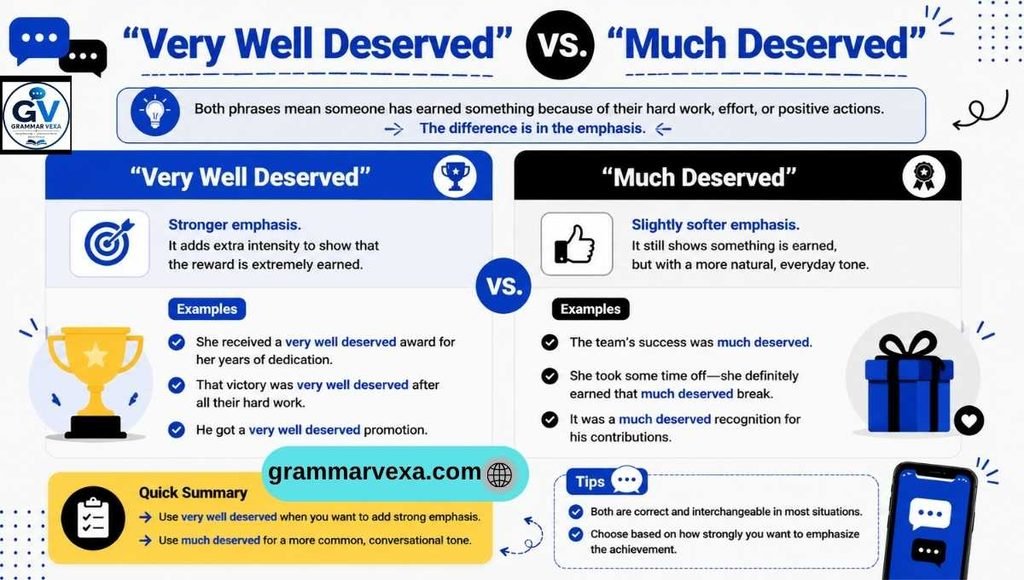
Both expressions can appear in English, but they don’t function exactly the same way.
Very Well Deserved
Very well deserved adds emphasis to well deserved.
Examples:
- “Your success is very well deserved.”
- “That award was very well deserved.”
- “Her promotion was very well deserved.”
The speaker is strongly affirming that the outcome was justified.
Much Deserved
Much deserved can also mean that something was strongly deserved.
Examples:
- “They received some much-deserved recognition.”
- “After years of work, he finally enjoyed some much-deserved rest.”
The expression is especially common before nouns:
“a much-deserved break”
However, much-deserved and well-deserved can carry slightly different stylistic flavors. Well-deserved is extremely common and natural in everyday English.
Well Deserved Synonyms and Alternatives
Sometimes repeating well deserved several times makes your writing feel flat. Fortunately, English offers several alternatives.
Deserved
The simplest alternative is:
“Her praise was deserved.”
This is direct and neutral.
Fully Deserved
Use this when you want to emphasize completeness:
“The criticism was fully deserved.”
Thoroughly Deserved
This is stronger and often appears in formal or evaluative writing:
“Their victory was thoroughly deserved.”
Richly Deserved
This expression emphasizes that someone deserves something to a significant degree:
“She received the richly deserved recognition.”
Well Earned
Use this when effort is especially important:
“He received a well-earned reward.”
Justified
Use justified when the focus is on whether something was reasonable or supported by circumstances:
“The decision was justified.”
These alternatives aren’t interchangeable in every sentence. Good writing depends on choosing the word that expresses the exact relationship between the person, action, and result.
Well Deserve vs. Well Deserved: Side-by-Side Comparison
The clearest way to understand the difference between well deserve and well deserved is to compare their grammatical functions.
| Phrase | Function | Correct example |
|---|---|---|
| deserve | Base verb | “You deserve this award.” |
| deserves | Present-tense verb | “She deserves recognition.” |
| deserved | Past form / adjective | “The award was deserved.” |
| well deserved | Predicative adjective phrase | “The award was well deserved.” |
| well-deserved | Compound adjective before noun | “She received a well-deserved award.” |
| well deserve | Not the standard phrase for this meaning | “You well deserve it” is not the normal modern form. |
This comparison also shows why searching for is well deserve correct can be confusing.
The problem isn’t that deserve is grammatically wrong. It’s that the verb form doesn’t fit the construction.
Can You Ever Say “Well Deserve”?
This question deserves a careful answer.
The answer isn’t simply that the two words can never occur next to each other under any imaginable grammatical circumstances. English allows many unusual constructions depending on context, dialect, historical usage, and sentence structure.
However, if your intended meaning is:
“This is something that someone completely deserves.”
then well deserved is the standard modern expression.
For example, avoid:
“You well deserve this award.”
Use:
“You well deserve this award.”
No—that still sounds unnatural in standard modern English.
The natural alternatives are:
“You certainly deserve this award.”
or:
“You thoroughly deserve this award.”
or:
“You well deserve this award.”
Even though the last construction can occasionally appear in literary or nonstandard usage, it isn’t the form to recommend to English learners or use as standard professional English.
The safest modern choices are:
- “You deserve this award.”
- “You certainly deserve this award.”
- “You thoroughly deserve this award.”
- “This award is well deserved.”
That distinction matters because well can modify verbs in English, but not every combination of well + verb sounds idiomatic. Natural English depends on established usage as well as grammatical possibility.
Why “You Well Deserve It” Sounds Unnatural
A sentence such as:
“You well deserve it.”
may look logical because deserve is a verb and well can sometimes modify verbs.
But English speakers usually choose another adverb with deserve in this structure.
More natural choices include:
- “You really deserve it.”
- “You certainly deserve it.”
- “You truly deserve it.”
- “You absolutely deserve it.”
- “You thoroughly deserve it.”
Or simply:
“You deserve it.”
The last version is often the strongest because it is clean and direct.
Meanwhile:
“It is well deserved.”
uses a very established adjective construction.
This is a useful lesson in natural English usage: grammatical word combinations aren’t always equally idiomatic. Fluent writing requires attention to both grammar and conventional usage.
Grammar Breakdown: Deserve, Deserved, and Deserving
Understanding the word family makes the well deserved grammar much easier.
| Word | Form | Typical function | Example |
|---|---|---|---|
| deserve | Base verb | Present/general action | “They deserve recognition.” |
| deserves | Third-person singular present | Present-tense verb | “She deserves praise.” |
| deserved | Past form | Past-tense verb | “He deserved the award.” |
| deserved | Past participle/adjective | Describes a result | “The award was deserved.” |
| deserving | Present participle/adjective | Describes someone or something worthy | “She is deserving of praise.” |
Deserve as a Base Verb
The base form appears after certain subjects and auxiliary structures.
Examples:
- “I deserve a break.”
- “They deserve recognition.”
- “You deserve to succeed.”
Deserves as a Present-Tense Verb
With a third-person singular subject, use deserves.
- “She deserves the award.”
- “He deserves respect.”
- “The team deserves credit.”
Deserved as a Past-Tense Verb
Use deserved when describing a past situation:
“She deserved the promotion.”
Here, deserved is functioning as the past-tense form of the verb.
Deserved as an Adjective
In:
“The promotion was well deserved.”
deserved describes the promotion.
English dictionaries recognize deserved as an adjective as well as a form related to the verb deserve.
This is why calling well deserved simply a “past tense” phrase doesn’t tell the whole story. In sentences such as “The award was well deserved,” the phrase functions adjectivally.
Is “Well Deserved” an Adjective Phrase?
Yes.
In:
“The award was well deserved.”
the words well deserved function together as an adjective phrase describing the subject “the award.”
The phrase tells us what kind of judgment applies to the award.
Similarly:
“Her success is well deserved.”
Here, well deserved describes “success.”
When placed before a noun, the phrase becomes a compound modifier:
“a well-deserved success”
The punctuation changes because the grammatical position changes.
This is why well deserved adjective phrase is a useful concept for English learners. It explains why the phrase can appear after a linking verb without acting like an ordinary verb phrase.
Is “Well Deserved” Grammatically Correct?
Yes. Well deserved is grammatically correct.
Examples:
- “Your success is well deserved.”
- “The team earned a well-deserved victory.”
- “Her recognition was well deserved.”
- “He received a well-deserved reward.”
Cambridge Dictionary directly lists well deserved as an adjective and separately shows well-deserved before a noun.
So if you’re asking is well deserved correct, the answer is clearly yes.
Is “Well Deserve” Grammatically Correct?
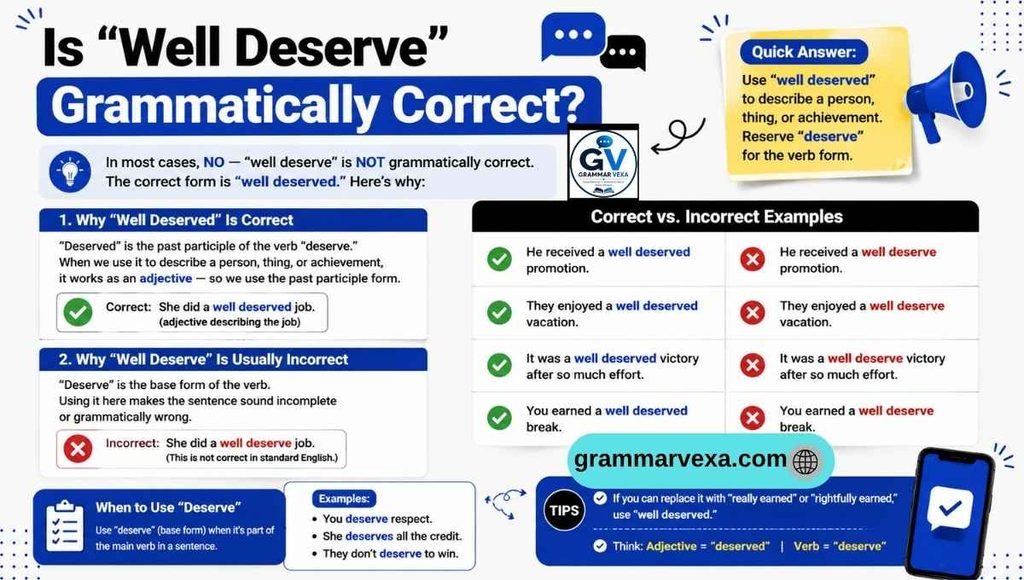
Not as the standard equivalent of well deserved.
If you want to say that someone deserves something, use the verb deserve in an appropriate structure:
- “You deserve it.”
- “She deserves the award.”
- “They deserve recognition.”
- “He deserves to win.”
If you want to describe something that someone merits, use well deserved:
- “The award was well deserved.”
- “The recognition was well deserved.”
- “It was a well-deserved award.”
This is the practical answer to is well deserve correct: don’t use well deserve as a replacement for well deserved.
How Native Speakers Use “Well Deserved”
In everyday English, the phrase often appears after a positive event.
Imagine a colleague has worked for months on a major project and finally receives a promotion.
A natural response would be:
“Congratulations! That’s a well-deserved promotion.”
Or:
“Congratulations! The promotion is well deserved.”
In casual spoken English, the response may become even shorter:
“Well deserved!”
This kind of elliptical expression is common in conversation because the context supplies the missing information.
Spoken English Examples
- “Nice job. Well deserved!”
- “You earned it. Well deserved.”
- “That was a well-deserved win.”
- “She definitely deserves the recognition.”
- “He deserves a break after all that work.”
The distinction between deserve and well deserved remains the same even when the language becomes informal.
Well Deserved in Professional Writing
The phrase works well in professional English when the claim is supported by a clear achievement.
Examples:
“Her promotion was well deserved given her sustained performance and leadership.”
“The research team received well-deserved recognition for its contribution.”
“The employee earned a well-deserved opportunity to lead the new project.”
However, professional writing benefits from precision.
Instead of saying:
“He deserves a well-deserved promotion.”
write:
“He deserves a promotion.”
or:
“He earned a well-deserved promotion.”
The first sentence uses deserves as the verb. The second uses well-deserved as an adjective.
Using both in the same construction can become repetitive or awkward.
Well Deserved in Academic Writing
Academic writing usually favors specific evidence over emotional evaluation.
Instead of:
“The researcher received well-deserved praise.”
a more evidence-focused sentence might say:
“The researcher received recognition for the study’s methodological contribution.”
However, well deserved isn’t grammatically unsuitable for academic writing. It simply carries an evaluative tone.
For example:
“The award was well deserved given the study’s methodological rigor and contribution to the field.”
That sentence makes the evaluation more transparent because it gives a reason.
This illustrates an important writing principle: precise context strengthens evaluative language.
Well Deserved in Casual Writing
Casual writing allows shorter and more expressive uses.
Examples:
- “Well deserved!”
- “You earned it!”
- “That win was well deserved.”
- “Enjoy your well-deserved break!”
- “Honestly, that’s very well deserved.”
On social media, the standalone form “Well deserved!” is particularly natural because readers already understand what achievement the commenter is discussing.
Common Mistakes With “Well Deserved”
Several errors appear repeatedly when people confuse the two forms.
Mistake 1: Using “Well Deserve” Instead of “Well Deserved”
Incorrect for the intended meaning:
“The award was well deserve.”
Correct:
“The award was well deserved.”
The subject is the award, and deserved describes it.
Mistake 2: Using the Wrong Form After “Does”
Remember that auxiliary verbs affect the following verb.
Correct:
“Does she deserve the award?”
Not:
“Does she deserved the award?”
After does, use the base verb deserve.
Similarly:
“She deserves the award.”
Here, there is no auxiliary does, so the third-person singular form deserves is required.
Mistake 3: Forgetting the Hyphen Before a Noun
Preferred:
“a well-deserved promotion”
Not:
“a well deserved promotion”
The hyphen makes the compound modifier easier to read.
Mistake 4: Adding a Hyphen After a Linking Verb
Preferred:
“The promotion was well deserved.”
The hyphen is generally unnecessary in this position.
Mistake 5: Confusing Deserve With Earn
These words overlap but aren’t identical.
“She deserves the award.”
focuses on merit.
“She earned the award.”
focuses more directly on achievement or effort.
Both may be true, but they emphasize different aspects of the situation.
A Quick Decision Guide
When you’re unsure which expression to choose, use this three-step method.
Step 1: Is a Person the Subject?
If the person is receiving or meriting something, use deserve.
“You deserve this.”
“She deserves recognition.”
Step 2: Are You Describing the Result?
If you’re describing the award, praise, success, break, or another outcome, use well deserved.
“The recognition was well deserved.”
Step 3: Does a Noun Come Immediately After the Phrase?
If yes, use well-deserved.
“a well-deserved reward”
This framework solves most well deserve or well deserved questions in seconds.
Real-World Examples of “Well Deserved”
The following examples show how the expression changes naturally across different contexts.
Workplace
- “Her well-deserved promotion reflects years of strong performance.”
- “The recognition was well deserved.”
- “After completing the project, the team took a well-deserved break.”
- “He earned a well-deserved reputation for reliability.”
Education
- “She received a well-deserved scholarship.”
- “His academic success was well deserved.”
- “The students earned well-deserved recognition for their research.”
Sports
- “The team celebrated a well-deserved victory.”
- “Their championship was well deserved.”
- “The player earned a well-deserved medal.”
Personal Achievements
- “You deserve this success.”
- “Your achievement is well deserved.”
- “After finishing the marathon, she took a well-deserved rest.”
- “That vacation is well deserved after such a demanding year.”
Social Media
- “Congratulations! Well deserved!”
- “What a well-deserved win!”
- “You worked for it. Well deserved.”
- “That recognition is absolutely well deserved.”
A Useful Grammar Framework
The difference becomes even clearer when you map each form to a sentence pattern.
| Pattern | Example |
|---|---|
| Subject + deserve + noun | “You deserve recognition.” |
| Subject + deserves + noun | “She deserves praise.” |
| Subject + deserved + noun | “He deserved the award.” |
| Subject + be + well deserved | “The award was well deserved.” |
| well-deserved + noun | “a well-deserved award” |
| Subject + deserve + to + verb | “They deserve to win.” |
This framework is more useful than memorizing one isolated phrase.
Why? Because it teaches the underlying sentence structure.
Once you understand that structure, you can create new sentences instead of simply remembering examples.
Why the Past Participle Matters
One reason learners struggle with this expression is that deserved has more than one grammatical function.
It can act as the past form of deserve:
“She deserved the award.”
It can also act as an adjective:
“The award was deserved.”
Add well:
“The award was well deserved.”
That creates the expression people commonly use to evaluate an outcome.
This is why describing deserved only as a “past-tense verb” can create confusion. In “was well deserved,” the word functions adjectivally.
The distinction between past participle vs base verb is therefore important. Deserve is the base form. Deserved is the past form and past participle of the regular verb. It can also serve as an adjective.
Well Deserved vs. Deserve: A Deeper Grammar Comparison
Consider these four sentences:
- “You deserve the award.”
- “She deserves the award.”
- “She deserved the award.”
- “The award was well deserved.”
The first three sentences focus on the person and use deserve as a verb.
The fourth focuses on the award and uses deserved adjectivally.
The tense also changes:
- deserve → present/base form
- deserves → present tense, third-person singular
- deserved → past tense
- well deserved → adjective phrase describing an outcome
This is the central grammar difference behind the entire topic.
Best Practices for Using “Well Deserved”
For polished English, keep these practical rules nearby.
- Use deserve when a person or subject merits something.
- Use deserved when describing something that was merited.
- Use well deserved after a linking verb.
- Use well-deserved before a noun.
- Don’t replace deserved with deserve simply because the meaning involves deserving.
- Use well-earned when you want to emphasize effort.
- Use deserving when describing someone or something as worthy of an outcome.
- Choose simple alternatives when they make the sentence clearer.
- In formal writing, support evaluative claims with specific reasons when appropriate.
Expert Tip: Don’t Learn the Phrase in Isolation
A useful way to improve English grammar is to learn patterns, not just vocabulary.
Instead of memorizing:
“well deserved = good”
learn this family:
You deserve it.
She deserves recognition.
The recognition was well deserved.
She received well-deserved recognition.
Now the relationship between the forms becomes obvious.
The same principle works with many other English verb families. Learning how a word behaves inside a sentence is often more useful than memorizing a dictionary definition alone.
Quick Reference: The Correct Forms
| If you want to say… | Use this |
|---|---|
| Someone merits something | deserve |
| A third-person subject merits something | deserves |
| Someone merited something in the past | deserved |
| Something is fully merited | well deserved |
| Something modifies a noun | well-deserved |
| Someone earned something through effort | well earned |
Conclusion
Well Deserve or Well Deserved: Which One Is Grammatically Correct? has a simple answer: well deserved is the correct phrase when you mean something was fully earned or justified. Use deserve as a verb when a person merits something, such as “You deserve the award.” Use well deserved when describing the result, as in “The award was well deserved.” Before a noun, write well-deserved, such as “a well-deserved promotion.”
Remembering these patterns makes Well Deserve or Well Deserved: Which One Is Grammatically Correct? much easier to handle. The key is to focus on the role each word plays in the sentence. Deserve expresses an action or judgment, while well deserved describes an outcome. Once you understand this difference, your everyday English, professional writing, and casual messages will sound clearer and more natural.
FAQs
Is “well deserve” or “well deserved” correct?
Well deserved is correct when describing something that someone has earned or merits. For example, “Her promotion was well deserved.”
Is “well deserved” grammatically correct?
Yes. Well deserved is grammatically correct when it describes an outcome, reward, or achievement that someone merits.
Should “well deserved” have a hyphen?
Use well-deserved before a noun, such as “a well-deserved award.” After a linking verb, write well deserved, as in “The award was well deserved.”
Can you say “well deserve”?
Deserve is a correct verb, but well deserve isn’t the usual standard expression for this meaning. Say “You deserve it” or “It is well deserved.”
What is the difference between “deserve” and “deserved”?
Deserve is the base verb, while deserved is its past-tense and past-participle form. “You deserve praise” differs from “The praise was well deserved.”
How do you use “well deserved” in a sentence?
Use it after a linking verb: “Her success was well deserved.” Before a noun, use well-deserved, such as “Her well-deserved success made everyone proud.”
Is “well deserved” the same as “well earned”?
They have similar meanings, but well deserved emphasizes merit or justification. Well earned places more emphasis on effort or hard work.
Is “Congratulations, well deserved” correct?
Yes, “Congratulations! Well deserved!” is natural in casual English. It means the person genuinely earned the achievement or recognition.
What does “well deserved” mean?
Well deserved means fully earned, justified, or appropriate based on someone’s actions, qualities, or achievements.

Jessica Morgan is an English language writer and researcher at Grammar Vexa. I enjoy exploring slang, vocabulary, word meanings, synonyms, and alternative phrases. Through my work, I aim to make English easier to understand by providing clear explanations, useful examples, and practical language tips.







2 thoughts on “Well Deserve or Well Deserved: Which One Is Grammatically Correct?”