of Benefit:
Opposite of benefit, the best word usually depends on what you mean. Harm, disadvantage, loss, damage, drawback, and detriment can all describe negative sides of something. However, they aren’t interchangeable.
In simple terms, a benefit is something that helps, improves, or gives an advantage. Its opposite can describe something that hurts, weakens, costs, or puts someone in a worse position. Cambridge defines benefit as a helpful or good effect, while Merriam-Webster describes it as something that produces good or helpful results or promotes well-being.
So, what’s the antonym of benefit?
Harm is often the closest choice when something causes injury or a negative effect. Disadvantage works better when something puts a person or option in a weaker position. Loss fits financial or material situations, while drawback describes an undesirable feature.
This guide explains the opposite meaning of benefit, compares the most useful benefit antonyms, and shows how to choose the correct antonym in everyday English, academic writing, business communication, and other contexts.
What Is the Opposite of Benefit?
The most common opposite of benefit is harm, but it isn’t always the most precise answer.
A benefit produces a helpful or favorable result. An opposite produces an unfavorable result, creates difficulty, removes value, or causes damage.
For example:
- Exercise can benefit your health.
- A serious injury can harm your health.
- A high price can be a disadvantage.
- A failed investment can create a loss.
- Poor maintenance can cause damage.
- A complicated interface can be a drawback.
These examples reveal an important point: antonyms depend on context.
Quick Answer: Common Opposites of Benefit
| Opposite | Basic meaning | Best context |
|---|---|---|
| Harm | Injury or negative effect | Health, people, environment |
| Disadvantage | Unfavorable position | Comparisons, competition |
| Loss | Lost money, value, or opportunity | Finance, business |
| Damage | Physical, functional, or reputational injury | Property, systems, reputation |
| Drawback | Undesirable feature | Products, plans, decisions |
| Detriment | Harm or disadvantage | Formal and academic writing |
| Disbenefit | Something disadvantageous | Technical or formal contexts |
| Downside | Negative aspect | Everyday English |
Merriam-Webster’s thesaurus lists disadvantage and drawback among the antonyms or near-antonyms of benefit.
That distinction matters. A good writer doesn’t simply grab the first word that looks opposite. The writer chooses the term that describes the intended meaning.
What Does “Benefit” Mean?
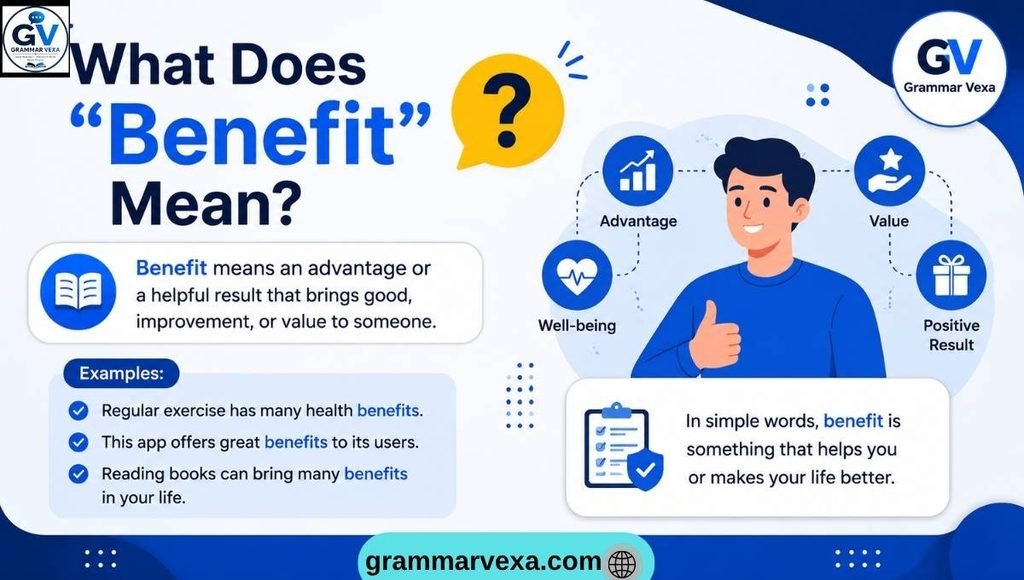
Before identifying the opposite, it’s useful to understand exactly what benefit means.
As a noun, benefit commonly means a helpful effect, advantage, gain, or form of assistance. Merriam-Webster also lists financial assistance, insurance payments, employee benefits, and similar uses as separate meanings.
For example:
Regular exercise has several health benefits.
Here, benefits means positive effects.
Another example:
The new software offers several benefits for small businesses.
Here, benefits means advantages or useful results.
The word can also describe employment-related compensation:
The job offers excellent health benefits.
In that sentence, benefits doesn’t mean simply “advantages.” It refers to services or rights provided in addition to wages, such as health insurance or paid leave.
Benefit as a Noun
As a noun, benefit can refer to:
- an advantage
- a helpful effect
- a positive result
- useful assistance
- financial support
- an employee perk
- an insurance or pension payment
- an event organized to raise money
The intended meaning determines which opposite makes sense.
For example:
1. Benefit → harm
The treatment provided a health benefit.
2. Benefit → loss
The investment generated a financial benefit.
3. Benefit → disadvantage
The flexible schedule gave employees a major benefit.
4. Benefit → drawback
The product has several benefits but one significant drawback.
Benefit as a Verb
The Benefit also works as a verb. It means to help someone or something, or to receive help from something. Cambridge gives examples such as people benefiting from someone’s knowledge or a law benefiting homeowners.
For example:
The new program benefits local students.
Possible opposite constructions include:
The new policy harms local students.
or:
The new policy disadvantages local students.
This is another reason context matters when choosing words opposite to benefit.
Beneficial and Benefit-Related Forms
The adjective beneficial means helpful or producing a good result.
Its strongest common opposite is usually harmful, detrimental, or damaging.
| Positive word | Natural opposite |
|---|---|
| benefit | harm |
| beneficial | harmful |
| advantage | disadvantage |
| gain | loss |
| improvement | deterioration |
| help | harm |
| profit | loss |
| reward | penalty |
| favorable | unfavorable |
These relationships aren’t perfect in every sentence. They simply show common word relationships in English.
Key Takeaways
The opposite of benefit isn’t always one fixed word. The most accurate choice depends on the context and the type of negative outcome.
Remember these core relationships:
- Benefit ↔ harm — positive effect versus injury or negative effect.
- Advantage ↔ disadvantage — favorable position versus unfavorable position.
- Gain ↔ loss — value gained versus value lost.
- Benefit ↔ damage — helpful result versus impairment.
- Benefit ↔ drawback — positive feature versus undesirable feature.
- Benefit ↔ detriment — positive effect versus formal concept of harm.
- Benefit ↔ disbenefit — favorable result versus disadvantageous result.
For everyday English, harm, disadvantage, drawback, and downside are usually the most useful choices. In financial contexts, loss often provides greater precision. In formal writing, detriment can be appropriate.
The real skill isn’t memorizing one antonym. It’s understanding the intended meaning, recognizing the word relationship, and choosing the term that communicates the idea most precisely.
That approach improves English vocabulary, writing skills, communication skills, and overall confidence with word usage.
Sources and Further Reading
- Cambridge Dictionary — Benefit
- Merriam-Webster — Benefit
- Merriam-Webster — Benefit Thesaurus
- Merriam-Webster — Harm
- Merriam-Webster — Disadvantage
- Merriam-Webster — Disbenefit
- Oxford Learner’s Dictionaries — Detriment
Common Words That Mean the Opposite of Benefit
Several terms can express the benefit opposite words depending on the situation.
Harm
Harm is one of the broadest and most natural choices.
Merriam-Webster defines harm as physical or mental damage or injury. Its usage can also include pain, suffering, or other negative effects.
Use harm when something actively causes injury, suffering, deterioration, or a negative effect.
Examples:
- Excessive exposure can harm your skin.
- The decision caused serious harm to the environment.
- Stress can create emotional harm.
- The policy may cause long-term negative effects.
The relationship is straightforward:
benefit ↔ harm
This pairing works particularly well for health, safety, people, animals, and environmental discussions.
Disadvantage
A disadvantage is an unfavorable condition that makes success more difficult or places someone in a weaker position. Cambridge defines it as a condition or situation that causes problems or makes someone or something less successful.
Use it when you’re comparing options.
For example:
One benefit of remote work is flexibility. One disadvantage is reduced face-to-face interaction.
Notice the difference. Remote work doesn’t necessarily harm someone. The lack of interaction may simply create a disadvantage in certain situations.
The natural relationship is:
advantage ↔ disadvantage
Since benefit often means advantage, disadvantage can serve as a strong antonym.
Loss
Loss works when the negative outcome involves something being lost, reduced, or not obtained.
Merriam-Webster includes failure to gain or obtain something and an amount by which costs exceed selling prices among its meanings of loss.
Examples include:
- financial loss
- loss of income
- loss of market share
- loss of opportunity
- loss of productivity
- loss of value
The most useful relationship is:
gain ↔ loss
Consider this example:
The investment produced a financial benefit.
Its opposite could be:
The investment produced a financial loss.
Here, harm would sound less precise because the important issue is money.
Damage
Damage refers to injury or impairment that reduces value, condition, usefulness, or function.
Merriam-Webster distinguishes damage from broader terms such as harm. It notes that damage often suggests injury that lowers value or impairs usefulness.
Examples:
- physical damage
- property damage
- reputational damage
- equipment damage
- environmental damage
- emotional damage
The relationship can therefore be:
benefit ↔ damage
However, this pairing isn’t as direct as benefit ↔ harm.
A benefit doesn’t necessarily improve physical condition. Likewise, damage doesn’t always represent the direct opposite of a benefit.
Drawback
A drawback is an undesirable feature or disadvantage.
Merriam-Webster defines it as an objectionable feature and gives cost as an example of a plan’s drawback.
Use drawback when something has advantages but also has a negative side.
For example:
The laptop has excellent battery life, but its weight is a drawback.
This wording sounds natural because the weight isn’t necessarily causing harm. It’s simply an undesirable feature.
The relationship is:
advantage ↔ drawback
and often:
benefit ↔ drawback
Detriment
Detriment is a more formal word for harm or damage.
Oxford Learner’s Dictionaries defines detriment as the act of causing harm or damage or something that causes harm or damage. It commonly appears in the phrase “to the detriment of.”
Examples:
The policy improved efficiency to the detriment of employee morale.
Excessive testing can be a detriment to effective learning.
This word fits particularly well in academic writing, professional communication, legal writing, and formal analysis.
Disbenefit
Disbenefit is a real English word. It means something disadvantageous or objectionable, essentially a drawback. Merriam-Webster lists disadvantage and disability among its synonyms.
For example:
The proposal could create a significant disbenefit for rural communities.
It is useful in technical or formal discussions. However, disadvantage, drawback, or negative effect will usually sound more natural in ordinary US English.
Downside
Downside means a negative aspect of something. Merriam-Webster lists disadvantage and drawback as synonyms.
For example:
The main downside of the plan is its high cost.
It works especially well in everyday conversations and informal explanations.
Benefit vs. Harm, Disadvantage, Loss, and Damage
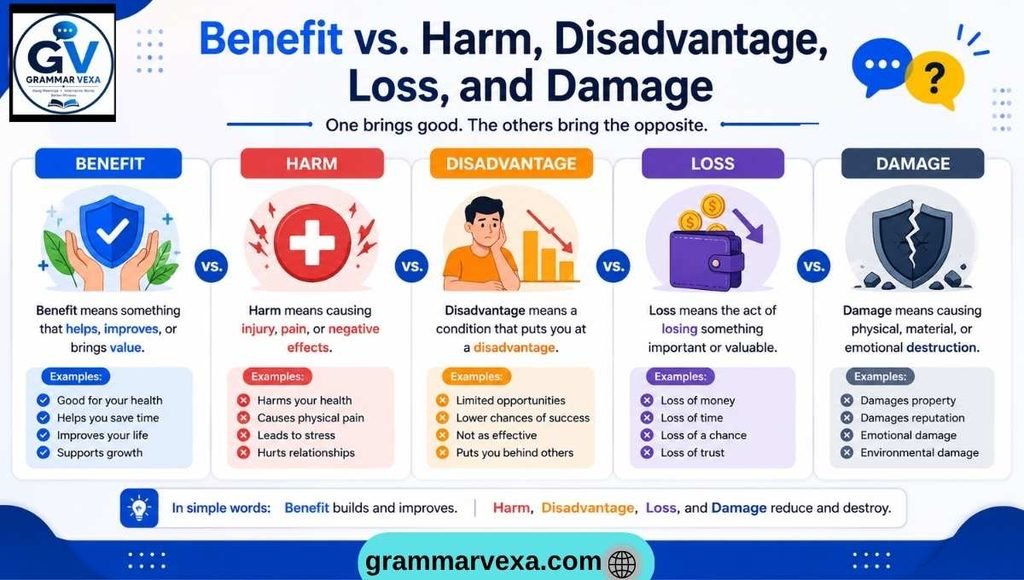
These words overlap, but their meanings aren’t identical.
| Comparison | What the negative term emphasizes | Example |
|---|---|---|
| Benefit vs. harm | Injury or negative effect | The chemical may harm wildlife. |
| Benefit vs. disadvantage | Weaker position | The price creates a disadvantage. |
| Benefit vs. loss | Lost value or money | The deal resulted in a loss. |
| Benefit vs. damage | Impairment or destruction | The storm caused property damage. |
| Benefit vs. drawback | Undesirable feature | The cost is a drawback. |
| Benefit vs. detriment | Formal harm | The change worked to their detriment. |
The easiest way to remember these distinctions is to ask what actually happened.
Did someone get hurt? Use harm.
Did someone become less competitive? Use disadvantage.
Was money or value lost? Use loss.
Was something physically or functionally impaired? Use damage.
Is there simply an undesirable feature? Use drawback.
Do you need a formal term for harm? Consider detriment.
Harm vs. Disadvantage
These two are often confused.
A disadvantage doesn’t necessarily cause direct injury. It means a condition makes success more difficult or puts someone in a weaker position.
Harm, by contrast, emphasizes a negative effect or injury.
Compare:
Working from home has the disadvantage of limited informal interaction.
This describes a downside.
Now compare:
The unsafe working environment harmed employees.
This describes a negative effect on people.
Merriam-Webster’s definition of disadvantage also connects it with unfavorable conditions and situations that make achievement more difficult.
A Simple Rule
Use:
- disadvantage for comparison
- harm for injury or negative impact
That small distinction can make your writing accurately much easier.
Benefit vs. Loss
The benefit vs loss distinction becomes especially important in financial and business contexts.
A benefit represents something valuable gained or received. A loss represents value that disappears, isn’t obtained, or falls below expectations.
Consider:
The investment generated a significant benefit.
versus:
The investment resulted in a significant loss.
The second sentence is stronger because loss directly identifies the financial outcome.
Merriam-Webster specifically includes financial meanings of loss, including situations where costs exceed selling prices.
Gain and Loss
The most direct semantic pair is:
gain ↔ loss
For example:
The company reported a gain on the transaction.
The company reported a loss on the transaction.
Although benefit and loss can contrast, they aren’t always exact antonyms.
Benefit vs. Damage
The benefit vs damage distinction is useful when discussing physical objects, systems, property, health, or reputation.
For example:
The protective coating provides a benefit by reducing corrosion.
Without protection, corrosion can cause damage.
Here, the benefit is the positive effect. The damage is the resulting deterioration.
Merriam-Webster notes that damage often refers to injury that lowers value or impairs usefulness.
That makes damage more specific than the broader word harm in many situations.
Opposite of Benefit in Different Contexts
The right benefit antonyms change with the subject.
Opposite of Benefits in Business
Business discussions often use:
- disadvantage
- financial loss
- cost
- liability
- drawback
- negative impact
- adverse effect
Suppose a company adopts a new software platform.
Potential benefits might include:
- faster workflows
- lower labor requirements
- better reporting
- improved customer service
Potential negatives could include:
- implementation costs
- training expenses
- operational disruption
- security risks
- compatibility problems
Calling every negative factor “harm” would make the analysis vague.
Instead:
The software reduced processing time, but its licensing fees created a significant cost.
The transition caused temporary disruption.
Limited compatibility became a major disadvantage.
Precise vocabulary makes business communication more credible.
Opposite of a Health Benefit
For health-related writing, harm, harmful effect, adverse effect, and health risk are often more appropriate.
For example:
Regular physical activity can provide health benefits.
The negative counterpart might be:
A treatment can also produce adverse effects.
or:
Certain behaviors may cause harm to health.
The exact wording depends on the evidence and situation. An adverse effect can describe an unwanted effect of an intervention, while harm is broader.
Avoid automatically replacing benefit with harm. A treatment can have both benefits and risks without the risk being a direct “opposite.”
Opposite of Benefit in Accounting and Finance
Financial contexts require more precision.
Depending on the sentence, the opposite may be:
- loss
- expense
- cost
- deficit
- reduction in value
- financial disadvantage
For example:
The acquisition provided a financial benefit.
Possible contrast:
The acquisition created a financial loss.
But if the issue is money spent rather than money lost:
The acquisition involved substantial costs.
That’s an important distinction.
Cost isn’t always the opposite of benefit.
A cost can exist alongside a benefit.
For example:
The company spent $50,000 on the software and gained $100,000 in measurable value.
The $50,000 is a cost. It isn’t necessarily a negative outcome.
This is why good word usage requires attention to meaning rather than simple word matching.
Opposite of “Benefit of the Doubt”
The phrase “benefit of the doubt” has a special meaning.
It refers to accepting someone or something as honest or deserving of trust despite uncertainty. Merriam-Webster describes it as an advantage derived from doubt about guilt, possible error, or the weight of evidence.
Because this is an idiomatic phrase, it doesn’t have one neat lexical antonym.
Possible opposite expressions include:
- refuse to give the benefit of the doubt
- assume someone is responsible
- distrust someone
- treat the evidence as unfavorable
- presume guilt, where that is actually intended
For example:
I wasn’t sure whether Alex was late because of traffic, so I gave him the benefit of the doubt.
An opposite idea could be:
I had already heard several conflicting explanations, so I refused to give him the benefit of the doubt.
The key point is that “benefit of the doubt” isn’t simply another meaning of benefit. It functions as an established phrase.
Opposite of Benefit in Academic Writing
Academic writing usually benefits from precise, neutral terminology.
Instead of repeatedly writing harm, consider terms such as:
- adverse effect
- negative consequence
- detriment
- disadvantage
- unfavorable outcome
- negative impact
- limitation
For example:
Less precise:
The policy had some harm.
More natural:
The policy produced several negative consequences.
Another option:
The intervention produced measurable positive effects, but researchers also identified several adverse effects.
This style improves academic vocabulary without making the prose unnecessarily complicated.
Benefit and Detriment in Formal Writing
The phrase “to the detriment of” is especially useful when one positive development creates a negative effect elsewhere.
For example:
Automation increased productivity to the detriment of some routine job functions.
The construction clearly shows a trade-off.
That’s more precise than saying:
Automation benefited productivity but harmed jobs.
Both can work, but the formal version fits certain analytical contexts better.
Opposite of Benefit in Everyday Conversations
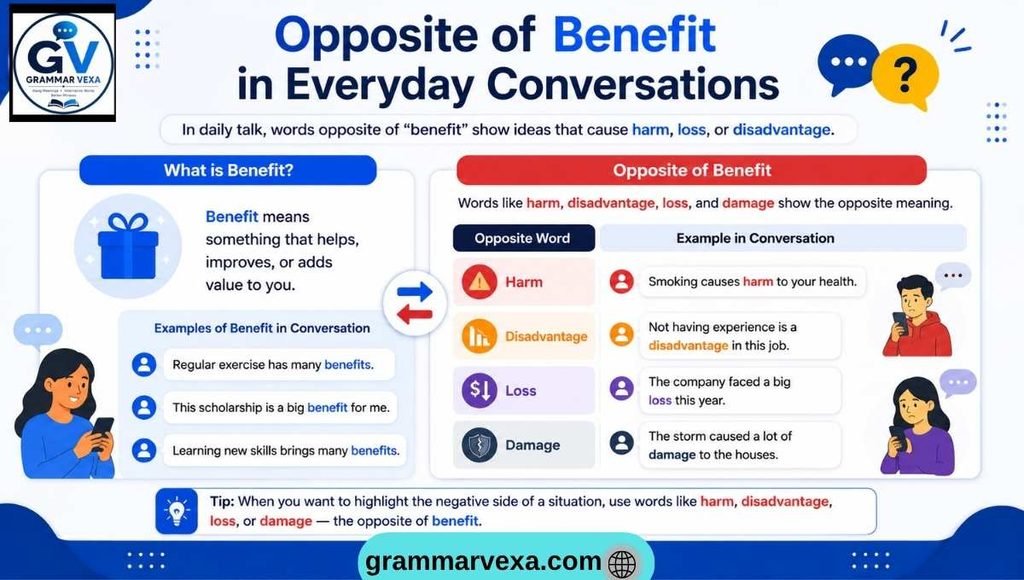
Everyday English favors simple, familiar words.
Good choices include:
- harm
- downside
- drawback
- disadvantage
- loss
- damage
For example:
What’s the benefit of buying this phone?
Natural responses include:
The main benefit is better battery life.
The biggest drawback is the price.
The downside is that it’s heavier.
The disadvantage is the limited storage.
These expressions sound more natural than forcing formal words like detriment into casual conversation.
Synonyms of Benefit
The synonyms of benefit depend on the exact meaning.
Common Synonyms
- advantage
- gain
- profit
- help
- improvement
- value
- reward
- support
- aid
- asset
- bonus
- positive effect
- favorable outcome
Merriam-Webster’s thesaurus includes terms such as advantage, asset, boon, aid, help, resource, support, blessing, and windfall among synonyms or closely related words for benefit.
Benefit Synonyms by Context
| Meaning of benefit | Useful synonym |
|---|---|
| Advantage | advantage |
| Financial benefit | gain, profit |
| Assistance | help, aid |
| Improvement | positive effect |
| Valuable feature | asset |
| Unexpected financial benefit | windfall |
| Employee benefit | perk, compensation |
| Positive result | favorable outcome |
Context again makes the difference.
A profit is a type of financial gain. It isn’t a universal replacement for benefit.
Synonyms of Harm
The synonyms of harm also vary in strength and context.
Common options include:
- damage
- injury
- detriment
- hurt
- impairment
- adverse effect
- negative impact
- harmful consequence
- destruction
- pain
Merriam-Webster lists damage, injury, detriment, hurt, and impairment among related words for harm.
Harm-Related Terms by Context
| Term | Typical emphasis |
|---|---|
| Harm | General negative effect |
| Injury | Physical or psychological injury |
| Damage | Impairment or reduced value |
| Detriment | Formal harm |
| Hurt | Physical or emotional pain |
| Impairment | Reduced ability or function |
| Destruction | Severe damage or ruin |
| Adverse effect | Unwanted result |
Semantic Word Pairs Related to Benefit
Learning antonyms in English becomes easier when you understand semantic relationships.
Some common pairs include:
- advantage ↔ disadvantage
- gain ↔ loss
- benefit ↔ harm
- benefit ↔ damage
- profit ↔ loss
- help ↔ harm
- improvement ↔ deterioration
- positive ↔ negative
- advantage ↔ drawback
- reward ↔ penalty
- value ↔ detriment
- support ↔ injury
- growth ↔ decline
- success ↔ failure
- favorable ↔ unfavorable
- positive result ↔ negative result
- progress ↔ setback
- wellness ↔ harm
These pairs can improve English vocabulary, reading comprehension, and writing precision.
However, don’t assume every pair works in every sentence. Semantic relationships are often approximate rather than perfectly symmetrical.
How to Choose the Correct Opposite of Benefit
Choosing the correct antonym becomes easy when you identify the type of negative outcome.
Use “Harm” for Injury or Negative Effects
Choose harm when something negatively affects health, people, animals, relationships, or the environment.
The chemical can harm aquatic life.
Use “Disadvantage” for an Unfavorable Position
Choose disadvantage when comparing people, choices, products, or strategies.
Limited funding puts the organization at a disadvantage.
Use “Loss” for Lost Value
Choose loss when money, property, opportunity, income, or another valuable thing disappears.
The company experienced a significant financial loss.
Use “Damage” for Impairment
Choose damage when something becomes physically, functionally, or reputationally worse.
The storm caused extensive damage to the building.
Use “Drawback” for an Undesirable Feature
Choose drawback when something has a negative side but isn’t necessarily harmful.
The only drawback is the limited storage space.
Use “Detriment” for Formal Writing
Choose detriment when you need a formal word for harm or disadvantage.
The policy improved efficiency to the detriment of flexibility.
Use “Disbenefit” for Technical Contexts
Choose disbenefit when discussing formal evaluations, projects, systems, or policies where a negative consequence is being assessed.
Merriam-Webster recognizes the word and defines it as something disadvantageous or objectionable.
A Simple Context Test for Finding the Right Antonym
When you’re unsure, ask one question:
What exactly became worse?
Then match the answer.
| If the problem is… | Choose… |
|---|---|
| Injury or suffering | harm |
| Weaker competitive position | disadvantage |
| Lost money or value | loss |
| Physical or functional impairment | damage |
| Unwanted feature | drawback |
| Formal harm | detriment |
| Technical negative outcome | disbenefit |
| General negative side | downside |
This approach is more reliable than memorizing a single antonym.
Examples of the Opposite of Benefit in Sentences
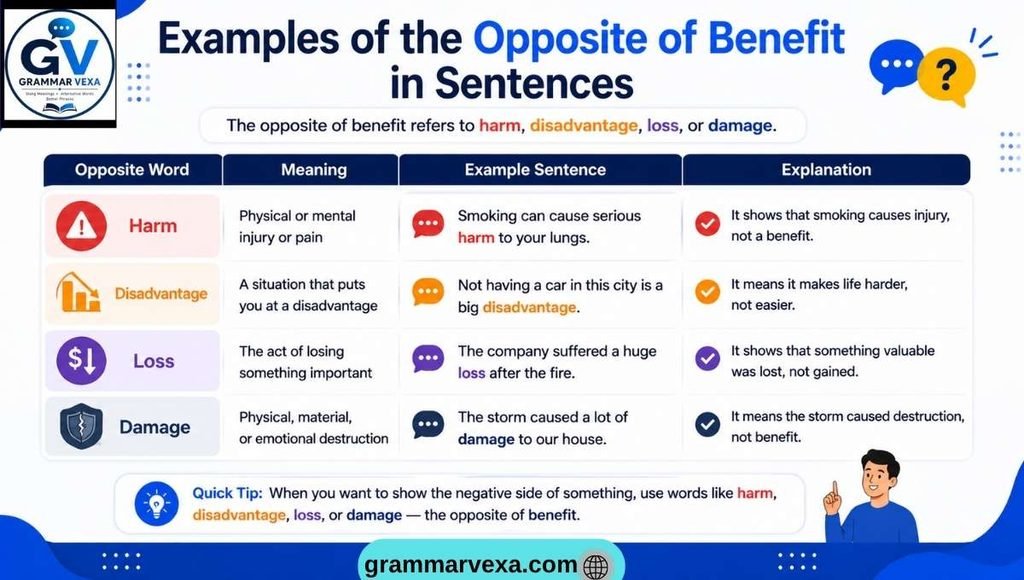
Here are practical sentence examples across different settings.
Everyday Examples
The benefit of this app is its simplicity.
The main drawback is the number of advertisements.
Exercise can benefit your health.
Poor sleep can harm your health.
The new route saves time but has the disadvantage of heavy traffic.
Business Examples
The software offers several benefits to small businesses.
High subscription costs are a major drawback.
The merger created financial benefits for shareholders.
Unexpected expenses resulted in a financial loss.
Limited production capacity puts the company at a disadvantage.
Academic Examples
The study identified several positive effects of the intervention.
Researchers also reported several negative effects.
The reform produced measurable benefits for students.
However, implementation costs became a significant disadvantage.
Health Examples
Regular physical activity provides important health benefits.
Certain behaviors can cause harmful effects.
The treatment produced a positive result.
Researchers also monitored possible adverse effects.
Technology Examples
Cloud storage provides the benefit of remote access.
Its major drawback is dependence on an internet connection.
A security vulnerability could cause serious damage.
These examples demonstrate why word meaning in context matters.
A Practical Comparison: Benefit and Its Main Opposites
| Word | Positive counterpart | Meaning | Tone |
|---|---|---|---|
| Harm | Benefit | Injury or negative effect | General |
| Disadvantage | Advantage/benefit | Worse position | Neutral |
| Loss | Gain/benefit | Value lost | Financial/general |
| Damage | Improvement/benefit | Impairment | Neutral |
| Drawback | Benefit | Negative feature | Conversational |
| Detriment | Benefit | Harm or disadvantage | Formal |
| Disbenefit | Benefit | Disadvantageous result | Technical/formal |
| Downside | Benefit | Negative aspect | Conversational |
This table provides a useful shortcut for choosing the right antonym.
Common Mistakes When Using Opposites of Benefit
Even advanced writers sometimes choose an antonym that sounds logical but doesn’t fit the sentence.
Mistake 1: Assuming “Harm” Is Always the Answer
Not every disadvantage causes harm.
The phone’s weight is a drawback.
Calling the weight “harm” would be inaccurate.
Mistake 2: Using “Loss” for Every Negative Outcome
A loss requires something to be lost, reduced, or not obtained.
High training costs are a drawback.
That doesn’t automatically mean the company experienced a loss.
Mistake 3: Confusing a Drawback With Harm
A drawback is simply a negative feature.
A harmful effect goes further because it causes actual injury, damage, or suffering.
Mistake 4: Treating “Cost” as a Universal Antonym
A cost can exist alongside a benefit.
The course costs $500 but provides valuable professional training.
The cost isn’t necessarily the opposite of the benefit.
Mistake 5: Using “Disbenefit” Everywhere
Although disbenefit is legitimate, it can sound overly technical in casual US English.
Instead of:
What’s the disbenefit of this phone?
Most speakers would say:
What’s the drawback of this phone?
Mistake 6: Confusing “Harm” With “Harmful”
Harm is commonly a noun or verb.
The policy caused harm.
Harmful is an adjective.
The policy had harmful effects.
Similarly:
- benefit → beneficial
- harm → harmful
- detriment → detrimental
- damage → damaging
Knowing these forms strengthens language skills.
Best Practices for Using Benefit and Its Opposites
Strong writing doesn’t merely use synonyms. It uses the most accurate word available.
1. Identify the Negative Outcome
First ask what happened.
Did something:
- injure someone?
- reduce value?
- create a weaker position?
- cost money?
- damage property?
- create an unwanted feature?
The answer determines the word.
2. Consider Your Audience
Use simpler words in everyday conversations.
Use more formal terms in academic writing or professional documents when they improve precision.
For example:
Casual:
The main downside is the price.
Formal:
The principal disadvantage is the implementation cost.
Both are correct.
3. Avoid Forced Antonyms
English doesn’t always work like a mathematical equation.
A sentence containing benefit doesn’t automatically need harm as its opposite.
Instead, identify the relationship between the two ideas.
4. Use Specific Terms When They Add Meaning
Compare:
The policy had a negative effect.
with:
The policy created a financial loss.
The second sentence tells the reader exactly what went wrong.
Precision improves communication skills and makes professional writing easier to understand.
Benefit and Harm: Why Context Changes Meaning
The relationship between benefit and harm becomes especially interesting when something produces both.
A single decision can have:
- positive effects
- negative effects
- short-term benefits
- long-term drawbacks
- financial gains
- social disadvantages
- health benefits
- environmental damage
For example, a new highway may provide transportation benefits while also producing environmental costs or community disruption.
Calling the entire project either “beneficial” or “harmful” oversimplifies the situation.
A more accurate analysis separates the outcomes.
| Outcome | Description |
|---|---|
| Transportation benefit | Faster movement |
| Economic benefit | Increased commercial activity |
| Environmental drawback | Habitat disruption |
| Financial cost | Construction expense |
| Social disadvantage | Possible displacement or noise |
This way of thinking is useful in policy analysis, business decisions, academic research, and everyday choices.
Real-World Decision-Making: Benefits, Drawbacks, Risks, and Costs
When people evaluate a product, policy, treatment, or business strategy, they rarely face a simple benefit-versus-harm choice.
They usually consider several dimensions:
Benefits
- What improves?
- What value is created?
- Who gains?
Drawbacks
- What becomes less convenient?
- What unwanted features appear?
Costs
- What must be paid or sacrificed?
Risks
- What could go wrong?
Harms
- What negative effects could actually occur?
Losses
- What value could disappear?
This framework prevents a common reasoning mistake: treating every negative factor as the same thing.
Example: Choosing a New Software System
Imagine a company evaluating a new project-management platform.
The benefits might include:
- better collaboration
- centralized information
- faster reporting
- improved workflow visibility
The drawbacks might include:
- complicated setup
- employee training requirements
The costs might include:
- subscription fees
- implementation expenses
The risks might include:
- data security concerns
- vendor dependency
Potential harms might include:
- serious disruption caused by a failed migration
Potential losses might include:
- lost productivity
- lost data
- lost revenue
Each term describes a different concern.
That’s the kind of distinction that makes professional communication clearer.
Pros and Cons: Benefit vs. Drawback
The familiar phrase pros and cons provides another way to understand the relationship.
Pros are favorable aspects.
Cons are unfavorable aspects.
A benefit usually belongs on the “pro” side. A drawback usually belongs on the “con” side.
For example:
| Product | Benefits | Drawbacks |
|---|---|---|
| Laptop | Portable, powerful, flexible | Cost, weight |
| Online course | Convenient, accessible | Limited interaction |
| Electric vehicle | Lower operating emissions in use | Charging requirements |
| Remote work | Flexibility, no daily commute | Possible isolation |
Notice that none of these drawbacks necessarily represents harm.
That’s why drawback is often a better antonym for benefit when discussing ordinary pros and cons.
Why Learning Opposites Improves Vocabulary

Understanding antonyms does more than help answer a vocabulary question.
It strengthens your ability to distinguish related ideas.
For example, learning:
benefit ↔ harm
is useful.
But learning the broader network is even better:
benefit → advantage → gain → positive effect
and:
harm → damage → injury → negative effect
Then add:
advantage ↔ disadvantage
gain ↔ loss
improvement ↔ deterioration
success ↔ failure
This creates a semantic map rather than a list of isolated words.
Benefits for English Language Learning
Studying antonyms in English can help with:
- vocabulary improvement
- reading comprehension
- writing accurately
- speaking more precisely
- understanding context
- recognizing subtle differences
- improving communication
- choosing stronger words
For language learners, these relationships are especially useful because two words may appear opposite but behave differently in sentences.
Opposite of Benefit: Quick Reference Guide
If you only need the answer quickly, use this guide.
- Harm — when something causes injury or negative effects.
- Disadvantage — when something puts someone in a weaker position.
- Loss — when money, value, resources, or opportunities are lost.
- Damage — when something becomes impaired or less useful.
- Drawback — when something has an undesirable feature.
- Detriment — when you need a formal term for harm or disadvantage.
- Disbenefit — when describing a formal or technical negative outcome.
- Downside — when talking casually about a negative aspect.
The safest general answer to “What is the opposite of benefit?” is harm or disadvantage, depending on the intended meaning.
If the context involves money, loss may be better. If it involves an undesirable feature, drawback is often more natural.
Frequently Asked Questions
What is the opposite of benefit?
The most common opposite of benefit is harm or disadvantage. The best choice depends on the context and intended meaning.
Is harm the exact antonym of benefit?
Harm is a strong antonym when something causes injury, suffering, or negative effects. However, disadvantage or drawback may fit better when describing an unfavorable feature.
What is the opposite of benefit in business?
Common choices include loss, disadvantage, drawback, cost, and negative consequence. Use loss for lost financial value and disadvantage for an unfavorable business position.
What is the opposite of a health benefit?
Harm, harmful effect, or adverse effect can describe the opposite of a health benefit. The most accurate term depends on the specific negative outcome.
Is disadvantage a synonym for the opposite of benefit?
Yes, in many contexts. A disadvantage describes a condition that puts someone or something in a less favorable position.
Can loss be the opposite of benefit?
Yes, especially when the Advantage involves money, resources, value, or an opportunity. The common semantic pair is gain and loss.
What is the opposite of beneficial?
The most common opposites of beneficial are harmful, detrimental, damaging, and adverse. Choose the word that best describes the negative effect.
Is “disbenefit” a real word?
Yes. Disbenefit is a recognized term for something disadvantageous or objectionable, although drawback and disadvantage are more natural in everyday US English.
How do I choose the correct antonym of benefit?
First, identify what became worse. Use harm for injury, loss for lost value, damage for impairment, disadvantage for an unfavorable position, and drawback for an undesirable feature.
Conclusions
The Opposite of Benefit: Meaning, Examples, Synonyms, and Usage Guide shows that no single word fits every situation. Harm works well for injury or negative effects. Disadvantage fits an unfavorable position. Loss works best for lost money or value. Damage describes impairment, while drawback points to an unwanted feature. Choosing the right antonym depends on context and intended meaning.
The Opposite of Benefit: Meaning, Examples, Synonyms, and Usage Guide also helps you use these words with greater accuracy. Understanding the difference between Advantage, harm, loss, disadvantage, and drawback can strengthen your English vocabulary and writing skills. Instead of forcing one opposite into every sentence, focus on the exact relationship between ideas. This simple approach makes everyday conversations, academic writing, and business communication clearer and more natural.

Jessica Morgan is an English language writer and researcher at Grammar Vexa. I enjoy exploring slang, vocabulary, word meanings, synonyms, and alternative phrases. Through my work, I aim to make English easier to understand by providing clear explanations, useful examples, and practical language tips.








2 thoughts on “Opposite of Benefit: Meaning, Examples, Synonyms, and Usage Guide”