WYO stands for “What You On,” a casual texting abbreviation used to ask someone what they’re currently doing or what their plans are for later. The WYO meaning in text centers on this everyday check-in, though a secondary usage appears in sales and marketplace conversations, where it stands for “What’s Your Offer.” Context always decides which one applies.
What makes WYO worth understanding isn’t the abbreviation itself, it’s how much meaning three letters can carry depending on who sends them. The same message can read as a friendly check-in, a soft invitation, or a straightforward business question, all without a single word changing.
This guide covers every layer of WYO slang: its origin in casual texting slang, how it compares to WYD, WTM, and HMU, how tone shifts when it comes from a guy or a girl, and how to reply naturally across Snapchat, Instagram, and everyday text messages. By the end, decoding WYO becomes automatic.
What Does WYO Mean in Text?
In the vast majority of casual conversations, WYO meaning in text boils down to one simple question: “What are you doing?” or “What are your plans?” It’s a low-effort, high-frequency way to check in with someone, gauge their availability, or open the door to making plans without sounding overly formal.
WYO stands for What You On, and it functions almost identically to asking someone what they’re up to right now or later today. Think of it as a shorter, slightly more relaxed cousin of “what are you doing” — the kind of message you send without overthinking it, usually to someone you already know well and text regularly.
There’s a second, less common meaning worth knowing. In sales conversations, online marketplaces, freelance negotiations, or any exchange involving money, WYO can mean “What’s Your Offer.” Someone selling an item, service, or freelance gig might type “wyo?” to ask a buyer what price they’re proposing. This usage shows up far less in everyday texting between friends and far more in comment sections, Facebook Marketplace, Depop, or negotiation-heavy DMs.
| Meaning | Full Phrase | Common Context | Example |
|---|---|---|---|
| Most common | What You On | Friends, group chats, social media | “yo wyo tonight?” |
| Less common | What’s Your Offer | Marketplace, sales, negotiations | “Listed at $40, wyo?” |
| Unrelated meaning | Wyoming (state abbreviation) | Highway signage, DMV, legal docs | “WYO 130” |
Key takeaway: If the message came from a friend, in a group chat, or on Snapchat/Instagram, assume it means “what you on.” If it showed up under a listing, a “for sale” post, or a negotiation thread, it almost certainly means “what’s your offer.”
Key Takeaways
- WYO meaning in text is most commonly “What You On,” a casual question about someone’s current activity or plans.
- A secondary, less common meaning is “What’s Your Offer,” used almost exclusively in sales, marketplace, and negotiation contexts.
- A third, entirely unrelated meaning identifies the state of Wyoming in highway signage, DMV paperwork, and legal citations.
- Context — who sent it, where the conversation is happening, and what came before — determines which meaning applies.
- WYO is closely related to WYD, WTM, and HMU, but each carries a slightly different function and tone.
- Tone from a guy or a girl depends on the relationship and conversation pattern, not the abbreviation itself.
- It fits naturally in casual conversation with friends and on social media platforms, but it doesn’t belong in professional conversations or first-time interactions.
- Reply with a short, honest status update for the casual meaning, or a specific number for the negotiation meaning.
- When in doubt, it’s always fine to ask directly what someone means — clarity beats guessing every time.
WYO Meaning: Automotive and State Abbreviation
Outside of texting slang entirely, WYO has a completely unrelated, well-established meaning: it’s the official abbreviation used for the state of Wyoming, particularly in automotive and transportation contexts. The Wyoming Department of Transportation (WYDOT) labels every state highway using this format — for example, WYO 130 or WYO 230 — where “WYO” simply replaces “Wyoming Highway” on road signage, maps, and official route documentation.
This meaning shows up in several formal, non-slang contexts:
- State highway naming, such as WYO 789 or WYO 59, maintained by WYDOT across the entire state highway system
- Vehicle registration and DMV paperwork that references Wyoming as the issuing state
- Insurance and legal citations, where “Wyo.” is used as shorthand in code references and administrative documents
- Road signage and mapping systems used statewide by drivers, delivery services, and navigation apps
This meaning is worth knowing simply because it’s the only version of WYO that has nothing to do with slang or casual conversation at all. If you see “WYO” on a map, a license plate reference, or a government document, it’s referring to Wyoming — not asking what you’re doing tonight. The two never overlap in real usage, since the contexts are completely different: one is a road sign, the other is a text message.
WYO Meaning in Text: What It Really Means and How to Use Right
How to Tell Which WYO Someone Means
Context does almost all the heavy lifting here, and once you know what to look for, the ambiguity disappears fast. WYO context is really just a matter of asking yourself three quick questions before you reply.
First, look at who sent it. A friend, sibling, or someone from your group chat almost never means “what’s your offer” — that phrasing belongs to strangers, sellers, and business-adjacent conversations. If it’s someone you already have a personal relationship with, default to the “what you on” reading.
Second, check where the conversation is happening. A DM under a marketplace listing, a comment on a “for sale” post, or a message inside a buy-and-sell Facebook group strongly signals the negotiation meaning. A Snap, an Instagram story reply, or a random text out of nowhere signals the casual meaning.
Third, look at what came before it. If the previous messages involve prices, items, deals, or services, “what’s your offer” fits. If the previous messages involve hanging out, weekend plans, or general catching up, “what you on” fits.
Quick Decision Framework
- Sender is a friend or contact you know personally → “What you on”
- Sender is a stranger from a sales listing or marketplace → “What’s your offer”
- Message appears in a group chat about weekend plans → “What you on”
- Message appears under a product post or classified ad → “What’s your offer”
- Message appears on a road sign, map, or government form → Wyoming (state abbreviation)
- Still unsure? → Ask directly: “wyo meaning?” This is completely normal and won’t come across as awkward.
This kind of context-reading is second nature to anyone fluent in texting slang, but it trips up people who are newer to digital communication norms or who mostly use messaging apps for work rather than casual chat.
Where WYO Comes From
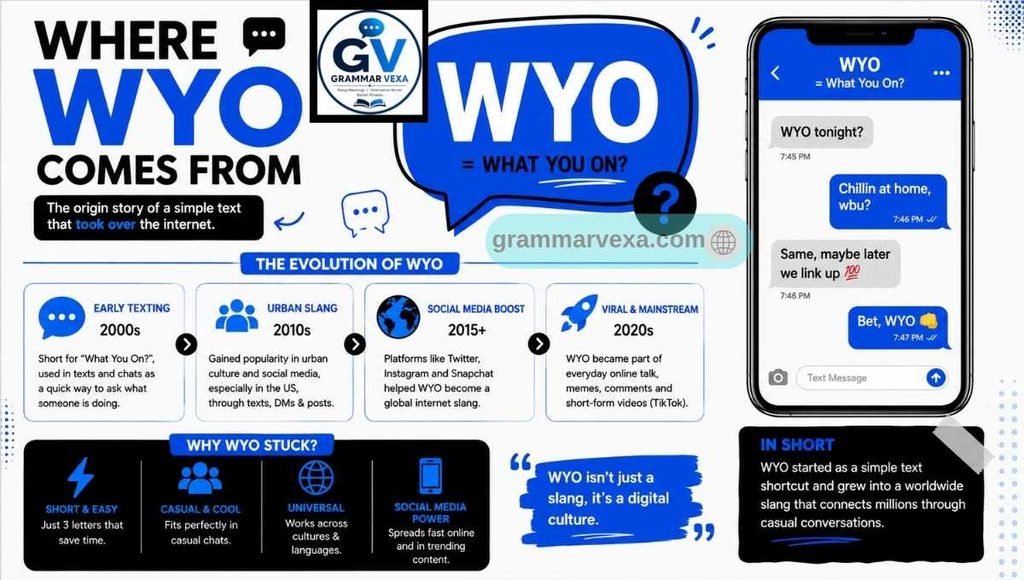
Like most internet slang, WYO didn’t originate from a single dictionary entry — it evolved organically out of the broader trend of text abbreviations that emerged as SMS character limits, and later, fast-paced app-based messaging, pushed users toward shorter phrasing. Abbreviations like WYD (“what you doing”), WYA (“where you at”), and HMU (“hit me up”) all come from the same family of shorthand: drop the small connector words, keep the essential meaning, and let context fill in the rest.
WYO likely branched off directly from WYD, replacing “doing” with “on,” a phrasing pattern common in African American Vernacular English (AAVE) and widely adopted across youth texting slang and social media slang. “What you on” as a full phrase has long been used informally to ask what someone is up to, what mood they’re in, or what they’re currently involved in — the abbreviation simply compresses an expression that already existed in spoken casual English.
WYO Meaning in Text: What It Really Means and How to Use Right
The “what’s your offer” meaning has a completely separate origin. It’s a straightforward abbreviation used in commerce and negotiation, not youth slang culture, and it shows up in contexts like classified listings and resale forums, where quick, transactional shorthand has always been common practice.
Over time, as messaging apps like Snapchat, Instagram, and WhatsApp became the dominant space for informal communication, the casual meaning of WYO spread faster and wider, especially among younger audiences who use it as a near-automatic conversation starter. Today, the casual meaning dominates everyday usage across social media platforms, while the negotiation meaning remains a smaller, context-specific pocket of use.
WYO vs. Similar Slang: What Sets It Apart
WYO doesn’t exist in isolation — it’s part of a whole family of related slang keywords that all orbit the same basic function: checking in, starting a conversation, or asking about someone’s availability. Knowing how WYO differs from its closest relatives makes it much easier to use all of them correctly.
WYO vs. WYD
WYD (“what you doing” or “what are you doing”) is the more literal, more universally recognized version of this type of message. It’s asking specifically about the person’s current activity. WYO, by contrast, is a little broader — it can mean current activity, but it can also lean toward asking about plans or general status (“what you on” can imply “what’s going on with you” more than “what exact task are you doing right now”).
In practice, most people use WYD and WYO almost interchangeably in casual texting, but WYD is slightly more direct and WYO carries a bit more of a laid-back, open-ended tone.
WYO vs. WTM
WTM (“what’s the move”) is more plan-focused than status-focused. Someone texting WTM is usually trying to figure out what’s happening next — where the group is going, what the plan is for the night. WYO is more about the individual’s current status or general availability rather than group logistics. If your friends are deciding where to go, WTM fits better. If you’re just checking on one person, WYO fits better.
WYO vs. HMU
HMU (“hit me up”) isn’t a question at all — it’s an invitation or instruction, asking the other person to reach out or reconnect. WYO asks a question that expects an answer about current activity; HMU is a call to action that expects a future response, not an immediate one. They often appear together: “wyo later, hmu if you’re free.”
Comparison Table
| Term | Full Meaning | Function | Typical Reply Style |
|---|---|---|---|
| WYO | What You On | Asks about current status/plans | “nm just chilling, u?” |
| WYD | What You Doing | Asks about current activity | “watching tv rn” |
| WTM | What’s The Move | Asks about group plans | “idk, park maybe?” |
| HMU | Hit Me Up | Invitation to reconnect | “will do!” or a thumbs up |
| WYA | Where You At | Asks about location | “at home, why?” |
Understanding these distinctions matters because using the wrong one can subtly change what you’re actually asking. Swapping WYO for WTM in a one-on-one chat, for example, can read as though you’re trying to organize a group event when you just meant to check in with one person.
How to Use WYO in a Sentence
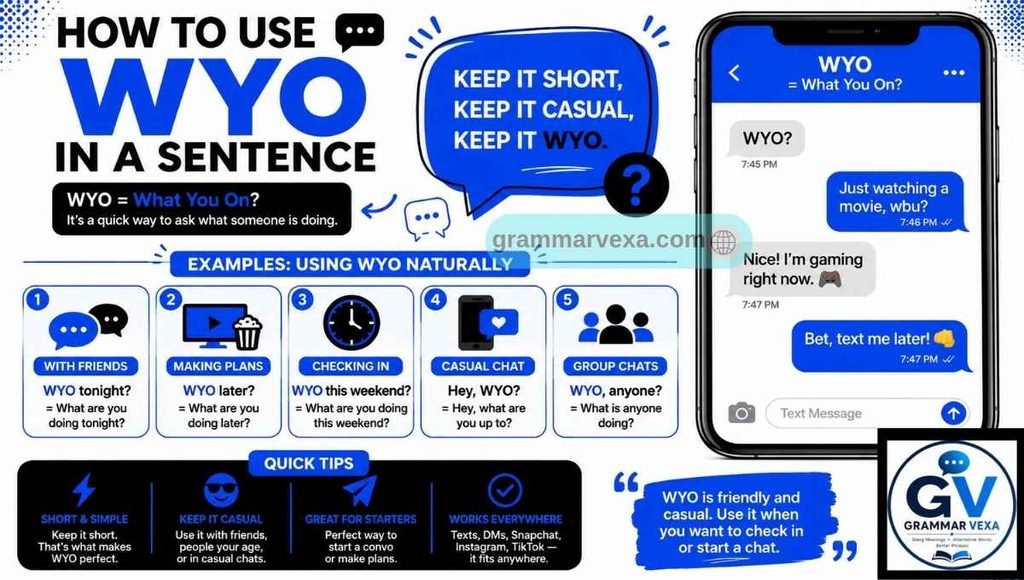
Using WYO in text naturally comes down to tone and timing. It works best as a low-pressure, casual message — not something you’d send in a formal or professional context. Below are the most common ways people actually use it.
Starting a Conversation
WYO is a go-to conversation starter precisely because it requires almost no effort to type and doesn’t demand an elaborate response. It’s the texting equivalent of a casual nod hello.
“yo wyo, we still on for later?”
“wyo this weekend, anything planned?”
Checking In Mid-Conversation
Sometimes WYO shows up in the middle of an ongoing chat, functioning as a pivot to ask about the other person’s current situation before continuing.
“lol that’s wild. anyway wyo rn, still at work?”
Using It in a Negotiation Context
When the “what’s your offer” meaning applies, it typically follows a listed price, a service description, or a back-and-forth about value.
“Selling my old bike, listed for $150 but wyo?”
“I can do the logo design, wyo for the full package?”
Real Example Exchanges
Casual example:
- Person A: “wyo tonight?”
- Person B: “probably just staying in, u?”
- Person A: “same lol, movie night?”
Negotiation example:
- Buyer: “Is this still available?”
- Seller: “Yep! Wyo?”
- Buyer: “Would you take $30?”
These short exchanges show exactly how tone, context, and prior messages guide the correct interpretation without anyone needing to explain what WYO means mid-conversation.
WYO Meaning in Text From a Guy
When a guy sends WYO, the underlying meaning doesn’t change — it’s still asking about your current activity or plans — but the intent behind it depends heavily on the relationship and the timing. From a guy you’re already close with, WYO is usually just a genuine, low-pressure check-in. From a guy you’re just getting to know, or one you’ve been texting with romantic undertones, WYO can double as a soft way of testing whether you’re free or interested in hanging out, without directly asking.
A few signals help clarify intent:
- Sent randomly, mid-day, with no follow-up plan → likely just a casual check-in
- Sent late at night or after a gap in conversation → may be testing availability or interest
- Followed by a suggestion to meet up or hang out → likely intended as a soft invitation
- Part of a longer, ongoing conversation → simply keeping the conversation going
There’s no universal rule here. The words themselves are neutral, and reading the surrounding conversation always tells you more than the abbreviation alone.
WYO Meaning in Text From a Girl
The same logic applies when a girl sends WYO — the literal meaning stays identical, but tone and context shape how it should be read. From a girl who texts you often and casually, WYO is typically exactly what it looks like: a simple, friendly check-in. In a newer or more flirtatious dynamic, it can carry a bit more weight, functioning as an easy, low-stakes way to see if you’re around and open to talking or meeting up.
The healthiest approach in either direction — from a guy or a girl — is to respond honestly and, if you’re unsure of the intent, let your own reply set the tone. Answering with a specific plan or a follow-up question (“nothing much, wyo? we should link up”) naturally signals interest without requiring anyone to spell out what they meant.
Expert tip: If you genuinely can’t tell whether a WYO text is casual or has more behind it, look at the pattern across the whole conversation rather than the single message. One WYO out of context tells you very little; a pattern of check-ins, quick replies, and follow-up questions tells you a lot more.
How to Reply to WYO
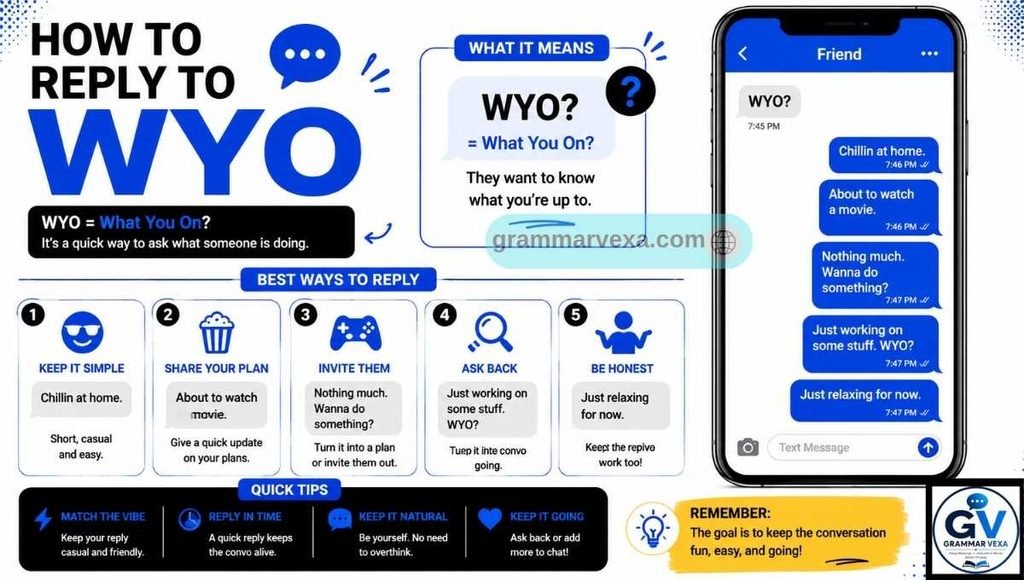
Replying to WYO meaning in text message situations depends heavily on which version you’re responding to, but a few general principles apply across both.
Replying to the Casual “What You On”
Keep it short, honest, and low-pressure. You don’t need a detailed itinerary — a quick status update is enough, and it’s completely normal to follow up with a question of your own to keep the conversation moving.
- “nothing much, you?”
- “just got home, why what’s up”
- “probably just relaxing, wyo?”
- “at work rn, off in an hour tho”
Replying When You Don’t Have Plans Yet
If you genuinely don’t know what you’re doing yet, it’s fine to say so — this is often exactly what opens the door to making plans.
- “idk yet, got anything in mind?”
- “nothing set in stone, why what’s good”
Replying to the “What’s Your Offer” Meaning
In a negotiation context, your reply should be direct and specific. Vague responses tend to stall the conversation or make you look unsure about what you’re willing to pay or accept.
- “Would $35 work?”
- “I can offer $200 for the full job.”
- “What’s the lowest you’d go?”
Expert tip: In negotiation contexts, responding to “wyo” with a specific number rather than a vague range (“something around $30-40”) tends to move the conversation forward faster and signals that you’re a serious buyer or client.
When WYO Is (and Isn’t) Appropriate to Use
WYO is built for casual conversation, and knowing its natural boundaries keeps you from sending it somewhere it doesn’t belong.
When It Fits Naturally
- Texting close friends or people in your regular group chats
- Replying to a Snapchat story or Instagram story
- Checking in with someone you talk to often, where formality isn’t expected
- Marketplace and classified conversations, when the “offer” meaning is clearly implied by context
When to Avoid It
- Messaging a coworker, manager, or anyone in a professional context — WYO reads as too informal and can come across as unprofessional in professional conversations
- Messaging someone you don’t know well yet, where the vagueness of the question might feel presumptuous
- Formal customer service or business inquiries, where clarity matters more than casual tone
- First-time conversations with someone new, since it can come across as low-effort rather than genuinely curious
Best practice: Match the formality of WYO to the formality of the relationship. The closer and more casual the relationship, the more naturally it fits.
WYO on Urban Dictionary
Crowdsourced slang dictionaries like Urban Dictionary host multiple submitted definitions for WYO, and the entries generally track the same two core meanings covered in this guide: “what you on” as the dominant, casual definition, and “what’s your offer” as the secondary, transactional one. Because Urban Dictionary is user-submitted, definitions vary in wording and quality, and some entries add regional or niche interpretations that aren’t widely used outside specific communities.
A few things worth knowing about how WYO is documented there:
- The top-voted entries consistently point to “what you on” as the primary casual meaning
- Lower-voted or newer entries occasionally list less common, joke, or regional variations that aren’t representative of everyday usage
- Crowdsourced definitions are useful for a quick gut-check but shouldn’t be treated as the final word, since slang meaning is ultimately set by how people actually use the term in real conversations, not by a single dictionary entry
If you look it up and see multiple conflicting definitions, that’s normal — it simply confirms what this guide already covers: context decides which meaning applies.
What Does WYO Mean on Instagram
On Instagram, WYO functions exactly the same way it does in regular texting — there’s no platform-specific twist to the meaning. You’ll most often see it in:
- Direct messages (DMs), used as a casual check-in or conversation starter
- Story replies, where someone reacts to your story and follows up with “wyo?”
- Comment sections, occasionally, though this is less common than DMs
Because Instagram conversations skew casual and social rather than transactional, the “what you on” meaning applies in nearly every case. The “what’s your offer” meaning would only realistically show up on Instagram in the comments of a business or resale account’s product post, which is a small slice of overall usage. If you get a “wyo” in your Instagram DMs from someone you follow or know, treat it the same way you’d treat it in a text message or on Snapchat.
Common Mistakes People Make With WYO
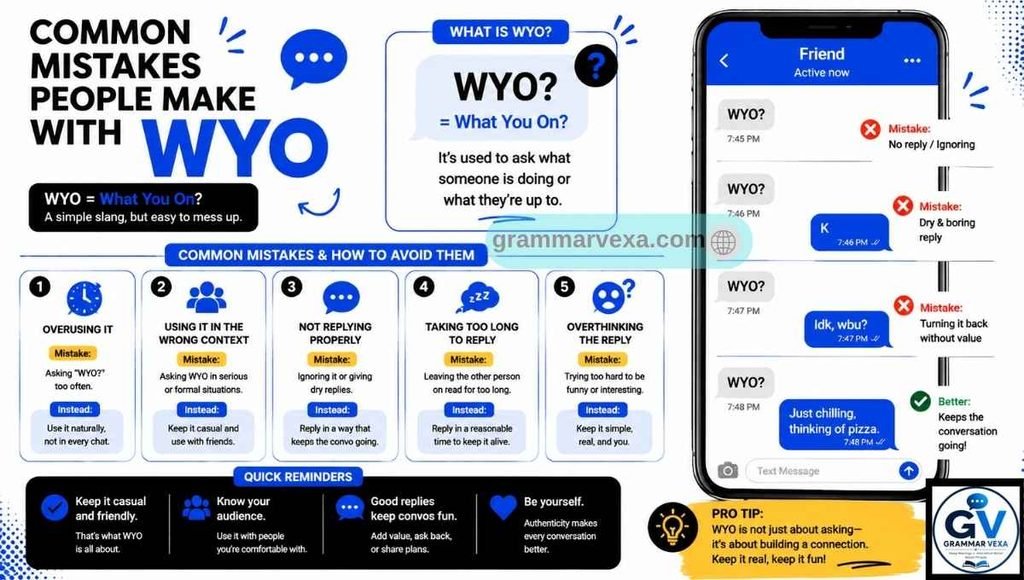
Even simple slang has room for missteps, and a few patterns show up again and again in how people misuse or misread WYO.
- Using it as a substitute for an actual invitation. Sending “wyo” without any follow-up plan can leave the other person unsure whether you actually want to hang out or you’re just making small talk. If you want to invite someone somewhere, it’s often better to be direct.
- Mixing up the two meanings mid-conversation. Switching between the casual and negotiation meanings without clear context can genuinely confuse the other person, especially in ambiguous settings like a shared marketplace group chat where both social and transactional messages happen.
- Overusing it without adding personality. Sending “wyo” as your only opener, repeatedly, without ever elaborating, can come across as low-effort. Pairing it with a specific detail (“wyo, thinking about grabbing food later”) tends to get better responses.
- Using it in the wrong register. Sending WYO in a professional email or formal message context signals a mismatch in tone that can undercut credibility, particularly in professional conversations where clarity and formality matter.
- Assuming everyone knows what it means. Not everyone is fluent in current texting abbreviations, especially across generational or cultural gaps. If there’s any doubt, spelling it out the first time avoids confusion.
Best Practices for Using WYO
- Use it with people who already text you casually and frequently
- Follow it up with a specific plan or question if you want an actual response
- Save the “what’s your offer” meaning strictly for sales, marketplace, or negotiation contexts
- Avoid it entirely in professional or first-impression conversations
- If unsure whether someone will understand it, ask directly what they mean rather than guessing
Conclusion
Understanding WYO meaning in text comes down to one simple habit: reading the context before you reply. Most of the time, it’s a friendly check-in asking what you’re up to. Sometimes it’s a question about a price. Knowing the difference takes seconds once you know what to look for. That’s the real value of this guide on WYO meaning in text: what it really means and how to use it right — it turns a confusing text into an easy, confident reply.
Slang like WYO will keep evolving, but the skill of reading context stays useful no matter what new terms show up next. Keep the tips from this guide on WYO meaning in text: what it really means and how to use it right in mind, and you’ll never freeze up over three letters again. A quick, honest reply is always the right move.
FAQs
What does WYO mean in text?
WYO meaning in text is most commonly “What You On,” a casual way of asking what someone is doing or planning right now.
Is WYO the same as WYD?
They’re close but not identical — WYD asks about a specific current activity, while WYO leans more toward general plans or status.
Does WYO always mean “what’s your offer”?
No, that meaning only applies in sales, marketplace, or negotiation contexts, not in everyday casual texting.
Is WYO appropriate for professional conversations?
No, WYO is informal communication and reads as unprofessional in work emails, client messages, or formal chats.
How do you reply to WYO from a friend?
Give a short, honest status update, like “nothing much, you?” — no long explanation needed.
Does WYO mean something different on Snapchat or Instagram?
No, the meaning stays the same across social media platforms; only the format of the reply (text vs. story) changes.
Can WYO be flirty?
It can be, depending on the relationship and conversation tone, but the abbreviation itself is neutral.
What’s the difference between WYO and HMU?
WYO asks a question expecting an immediate answer, while HMU is an invitation to reach out later.
Where did the slang term WYO originate?
It evolved from casual texting abbreviations like WYD, shortening “what you doing” into a more relaxed “what you on.”
Does WYO have a meaning outside of texting?
Yes, WYO is also the official abbreviation for the state of Wyoming, used on highway signs and in DMV or legal documents.

Jessica Morgan is an English language writer and researcher at Grammar Vexa. I enjoy exploring slang, vocabulary, word meanings, synonyms, and alternative phrases. Through my work, I aim to make English easier to understand by providing clear explanations, useful examples, and practical language tips.







5 thoughts on “WYO Meaning in Text: What It Really Means and How to Use Right”