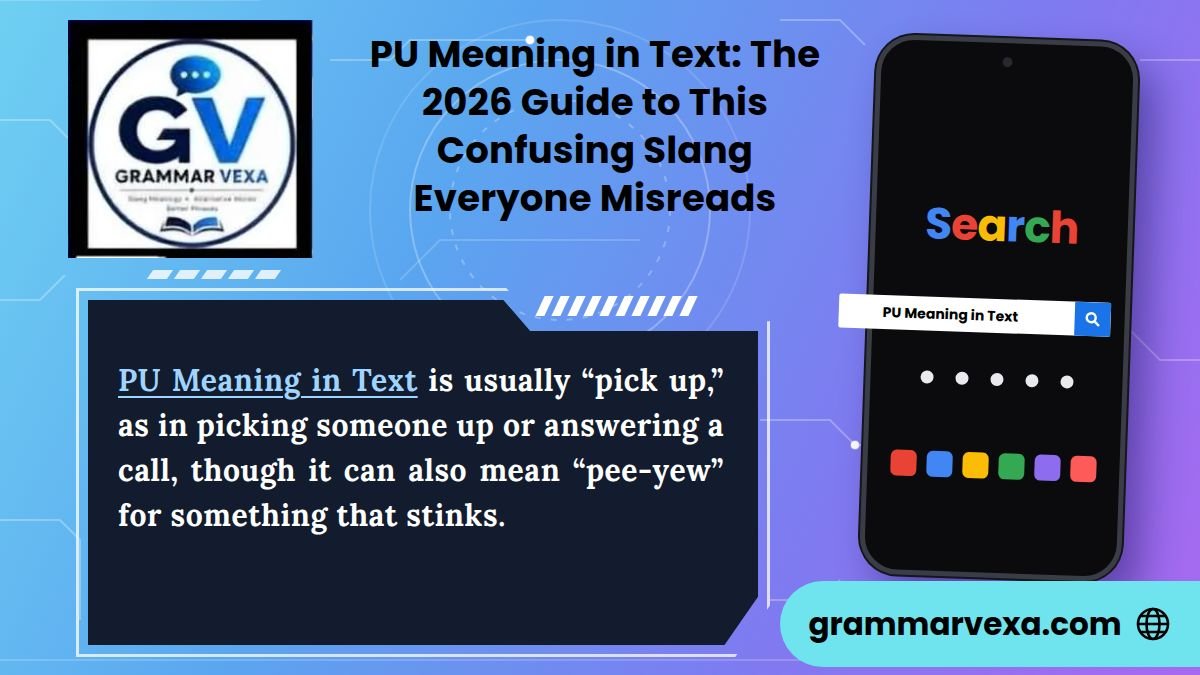
PU Meaning in text usually refers to “pick up,” especially when someone asks another person to collect them or an item. Depending on the conversation, PU can also mean “pop up.” The form “P.U.” has a different use as an expression of disgust, usually in response to a bad smell. Context determines which meaning fits.
The tricky part is that these two letters can change meaning without warning. A message like “Can you PU me at 7?” clearly points toward pick up, while “P.U.! That smells awful” expresses disgust. Understanding the surrounding words, punctuation, and conversation topic can help you decode texting slang without making an awkward assumption.
Once you know the common patterns, PU becomes much easier to understand across texts, DMs, social media, gaming chat, and casual messaging. The sections ahead break down each meaning with clear examples, context clues, and practical replies so you can recognize the intended PU meaning quickly and confidently.
PU Meaning in Text: The Quick Answer
PU most commonly means “pick up” in casual texting when someone is arranging transportation or asking you to collect something. In some contexts, PU can also mean “pop up,” particularly when discussing something that suddenly appears.
The traditional “P.U.” has a separate meaning. People use it as an exclamation when something smells unpleasant.
| PU usage | Meaning | Typical context | Example |
| PU | Pick up | Rides, people, packages | “Can you PU me?” |
| PU | Pop up | Something appearing suddenly | “A notification PU on my screen.” |
| P.U. | Disgust/bad smell | Reactions | “P.U.! What is that smell?” |
| PU | Put up | Specific phrases | “PU the poster.” |
There isn’t one official dictionary rule that assigns one universal meaning to every use of “PU.” Like many forms of texting slang, meaning comes from context.
Quick rule: Read the entire message before deciding what “PU” means.
That simple habit prevents most misunderstandings.
What Does PU Mean in Text?
The PU definition changes depending on what the sender is talking about. The abbreviation works because people often remove unnecessary words when communicating through messages.
Think of “PU” as a shortcut rather than a fixed chat acronym. The surrounding sentence tells you which road to take.
PU Meaning “Pick Up”
The most straightforward interpretation of PU is “pick up.”
Someone may use it when asking another person to collect them, collect an item, or sometimes answer a phone call.
For example:
- “Can you PU me at 7?”
- “Can you PU the package?”
- “I’ll PU some food on my way.”
- “Are you coming to PU your brother?”
- “Can you PU the kids after school?”
In these examples, pick up fits because the conversation involves collecting a person or object.
A transportation conversation makes the meaning especially clear:
Person A: “My car won’t start.”
Person B: “I’ll PU you after work.”
Here, “PU” clearly means pick up.
You may also see related phrases such as pickup request, ride request, or “come get me.” These phrases give you strong contextual clues.
PU Meaning “Pop Up”
In some conversations, PU can be used as shorthand for “pop up.”
“Pop up” means something appears or happens suddenly. The phrase can describe notifications, messages, windows, events, visits, or unexpected appearances.
For example:
- “A notification popped up.”
- “He might pop up later.”
- “A new message popped up.”
- “The offer popped up on my screen.”
If someone writes PU while discussing something appearing unexpectedly, “pop up” may be the intended meaning.
However, there’s an important point here: “PU” isn’t a universally standardized abbreviation for “pop up.” Don’t automatically interpret it that way simply because the letters fit.
The sentence has to support the meaning.
P.U. Meaning “That Smells Bad”
The “P.U.” spelling has a completely different history and function in casual English.
People traditionally use “P.U.!” as an exclamation of disgust when they encounter a bad smell.
For example:
“P.U.! What is that smell?”
Here, nobody means “pick up” or “pop up.”
The punctuation provides a useful clue. “P.U.!” often functions as an interjection rather than a text abbreviation for a longer phrase.
You’ll commonly see it in humorous conversations about:
- Dirty socks
- Spoiled food
- Garbage
- Strong odors
- Sweaty shoes
- Pets
- Bathrooms
This usage can also appear without periods in informal messaging:
“PU 🤢”
The emoji and surrounding conversation can make the intended chat meaning obvious.
PU Meaning “Put Up”
In certain situations, people may use PU as shorthand for “put up.”
For example, someone might abbreviate an instruction involving placing or displaying something. However, this isn’t a meaning you should assume automatically.
“Put up” usually appears naturally as part of a larger phrase:
- “Put up the sign.”
- “Put up the decorations.”
- “Put up a notice.”
Because PU can be ambiguous, spelling out “put up” is often clearer.
In everyday messaging, “pick up” is generally a much more obvious interpretation when someone uses PU in a transportation or collection context.
Also Read: What Does CTFU Mean in Text? A Complete Guide to Its Meaning, Usage, and Contexts
Also Read: WTV Meaning in Text: What It Really Means for You!
Also Read: What Does “SG” Mean in Text? A Complete Guide to Its Uses and Interpretations
What Does PU Mean? Common Definitions and Uses
PU and P.U. can have several meanings depending on where you see them. In everyday English, “P.U.” commonly works as an expression of disgust when someone notices a foul or unpleasant smell. In texting and social media, however, “PU” may appear as shorthand for phrases such as “pick up,” “pull up,” or, in some contexts, “pop up.” The surrounding words usually reveal the intended meaning.
Common Meanings of PU
- Bad Smell — “P.U.”: An informal interjection used to react to something that smells unpleasant. For example, “P.U.! What is that smell?”
- Texting — “Pick Up”: In casual messages, PU can mean “pick up,” especially when someone asks another person to collect them or an item. Example: “Can you PU me at 7?”
- Texting — “Pull Up”: In some informal conversations, PU can refer to “pull up,” meaning to arrive, come over, or show up at a location.
- Texting — “Pop Up”: In certain contexts, PU may be shorthand for “pop up,” particularly when discussing something that suddenly appears.
- Chemistry — Plutonium: Pu is the official chemical symbol for plutonium, a radioactive chemical element with atomic number 94.
- Manufacturing — Polyurethane: PU commonly stands for polyurethane, a polymer used in products such as foams, coatings, adhesives, footwear, and synthetic materials.
- Universities and Organizations: PU can also serve as an abbreviation for institutions whose names contain words such as “University.” The exact meaning depends on the institution and context.
The key is to avoid assigning one definition to every use of PU. A text message, chemistry lesson, product label, and university reference can all use the same two letters for completely different reasons.
What Does PU Mean in Texting?
PU in texting can have different meanings depending on the conversation. It may mean “pick up,” “pull up,” or sometimes “pop up.” Read the surrounding message to identify the intended meaning.
What Does PU Mean as a Material?
PU as a material usually means polyurethane, a versatile polymer used in products such as foam, coatings, adhesives, footwear, and synthetic materials. Its properties can vary depending on how manufacturers formulate it.
What Does PU Mean in Leather?
PU leather means polyurethane-coated synthetic leather. Manufacturers typically apply a polyurethane layer over a fabric or other backing to create a leather-like surface. It’s different from genuine animal leather.
What Does PU Mean on Snapchat?
On Snapchat, PU doesn’t have one fixed meaning. Depending on the conversation, it may stand for “pick up,” “pull up,” or another phrase. The surrounding DMs and previous messages usually provide the clearest clue.
What Does PU Mean in English?
In English, PU can represent several different things. “P.U.” is commonly used as an informal expression of disgust at a bad smell, while PU can also appear as an abbreviation for phrases such as “pick up” or technical terms such as polyurethane.
What Does PU Mean in University?
PU can be an abbreviation for a university name, but the exact meaning depends on the institution. For example, different universities use “PU” as part of their abbreviated name, so the location or full institution name is needed for an exact identification.
What Does PU Mean as “Pull Up”?
In casual texting, PU can sometimes mean “pull up,” especially when someone invites another person to arrive at a location. For example, “PU when you’re outside” can mean “pull up when you’re outside.” This usage is informal and depends on context.
What Does PU Mean in Shipping?
In shipping and logistics, PU can have industry-specific meanings, so it shouldn’t automatically be interpreted as texting slang. In transportation contexts, it may refer to a pickup or a pickup-related instruction. The exact definition depends on the carrier, shipping document, or logistics system being used.
PU Meanings at a Glance
Here’s a practical PU meaning reference you can save:
| If the message talks about… | PU probably means… |
| Getting a person | Pick up |
| Collecting an item | Pick up |
| Getting a ride | Pick up |
| Answering or receiving a call | Potentially pick up |
| Something suddenly appearing | Potentially pop up |
| A terrible smell | P.U. |
| Placing or displaying something | Potentially put up |
| A completely unrelated subject | Ask for clarification |
The word immediately following “PU” can also help.
For example:
“Can you PU me?”
The person is probably asking you to pick up them.
“It PU on my screen.”
The sender may mean something popped up, although the sentence is grammatically awkward.
“PU! 🤢”
The sender probably reacted to an unpleasant smell.
This is why the meaning of PU can’t always be determined from the two letters alone.
How to Tell Which PU Meaning Someone Intended
When an abbreviation has several possible definitions, use a simple context-first approach.
Look at the Words Around “PU”
The surrounding words often provide the strongest clue.
Consider these messages:
“Can you PU me at 6?”
The word “me” and the time strongly suggest pick up.
Now compare:
“A weird window PU while I was browsing.”
The subject involves something appearing on a screen. That points toward pop up.
Finally:
“PU! That lunch smells awful.”
The exclamation clearly signals disgust.
The letters haven’t changed. The context has.
Check What You Were Talking About
Before searching for a PU definition, look at the previous messages.
Suppose someone says:
“I’m stuck downtown.”
Then they message:
“Can you PU?”
The conversation already establishes a transportation problem. You don’t need to invent another meaning.
On the other hand, if you’ve been discussing website notifications, “pop up” becomes more plausible.
This approach works across online platforms, from ordinary texts to social apps.
Consider the Full Sentence
Never interpret an abbreviation in isolation if the sentence looks ambiguous.
For example:
“I’ll PU later.”
This could be unclear.
Does the sender mean:
- “I’ll pick you up later”?
- “I’ll pop up later”?
- Something else?
A quick clarification solves the problem:
“Do you mean pick me up?”
That’s much safer than confidently guessing.
Pay Attention to Punctuation and Capitalization
Texting doesn’t follow one universal capitalization system.
Someone might write:
- PU
- pu
- P.U.
- P.U.!
- “PU 🤢”
These versions don’t always carry identical meanings.
P.U.! followed by a disgusted reaction strongly suggests the smell-related expression.
Meanwhile, “PU me at 8” strongly suggests “pick up.”
Capitalization alone isn’t enough. Look at punctuation, emojis, sentence structure, and context together.
PU Meaning in Different Texting Contexts
The PU meaning in text can become easier or harder to identify depending on the communication setting.
In Regular Text Messages
Traditional SMS and modern phone messaging often use abbreviations to save typing time.
That’s where “PU” can appear in practical messages involving:
- Rides
- Errands
- Packages
- Family plans
- Phone calls
- Meeting arrangements
For example:
“Can you PU dinner?”
The intended meaning could depend on the conversation. If you’re discussing collecting food, pick up makes sense.
However, shorthand isn’t standardized. One person’s abbreviation may be unfamiliar to another person.
On Snapchat, Instagram, TikTok, and Other Social Apps
On Snapchat, Instagram, and TikTok, people communicate through DMs, comments, Stories, and short replies.
That environment encourages compact language.
You might see:
- DMs
- Short abbreviations
- Emojis
- Initialisms
- Informal spelling
- Community-specific internet slang
Still, don’t assume that Snapchat Instagram users have a special universal definition for PU.
The platform usually doesn’t determine the meaning. The conversation does.
For example, someone might write:
“PU tonight?”
If you’ve been discussing meeting up, you need the previous conversation to determine what the sender intended.
In WhatsApp and Group Chats
WhatsApp conversations often move quickly. Friends may use shorthand because everyone already understands the shared context.
A group chat might contain:
“Who can PU Sarah?”
Here, “pick up” is obvious because the sentence involves a person.
In a different conversation, someone might write:
“P.U. 😂”
If everyone is reacting to an unpleasant smell, the meaning changes completely.
In Gaming and Discord Chats
Gaming chat has its own vocabulary because players need to communicate quickly.
During a multiplayer match, gamers often favor short commands and established abbreviations. That’s especially true when teammates need to coordinate movement, objectives, or equipment.
You’ll encounter terms related to:
- Team coordination
- Matchmaking
- Voice chat
- Multiplayer chat
- Player roles
- Game objectives
- Fast coordination
Platforms such as Discord make this style especially common.
However, “PU” shouldn’t automatically be labeled gamer slang. Gaming communities use many specialized abbreviations and terms. The meaning depends on the specific game and conversation.
If you’re unsure, check the words around PU or ask the sender.
In Workplace Chats
Workplace messaging requires more caution.
A casual friend might immediately understand:
“Can you PU the files?”
A coworker might interpret it differently.
In professional communication, clarity matters more than saving two characters.
Instead of:
“Can you PU this?”
Write:
“Can you pick up this document?”
That’s especially useful in:
- Slack messages
- Teams messages
- Business texts
- Work chats
- Office communication
- Formal communication
A few extra words can eliminate an unnecessary misunderstanding.
Also Read: What Does “WYO” Mean in Text? Complete Guide to Its Meaning, Usage, and Contexts
Also Read: TSTS Meaning in Text Explained: Definition, Uses & Examples
Also Read: Zooming Into Science: Fascinating Science Words That Start With Z
Can PU Have a Flirty or Sexual Meaning?
Sometimes people wonder whether PU has a hidden romantic meaning.
There’s no single universal flirty or sexual definition of PU that applies across ordinary texting.
A message can sound flirtatious because of the romantic context, not because PU itself has a fixed romantic definition.
For example:
“Can you PU tonight? 😉”
The wink may change the tone. But “PU” could still simply mean pick up.
Similarly:
“PU and come over.”
The phrase may sound more personal because of the surrounding invitation.
This distinction matters on dating apps such as Tinder, Hinge, and Bumble. A message’s tone can depend on the relationship between the two people, previous messages, emojis, and the situation.
Dating Chat Requires More Context
In dating chat, people often use short messages because conversations move quickly.
Suppose someone sends:
“PU at 9?”
If you’ve already arranged a date and discussed transportation, “pick up” is the obvious interpretation.
If the conversation has no transportation context, asking for clarification makes sense.
Don’t turn an ordinary abbreviation into a hidden message without evidence.
How PU Can Change the Tone of a Message
The abbreviation itself usually isn’t enough to determine someone’s attitude.
Neutral Use
“Can you PU me after work?”
This sounds practical and neutral.
Casual or Friendly Use
“Can you PU me? I owe you coffee 😂”
The meaning remains pick up, but the emoji creates a warmer tone.
Confusing Use
“I’ll PU later.”
This needs context.
The sentence doesn’t tell you enough about what the sender intends.
Rude or Dismissive Interpretation
A sender can make almost any short abbreviation sound abrupt.
For example:
“PU. Now.”
The blunt tone comes from the entire sentence, not from the letters PU themselves.
That’s an important principle in chat language: meaning and tone aren’t always the same thing.
Real Text Examples of PU Meaning
Realistic examples make the difference easier to understand.
“Can You PU Me?”
Likely meaning: Pick up.
Example:
“My ride canceled. Can you PU me?”
The transportation context makes the PU abbreviation straightforward.
“PU at the Store”
This is more ambiguous.
Someone might mean:
“Pick up at the store.”
But the exact interpretation depends on the rest of the conversation.
A better message would be:
“Can you pick it up at the store?”
Clear language wins when ambiguity could cause a problem.
“It PU on My Screen”
This likely attempts to describe something that popped up.
However, the natural English version would be:
“It popped up on my screen.”
The expanded phrase sounds clearer and more natural.
“P.U.! What Is That?”
Likely meaning: Disgust at a bad smell.
The punctuation and question about smell provide strong evidence.
When “PU” Is Too Ambiguous
Consider this:
“I’ll PU tomorrow.”
There’s no reliable way to know what the sender intends without more context.
The smartest response isn’t a wild guess.
Ask:
“Do you mean pick up?”
That takes seconds and prevents a potentially awkward misunderstanding.
How to Reply When Someone Says “PU”
Once you identify the likely meaning, your reply can stay simple.
If They Mean “Pick Up”
If you can help:
“Sure. What time?”
If you need the location:
“Sure. Where should I pick you up?”
If you can’t:
“Sorry, I can’t today.”
If you need more information:
“Who am I picking up?”
These responses work well for a pickup request or ride request.
If They Mean “Pop Up”
If someone is talking about an unexpected appearance, respond according to the situation.
For example:
“Yeah, that notification popped up for me too.”
Or:
“What popped up?”
The goal is to respond to the actual subject rather than the abbreviation itself.
If You Don’t Know What They Mean
The safest response is short:
“Do you mean pick up?”
Or:
“What do you mean by PU?”
There’s nothing awkward about asking.
In fact, clarification is often the clearest form of digital communication.
Funny Casual Replies
Among close friends, you can use humor when the meaning seems obvious:
“PU what? My ride or my snacks? 😂”
Or:
“Pick up where? Give me the coordinates!”
Humor works best when the relationship is already informal.
Professional Responses
For professional messages, skip the guesswork.
Try:
“Could you clarify what you mean by ‘PU’?”
Or:
“Do you mean pick up the documents?”
Clear questions are better than incorrect assumptions in business communication.
Also Read: Pre and Post Meaning: Understanding Their Usage and Importance
Also Read: PTSO Meaning in Text: What Does PTSO Mean?
Also Read: 150+ Other Ways to Say “Keep Up the Good Work”
Common Mistakes People Make With PU
A few interpretation errors appear repeatedly.
Assuming PU Always Means “Pick Up”
This is probably the biggest mistake.
“Pick up” is a strong possibility in transportation contexts. It isn’t a universal translation for every PU message.
Confusing “PU” With “P.U.”
The difference can be tiny on screen but significant in meaning.
“Can you PU me?”
Likely means pick up.
“P.U.! 🤢”
Likely expresses disgust.
Ignoring the Conversation Context
If someone has spent five minutes discussing a ride, don’t suddenly interpret PU as something unrelated.
Conversation history acts like a decoder.
Treating Every Social Platform as Having Its Own Definition
There’s no reliable rule saying:
“PU always means X on Instagram.”
The same person can use PU differently in different conversations.
Social platforms influence communication style, but context determines meaning.
Guessing at a Flirty Meaning
A short abbreviation doesn’t automatically contain romantic intent.
Look at the entire conversation before assigning emotional meaning.
Using PU in Formal Messages Without Explanation
Short forms can save time. They can also create confusion.
In professional messages, clarity usually matters more than brevity.
Is PU Still Used in 2026?
Yes, PU still appears in informal digital communication, but its usage isn’t uniform.
Texting language changes constantly. Some abbreviations become widespread while others remain limited to specific communities.
That means it’s better to treat PU as context-dependent shorthand rather than a universally recognized modern slang term.
This distinction is important.
There isn’t a single authoritative database that tracks every informal abbreviation used across every private text, social platform, gaming community, and age group. As a result, claims such as “PU always means X in 2026” would be too absolute.
Modern online communication is highly flexible.
People combine:
- Traditional abbreviations
- Initialisms
- Emojis
- Memes
- Community slang
- Platform-specific language
- Personal shorthand
That’s why context remains the strongest clue.
PU vs Other Similar Texting Abbreviations
Understanding the difference between related uses can make text slang much easier to read.
| Form | Likely meaning | Main clue |
| PU | Pick up | Person, item, ride, collection |
| PU | Pop up | Appearance or sudden event |
| P.U. | Disgust | Smell or unpleasant odor |
| put up | Place/display something | Physical placement |
| pick up | Collect/get something | Transportation or collection |
PU vs Pick Up
“PU” is simply shorthand when the context supports pick up.
For example:
“Can you PU me?”
Expanding it gives:
“Can you pick me up?”
The longer version is clearer.
PU vs P.U.
This distinction deserves special attention.
PU can function as an abbreviation.
P.U.! can function as an interjection expressing disgust.
Punctuation isn’t an absolute rule. Still, it’s a valuable contextual clue.
PU vs Pop Up
“Pop up” describes something appearing suddenly.
For example:
“A window popped up.”
When PU appears in a similar context, “pop up” may be intended.
However, spelling out pop up is usually safer because PU has competing meanings.
When You Should Avoid Using PU
Although abbreviations can make messaging faster, some situations call for clarity.
Professional Emails and Workplace Communication
Avoid unexplained abbreviations when communicating with clients, managers, or unfamiliar coworkers.
Instead of:
“Can you PU this?”
Use:
“Can you pick up this document?”
Important Instructions or Appointments
Don’t rely on PU when a misunderstanding could cause someone to arrive at the wrong place or time.
For example:
“Can you pick me up at 8 PM?”
is much clearer than:
“Can you PU at 8?”
Conversations With Someone Unfamiliar With Text Slang
Not everyone knows the same chat abbreviation.
This becomes especially important when communicating across age groups, countries, or professional backgrounds.
Situations Where Misunderstanding Could Cause Problems
Use complete phrases whenever clarity matters more than speed.
Good alternatives include:
- pick me up
- pick up the package
- pop up
- put up the sign
- answer the phone
- collect the item
- get someone
A two-word phrase can prevent a ten-message clarification.
A Simple Framework for Decoding PU
When you encounter an unfamiliar text abbreviation, use this four-step method.
Step 1: Read the Previous Message
Ask what the conversation was about.
Was it transportation? A notification? A smell? A work task?
Step 2: Replace PU With “Pick Up”
See whether the sentence makes sense.
“Can you pick up me?”
If the grammar or meaning doesn’t work, don’t force it.
Step 3: Try “Pop Up”
Check whether the message describes something appearing suddenly.
“A notification popped up.”
If that fits the conversation, you’ve found another possibility.
Step 4: Ask When the Meaning Remains Unclear
Use a simple clarification:
“What do you mean by PU?”
That’s the most reliable solution when context doesn’t provide enough information.
Expert Tips for Understanding Texting Slang
A few habits make unfamiliar online abbreviation much easier to decode.
Don’t read abbreviations like dictionary entries. Read them as part of a conversation.
Look for verbs and objects. Words such as “me,” “package,” “screen,” and “smell” provide useful clues.
Check punctuation. “P.U.!” behaves differently from “PU me.”
Consider the communication setting. A gaming message may use different shorthand than a business text.
Don’t overinterpret romantic context. An abbreviation doesn’t automatically have a hidden meaning.
Ask when necessary. Native speakers clarify slang too.
A Useful Context Checklist
Before interpreting PU, ask:
- What were we discussing?
- Who sent the message?
- What words appear around PU?
- Is this a personal or professional conversation?
- Is there a transportation context?
- Is something appearing on a screen?
- Is someone reacting to a smell?
- Does punctuation change the tone?
- Would another interpretation make more sense?
- Should clarification be requested?
This approach is far more dependable than memorizing a single PU meaning.
Key Takeaways
The PU meaning in text isn’t fixed to one definition.
The most useful interpretations to remember are:
- PU = pick up when someone is collecting a person or item.
- PU = pop up when the context involves something appearing suddenly.
- P.U. = an expression of disgust, especially around bad smells.
- PU = put up can occur in specific shorthand contexts but isn’t usually the first interpretation.
- Context determines the intended meaning.
- Social media, gaming communities, dating chats, and workplace messaging can all use shorthand differently.
- If a message remains unclear, ask instead of guessing.
The best way to understand PU slang isn’t to memorize one definition. It’s to read the abbreviation alongside the words, tone, punctuation, and conversation surrounding it.
Frequently Asked Questions About PU Meaning in Text
What does PU mean in text messages?
PU commonly means “pick up” in text messages. Depending on context, it can also refer to “pop up.” The separate expression “P.U.!” usually signals disgust at a bad smell.
What does PU mean from a girl or guy?
There isn’t a special universal meaning based on whether a girl or guy sends “PU.” The intended meaning depends on the conversation. If you’re discussing transportation, it likely means pick up.
Does PU mean pick up?
Yes. PU can mean “pick up,” particularly when someone asks another person to collect them or an item.
For example:
“Can you PU me at 7?”
usually means:
“Can you pick me up at 7?”
What does P.U. mean in texting?
P.U. is traditionally an exclamation showing disgust at an unpleasant smell.
For example:
“P.U.! Those shoes stink.”
It isn’t the same usage as “PU” in “Can you PU me?”
Does PU mean pop up?
It can, depending on the context. However, “pop up” isn’t a universal definition of PU. If someone is describing a notification or window appearing suddenly, “pop up” may fit.
Is PU a slang word?
PU can function as texting slang or shorthand, depending on how someone uses it. Its meaning isn’t standardized across every online community.
Is PU still used in 2026?
Yes, people still use PU in informal messaging and online communication. However, its meaning varies by context, community, and conversation.
How can I tell what PU means in a text?
Start with the conversation topic. Then examine the surrounding words and punctuation. If the message still doesn’t make sense, ask the sender what they mean.
What does PU mean on Snapchat?
There isn’t one fixed Snapchat definition for PU. A Snapchat message could use PU to mean pick up, pop up, or another context-specific phrase.
What does PU mean on Instagram?
On Instagram, PU doesn’t have one universal platform-specific definition. Check the surrounding Instagram messages, DMs, or previous conversation to determine what the sender intended.
What does PU mean in gaming chat?
Gaming chat can contain many forms of shorthand, but PU doesn’t have one universal gaming definition. Check the specific game, community, and surrounding messages before interpreting it.
Should you use PU in professional communication?
Usually, it’s better to spell out the intended phrase in professional communication. “Pick up,” “collect,” or another complete phrase reduces ambiguity and makes workplace messaging clearer.
Conclusion
Understanding PU Meaning is mostly about paying attention to context. In texting, PU can refer to phrases like “pick up,” “pop up,” or “pull up.” The meaning can change based on the words around it, the platform, and the conversation. Meanwhile, “P.U.” can express disgust at a bad smell. That’s why it’s better to read the full message before deciding what someone means.
The easiest way to understand PU Meaning is to look at the situation first. Check what you were discussing and how the abbreviation appears in the sentence. This simple approach can help you avoid awkward replies or misunderstandings. Whether you see PU in a text, social media DM, gaming chat, or another online conversation, context remains the best clue to its intended meaning.

Jessica Morgan is an English language writer and researcher at Grammar Vexa. I enjoy exploring slang, vocabulary, word meanings, synonyms, and alternative phrases. Through my work, I aim to make English easier to understand by providing clear explanations, useful examples, and practical language tips.